
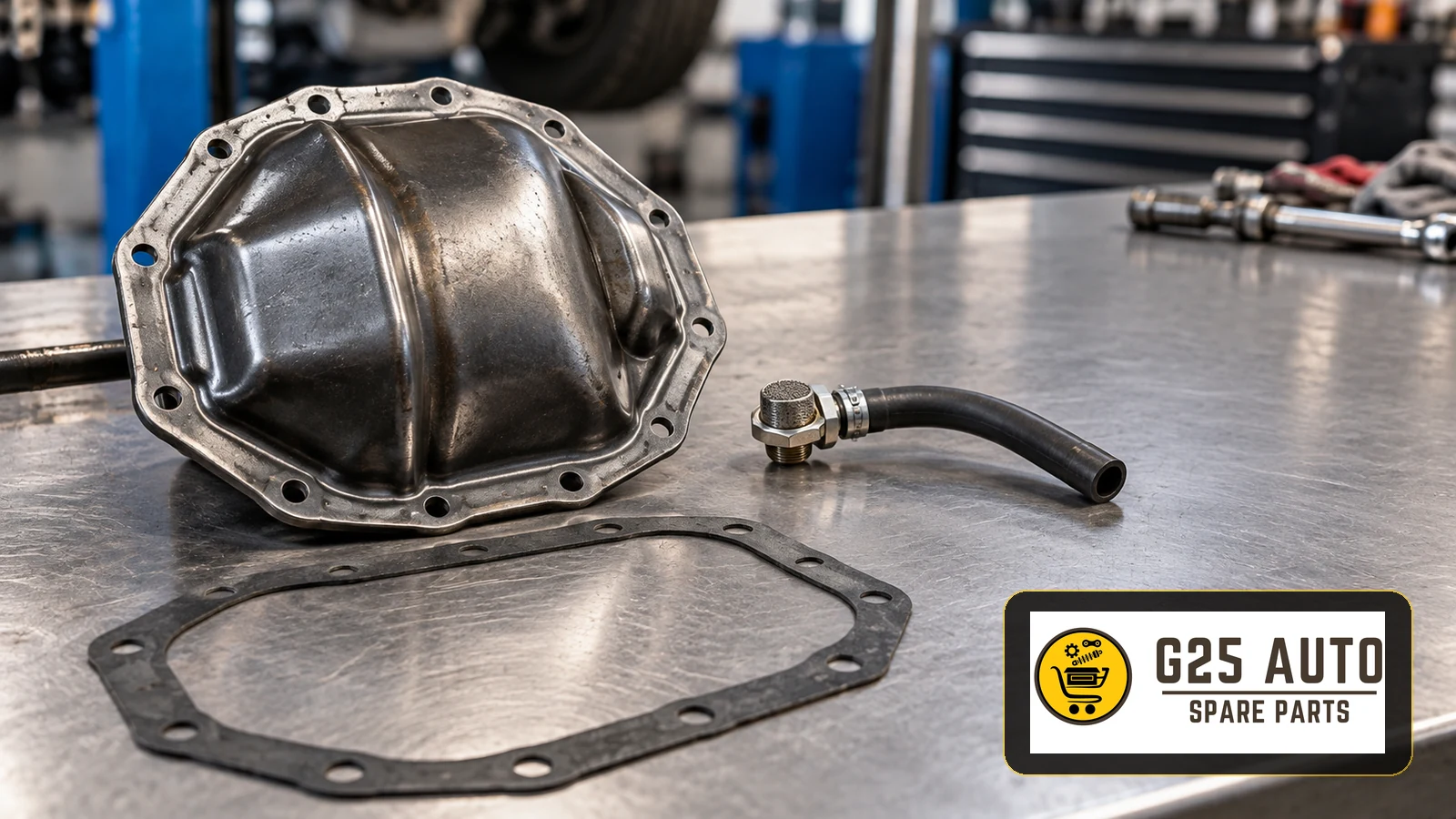
A differential cover gasket seals the cover-to-housing joint, while the axle breather manages ventilation. When investigating oil leakage, workshops should check the leak origin and the breather arrangement before ordering sealing parts. For European and Balkan B2B buyers, the useful starting point is an identified axle, documented workshop findings and an application-confirmed gasket or sealing system.
Understand which joint needs attention
The cover retains lubricant and protects the differential’s internal components. However, not every cover uses a separate gasket. Fel-Pro’s differential cover repair guide notes that many original covers use RTV sealant and that its replacement gaskets are application-specific.
Ask the technician to identify the joint being repaired: a removable rear cover, a carrier-to-housing interface or another sealing point. Use that description consistently in the enquiry, quotation and workshop job card. An order described only as a “differential gasket” leaves too much unresolved.
Record the leak location before selecting parts
Request photographs and a written description of the observed leakage. Ask the workshop to distinguish the cover joint from plugs, shaft seals and the breather area. Keep the reported symptom separate from the technician’s diagnosis, especially where the vehicle has already received a sealing repair.
A useful handover records when the complaint appeared, previous axle work, checks completed and outstanding questions. If the workshop has not established the failed component, mark the quotation as provisional. Agree who will confirm the repair scope before the purchasing team releases the order.
Include the breather in the investigation
Include the installed breather and any connected hose in the workshop’s assessment under the applicable service instructions. Record the actual arrangement rather than assuming every axle uses the same removable cap. Ask the technician to document contamination, damage or routing concerns and the required corrective work.
Breather leakage can require a specific manufacturer’s remedy. For example, a Western Star bulletin on certain Freightliner tandem rear axles describes an additional internal breather for a defined external-breather oil leak. It also excludes a particular housing configuration from that installation. This is an application-specific example, not a modification to copy onto other axles.
For a repeat complaint, ask whether current vehicle or axle technical information covers the observed fault. Supply that information with the enquiry. Avoid treating a fresh cover gasket and a new breather as an automatic package for every leak.
Identify the axle and confirm the offered reference
Build the enquiry around the VIN and available vehicle production details, then add the installed axle’s identification plate or markings and its position on the vehicle. Include legible references from the existing parts and clear photographs of the cover and breather arrangement. If the axle’s identity is uncertain, resolve that with the workshop before ordering.
Ask the supplier to confirm the exact manufacturer’s article reference against the documented application. Record catalogue restrictions and clarify any proposed supersession or substitution. A similar outline, bolt pattern or cap shape is useful supporting evidence, but should not become the entire fitment decision.
For cross-border purchasing, keep the manufacturer’s reference alongside the local component description. Use the same identification record when comparing genuine and aftermarket offers. Request product documentation and package contents for each offer rather than assuming equivalent materials, service life or included hardware.
Agree the sealing method before installation
Confirm whether the actual repair requires a formed gasket, an approved liquid sealant or another specified sealing arrangement. Fel-Pro promotes particular replacement gaskets for appropriate applications; that does not establish that any gasket can replace any RTV joint.
Obtain the selected product’s installation instructions and the applicable vehicle or axle repair information. Ask the workshop to check the cover and mating surfaces and record any condition that changes the proposed repair. Resolve damaged components before treating the job as a straightforward gasket replacement.
Do not add sealant simply as extra insurance. Fel-Pro’s RTV guidance explains that some gaskets need only local supplemental sealant and that the manufacturer’s directions determine its use. Follow the instructions for the actual gasket and joint; the guidance for an engine gasket does not define an axle-cover procedure.
Make the quotation and completion record usable
List the identified sealing item, any approved breather work and other workshop-confirmed requirements separately. Verify what each package includes. Obtain current price, availability and supply terms from the supplier for that transaction, and keep those commercial details with the accepted quotation.
Before work begins, ensure the workshop has the relevant tightening, lubricant, filling and sealant curing instructions. This guide supplies no universal torque, oil grade, capacity or waiting period. Ask the technician to document the fitted references and completion checks required by the applicable repair information.
For recurring leakage, retain the earlier repair record and the new findings together. Agree any follow-up with the workshop according to the vehicle’s requirements and the fault identified. Avoid replacing an application-specific service plan with a fixed mileage or annual interval taken from a general article.
Workshop and purchasing checklist
- Identify the leaking joint and separate symptoms from diagnosis.
- Record the installed axle identification and vehicle details.
- Include the breather arrangement in the workshop assessment.
- Check applicable technical information for recurring complaints.
- Obtain application confirmation for the exact offered reference.
- Resolve gasket, sealant and package-content questions before ordering.
- Agree the repair scope and obtain the relevant installation instructions.
- Retain fitted references, completion findings and any follow-up plan.
Frequently asked questions
Does oil around the differential prove the cover gasket has failed?
No. Ask the technician to establish the leak origin before selecting the replacement part.
Can a gasket always replace RTV?
No. Confirm the proposed gasket and sealing method for the exact cover, axle and application.
Should the breather always be replaced with the gasket?
Base the decision on the workshop’s findings and applicable service information rather than an automatic parts bundle.
Is the VIN enough to complete the order?
Provide it with the installed axle details and obtain application confirmation for the offered reference. Resolve missing identification before approval.