
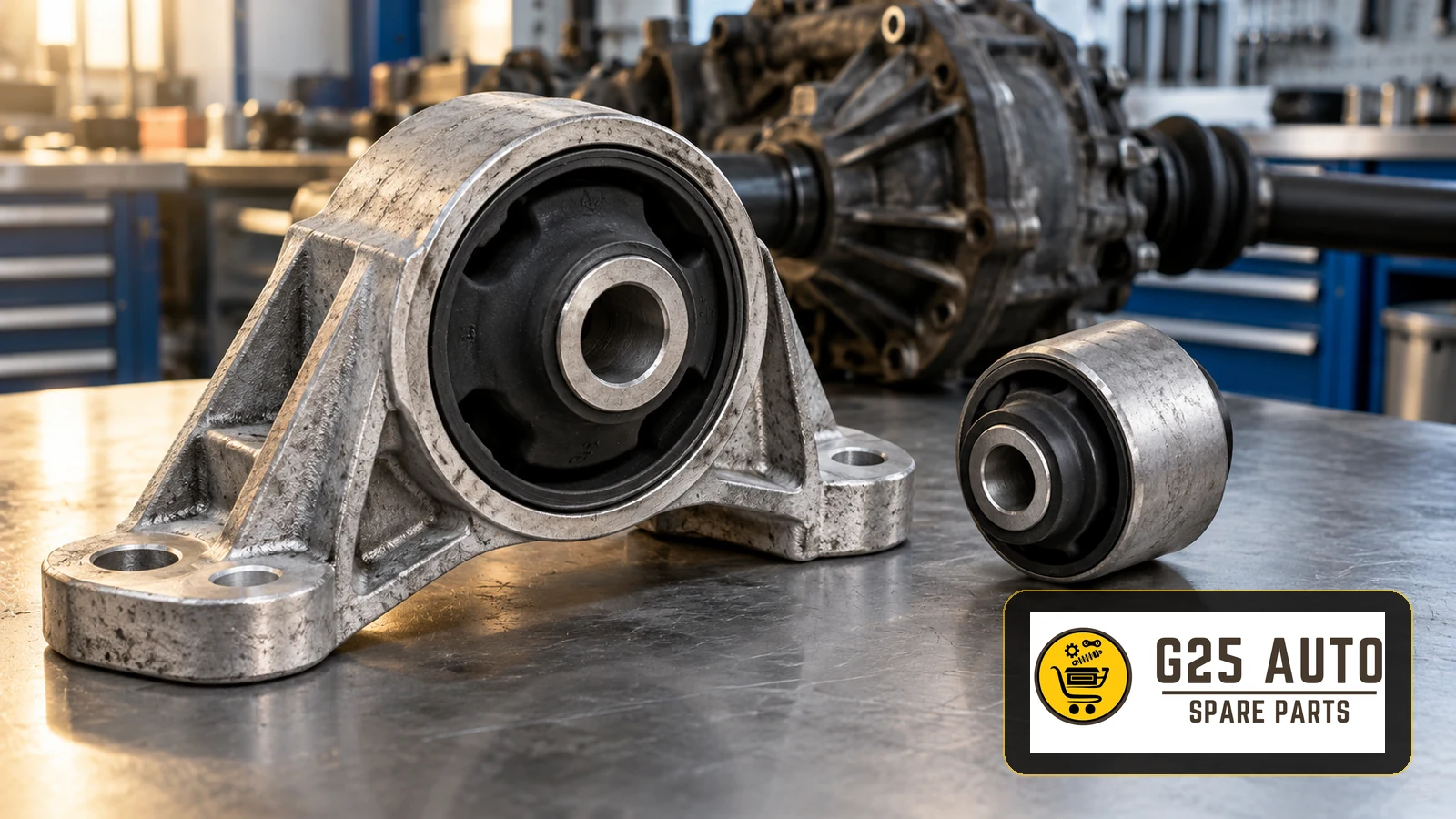
Differential mounts and bushings hold the differential at its mounting points while helping to isolate vibration and control movement. Choosing replacements requires the actual vehicle configuration, mounting location and confirmed part reference. For European and Balkan workshops and parts buyers, the most useful starting point is a documented inspection and an application check, rather than a purchase based only on a noise or the shape of an old bushing.
Understand the mounting arrangement first
A differential mount is a support component, not another name for every transmission mounting. Depending on the installation, the enquiry may concern a separate bushing or a larger mounting assembly. Ask the technician to identify the location on the vehicle and explain precisely which component needs replacement.
Rubber-to-metal components combine load transfer with vibration isolation. ZF’s driveline component overview explains how bonded rubber and metal transmit forces while reducing vibration and structure-borne noise. Its examples include engine and transmission mounts; these explain the general technology and do not establish the specification of a particular differential mounting.
Rubber construction and hydraulic designs
A black rubber element does not tell the buyer everything about a mount’s internal design. The construction must be identified from the application and product documentation. Do not assume that every differential bushing is hydraulic or that a solid-looking replacement is an approved substitute.
MEYLE’s suspension and axle mount overview distinguishes fluid-free designs in its range from hydraulic suspension bushings. That distinction illustrates why construction matters, but it is not permission to interchange designs on any vehicle. For a proposed alternative, request confirmation covering the exact vehicle and mounting position.
Turn a reported symptom into an inspection request
A customer may report vibration, a clunk when taking up drive or a change in refinement. Record when it occurs, how consistently it can be reproduced and whether it followed other work. These observations give the workshop a useful starting point; they are not proof that the differential mount is responsible.
Ask for an inspection report naming the affected component and describing the evidence. Useful records include photographs of the rubber and its connection to the metal, the supporting bracket and the surrounding attachment area. Have the technician distinguish a confirmed defect from an observation that still needs assessment against the applicable service information.
Keep other possible sources of the complaint in the diagnostic scope. Ask what was checked around the driveline and associated supports and which causes remain unresolved. Avoid ordering a mounting simply because it is the first visibly aged rubber component. Any decision about vehicle use pending repair belongs with the inspecting workshop.
Identify the part before comparing quotations
Build one application record that the workshop, distributor and buyer can all use. Include the VIN, available production details, drivetrain configuration and differential identification where accessible. Add the exact mounting position, legible existing references and photographs of the complete installed component.
Record any known changes to the axle, subframe or drivetrain. If information is incomplete, keep the enquiry provisional and assign responsibility for resolving it. A cross-reference or photograph supports identification; it does not replace confirmation for the offered manufacturer’s article reference.
Compare equivalent order scope
Clarify whether each quotation covers a loose bushing, a bracket containing a bushing or a kit. Confirm quantities, package contents and any separately required hardware. Ask the supplier to state application restrictions, reference changes and installation notes in the quotation.
Compare genuine and aftermarket offers using the same documented requirements. Neither category establishes a universal service life, price advantage or performance equivalence. Obtain current commercial terms for the actual enquiry and keep the accepted reference on the order. Require review before a substitute is supplied, especially where its construction differs from the original proposal.
Match installation planning to the component
Before booking the job, ask the workshop to confirm the relevant repair instructions, access requirements, support equipment and any dedicated tooling. Establish whether the specified repair concerns a replaceable bushing or a complete assembly. This makes the parts order and workshop plan describe the same work.
Orientation and pressing position can be significant in bushing installation. MOOG’s control arm bushing installation guide explains that some of those bushings require a specified radial orientation and axial position. It also notes that the old component’s position may be hard to establish when it is badly worn.
That guide addresses control arms, not a differential replacement procedure. For the actual differential mounting, obtain the applicable instructions for tool placement, orientation, installation depth, fastening and final checks. Do not transfer a pressing angle, tightening condition or lubricant recommendation from an unrelated component.
Have related mountings assessed when defining the repair, but base replacement scope on the inspection and applicable requirements. One failed bushing does not by itself establish that every nearby mount must be renewed. Likewise, ask whether a geometry check is required for the work performed instead of treating it as an automatic requirement for every mounting repair.
Workshop and purchasing checklist
- Describe the complaint and the conditions under which it occurs.
- Obtain an inspection finding identifying the affected mounting.
- Record vehicle details, location and installed-part evidence.
- Confirm construction and application for the exact offered reference.
- Compare quantities, assembly scope and package contents.
- Resolve substitutions and missing information before order release.
- Confirm repair instructions, equipment and required hardware.
- Retain fitted references and the workshop’s completion findings.
Frequently asked questions
Can a vibration identify a failed differential mount?
No. It is a reason to request diagnosis, not sufficient evidence to choose a replacement component.
Can hydraulic and solid rubber designs be swapped?
Only approve a proposed replacement after obtaining application confirmation and the relevant product and installation information. Appearance alone is insufficient.
Should every differential bushing be replaced together?
Ask the workshop to define the scope from actual findings and applicable requirements. Avoid an automatic complete-set order.
What should be recorded after fitting?
Keep the fitted references, completed work and final checks with the original complaint. Record any remaining symptom so the next diagnostic decision uses the full repair history.