
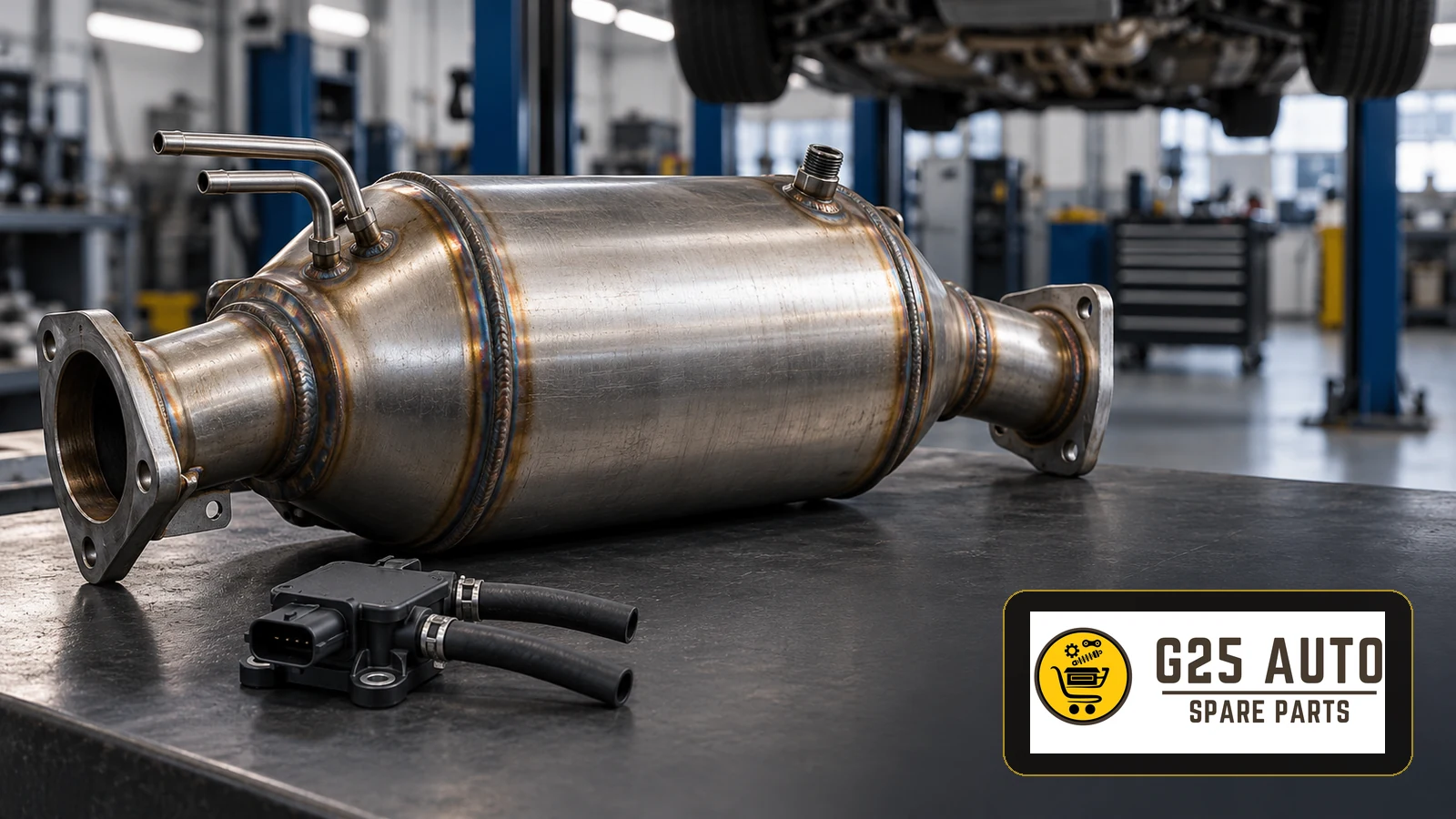
A diesel particulate filter warning calls for diagnosis before a workshop authorises regeneration, cleaning or replacement. Establish whether the concern is soot loading, accumulated ash, a pressure-sensing fault or physical damage, then select the repair using the vehicle manufacturer’s procedure. For European and Balkan B2B buyers, a defensible DPF order starts with the vehicle specification, a documented diagnostic conclusion and written confirmation of the proposed assembly.
Understand the filter and its monitoring system
The DPF captures soot from diesel exhaust. Regeneration reduces combustible soot, while accumulated ash remains a separate service concern. A differential pressure sensor measures across the filter; exhaust temperature information also supports system control. Some assemblies combine the particulate filter with other exhaust-treatment components, so a similar-looking housing does not establish interchangeability. HELLA’s aftertreatment overview explains these functions.
Record the exact dashboard message and the driver’s account. Reduced power, increased consumption or repeated warnings are useful observations, but they do not identify the failed component. Keep the operating history with the job: a delivery van used on short urban routes and a vehicle used on longer regional journeys may need different diagnostic questions.
Separate a restricted filter from misleading pressure data
A pressure-related fault deserves checks of the measuring system as well as the filter. Damaged wiring, cracked hoses, blocked pressure paths and exhaust leaks can affect diagnosis. Delphi’s differential pressure sensor guide describes these inspection areas and directs technicians to vehicle-specific service information.
Ask the technician to retain fault descriptions, relevant operating conditions, pressure and temperature readings, available loading estimates and regeneration history. Label each reading with its test conditions. A screenshot without that context is a weak basis for ordering an expensive assembly. Avoid applying an internet pressure limit or a diagnostic value from another engine to the vehicle in the bay.
Choose between regeneration, cleaning and replacement
Regeneration needs an authorised diagnostic path
Forced regeneration is a controlled service operation, not a default response to every DPF warning. Ross-Tech’s emergency regeneration guidance shows how supported routines and prerequisites differ between covered Volkswagen Group engine controllers. It also warns against regeneration when specified loading limits are exceeded because of fire risk. Its procedures are application-specific examples, not instructions for every diesel vehicle.
Ash loading needs a separate assessment
Another regeneration does not remove accumulated ash. HELLA’s DPF system note distinguishes the retained ash and the need to assess cleaning or renewal. Ask a cleaning specialist to document the filter’s identity, condition, proposed method and acceptance criteria. Request an inspection report rather than accepting a blanket promise that every blocked filter can be restored.
If damage is suspected, obtain a documented assessment before committing to cleaning. The repair decision should state why the existing assembly is serviceable or why replacement is required. Give responsibility for investigating the original problem to the workshop; a parts quotation cannot replace that diagnostic work.
Build a complete B2B parts enquiry
Use one enquiry record for the workshop, buyer and supplier. Identify the vehicle and installed exhaust configuration, then ask the supplier to confirm the proposed reference against current application information. Treat a readable original part number as evidence to investigate, including any supersession, rather than a stand-alone fitment guarantee.
- Record the VIN, engine identification, production information and relevant vehicle specification.
- Photograph the installed assembly, identification marks, mounting points, connections and sensor locations.
- Attach the diagnostic conclusion and explain why cleaning or replacement is being considered.
- Request written application confirmation for the exact offered reference and any documented supersession.
- Clarify whether the offer covers a filter alone, a combined assembly or a wider installation kit.
- List included and excluded sensors, pipes, seals, clamps and mounting hardware.
- Request application-specific documentation, installation information and any approval evidence required for the intended market.
- Confirm quoted availability, commercial terms, returns conditions and any core-return requirements directly with the supplier.
Compare original-equipment, aftermarket and professionally serviced options against the same enquiry. Ask for evidence behind performance and application claims. A low quotation, a broad vehicle list or an unspecified certificate is insufficient to resolve an unclear reference. Keep unresolved questions visible before the order is released.
Receive, install and close the job with evidence
At receipt, match the delivered reference and documents to the confirmed order. Photograph packaging damage or an obvious configuration difference before installation. Preserve identification and traceability records in the job file, and resolve discrepancies with the supplier before modifying the part.
Installation, any required adaptations and final checks belong to the applicable vehicle repair procedure. Request the technician’s completion report and relevant before-and-after evidence. Give the fleet operator a clear handover describing the diagnosed cause, work completed and manufacturer-based operating guidance. Record a return visit against the original job so that a recurring warning prompts investigation rather than an automatic repeat order.
Frequently asked questions
Does a DPF warning prove the filter needs replacing?
No. The workshop must distinguish filter loading or damage from pressure-sensing and other system faults before recommending a part.
Will regeneration remove ash?
No. Ash remains a separate concern requiring assessment for suitable cleaning or replacement.
Can a matching engine size confirm compatibility?
No. Request confirmation for the precise vehicle specification and exhaust assembly, supported by current application information.
What should accompany a replacement quotation?
The confirmed reference, application evidence, assembly scope, included hardware, installation documents and clearly stated commercial terms.