
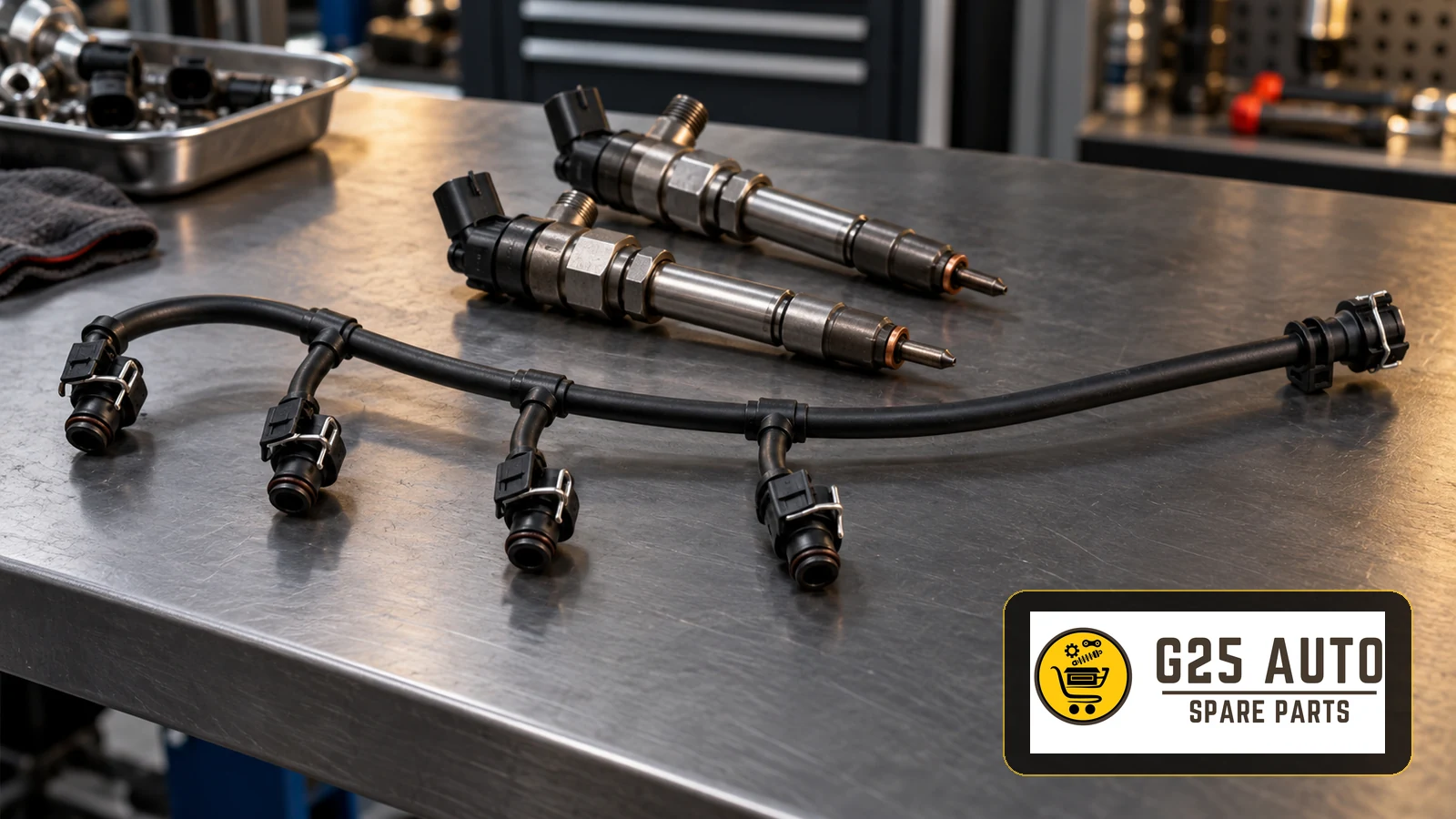
Diesel injector return hoses and leak-off connectors should be replaced when a confirmed defect affects the return assembly, using parts verified for the exact engine and injection system. Fuel around an injector does not by itself prove that the injector needs replacing. For European and Balkan workshops, the purchasing priority is to separate an external hose or connector leak from excessive internal injector return flow, then order the documented repair scope.
Understand the return assembly before ordering
The injector return circuit carries leak-off fuel away from the injectors through the vehicle’s return system. It is separate from the high-pressure pipes supplying the injectors. Depending on the application, the assembly may include flexible hose, formed tubing, connectors, seals, retainers and additional components specified in the vehicle catalogue. Do not assume every engine uses a simple hose running directly to the tank.
Terms such as spill pipe, leak-off line and injector return hose can describe different supply units. A quotation should identify whether it covers a complete assembled line, an approved repair section or individual service parts. A photograph helps explain the layout, but the application record remains essential.
Separate external leakage from injector back leakage
Locate the external defect
A technician should establish where fresh fuel appears and document any damaged hose, connector, sealing point or retention feature. Fuel can spread across neighbouring surfaces, so its resting place may differ from its origin. Starting difficulties, uneven running and loss of power require diagnosis; they do not identify a return hose as the cause.
Delphi’s common rail servicing guidance treats fault-code investigation, injector checks and pump assessment as distinct diagnostic tasks. Give the purchasing team the confirmed finding rather than a list of symptoms. This helps prevent a hose enquiry turning into an unnecessary injector order.
Interpret return-flow testing in context
Excessive fuel returning through an injector is a different finding from fuel escaping outside a return connection. Laser Tools explains this distinction through its injector return-flow tester instructions: excessive back leakage can prevent the system from developing adequate pressure. Its tool connects to the return side, and the instructions defer to the vehicle manufacturer’s service manual. Test conditions and acceptance limits must come from the applicable procedure; a general bottle comparison is not a universal replacement rule.
Build an application-specific B2B enquiry
Use a single enquiry record shared by the workshop, distributor and supplier. Record the VIN, engine code, production information, injector identification where relevant, and the existing assembly reference if legible. Ask the supplier to verify the catalogue application and any supersession. Resolve conflicting references before authorising dispatch.
Add clear photographs of the complete route, connector interfaces and damaged area. State whether previous repairs or injector changes are known. These details give the supplier a basis for checking differences that a model name and registration year may conceal. They do not replace written application confirmation.
Confirm the supplied assembly and materials
Ask which connectors, seals, clips and protective features are included. Where the catalogue offers a service section, obtain its installation requirements and exclusions. Avoid selecting a loose hose simply because it fits over an old fitting or resembles the removed material.
Gates publishes fuel-hose specifications that distinguish construction, fuel compatibility and operating limits. This illustrates why a broad description such as rubber hose is insufficient. It is not approval of that product for an injector return assembly: the selected component still needs application-specific documentation for its fuel, temperature, pressure and connection requirements.
Agree the repair scope before purchase
Replacement of one serviceable section or the complete line should follow the vehicle repair information and the condition assessment. Ask the technician to record the reason for the choice. Do not turn similar age into an automatic instruction to replace every injector or every return component.
For cross-border purchasing, keep the technical specification attached to the quotation. Confirm the supplied quantity, packaging unit, included accessories, warranty terms and returns conditions in writing. Obtain price, availability and delivery information for the actual order. Generic catalogue descriptions cannot establish those commercial facts.
Workshop and receiving checklist
- Record vehicle and injection-system identification against the repair job.
- Document the confirmed leak location and any separate injector test finding.
- Verify the assembly reference, catalogue application and supersession.
- Confirm whether the order is a complete line or an authorised service section.
- List supplied seals, connectors, retainers and protective components.
- Check the delivered label, packaging and component condition before fitting.
- Have the technician follow the applicable installation and leak-check procedure.
- Retain the supplier record, installed reference and final verification with the job.
Installation control and repair records
Fuel-system work requires trained technicians, suitable equipment and the vehicle-specific procedure. Delphi’s injector replacement guidance emphasises checking residual pressure and protecting exposed connections from contamination. Its injector removal and coding steps concern injector replacement; they should not be copied into a hose-only job without the applicable service instructions.
For the return assembly, document the required routing, connection engagement and retention checks. Record the completed leak inspection and any follow-up diagnosis. If the original symptom remains, reopen the diagnostic finding rather than treating a new hose as proof that the entire injection system is sound.
Frequently asked questions
Does a wet injector mean the injector has failed?
No. The technician must trace the source and distinguish the return connection, injector and other nearby fuel connections before deciding which component needs attention.
Can any diesel-rated hose replace a return line?
No. Fuel resistance alone does not establish the required dimensions, connections, operating limits or approved repair method. Verify the complete application.
Should the whole assembly always be replaced?
Follow the documented service options and inspection findings. A separately supplied component is useful only when the repair procedure permits it.
Is there a universal replacement interval?
Use the vehicle manufacturer’s maintenance information and the assembly’s assessed condition. A general age or mileage estimate cannot establish a replacement schedule for every system.