
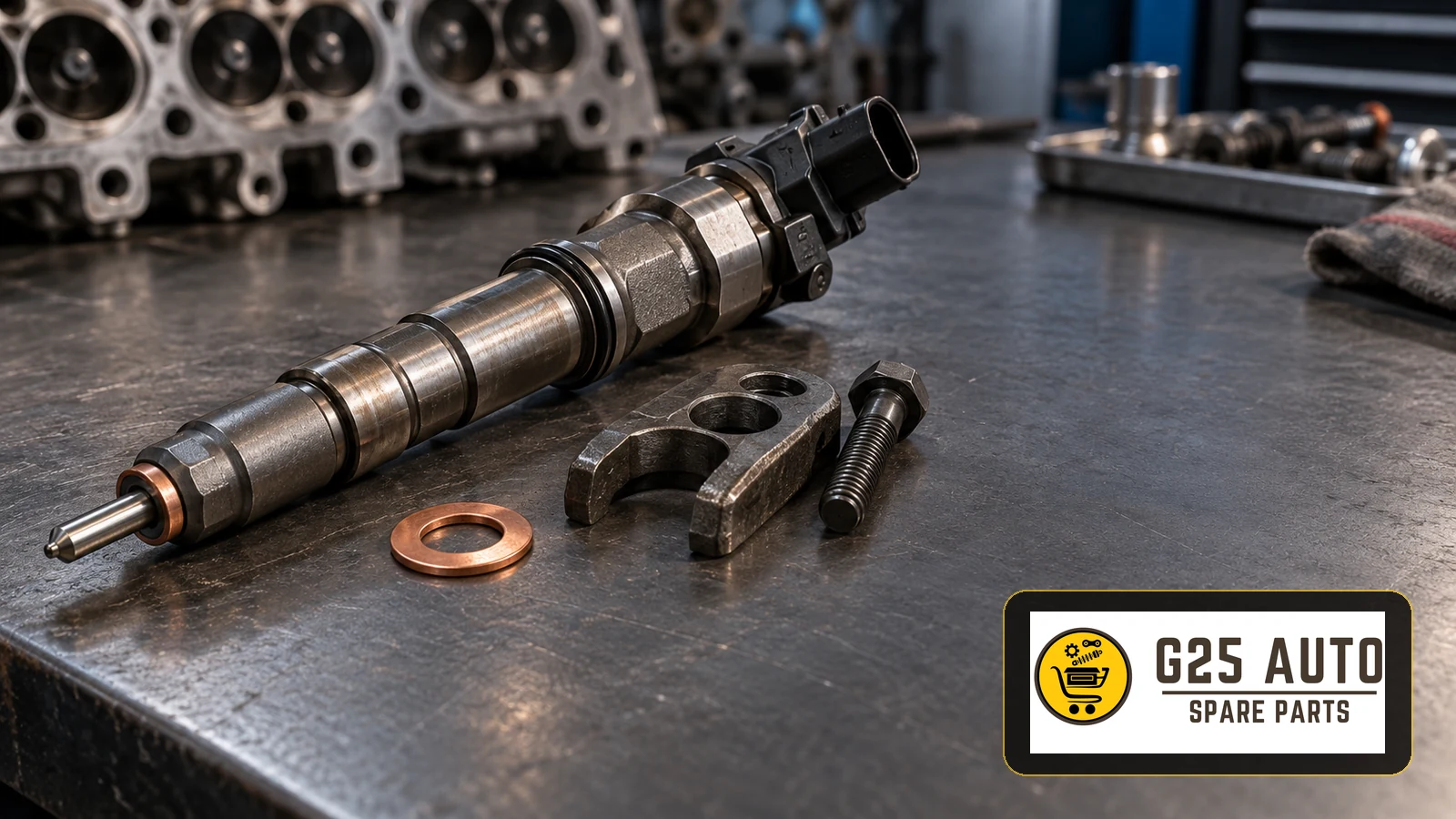
Choose a diesel injector copper sealing washer and retaining clamp against the confirmed engine and injector application, then follow the vehicle manufacturer’s installation instructions. The washer seals the injector-to-cylinder-head interface; the clamp retains the injector in position. A similar appearance is insufficient evidence of compatibility. For European and Balkan workshops, the purchasing decision should combine a confirmed diagnosis, documented part identification and a clear list of the seals and fasteners required for the actual repair.
Understand the washer, clamp and surrounding seals
The combustion seal at the injector seat has a different job from seals on the fuel return connections. Keep those items separate on the job card and purchase order. A request for an “injector seal kit” needs clarification: which interface is being repaired, which injector is installed and what the kit actually contains?
The retaining clamp is also distinct from its securing bolt or stud. Do not assume that the same replacement rule applies to both. Record the manufacturer’s instructions for inspecting or renewing each item rather than treating every clamp as disposable or every fastener as reusable.
Confirm the fault before ordering parts
Deposits and running symptoms need investigation
A missing or incorrectly seated nozzle washer can allow combustion residue past the sealing interface, as described in Delphi’s common rail service guidance. Deposits around an injector deserve investigation, but rough running, difficult starting or increased consumption do not identify the copper washer as the cause. Injector operation and other fuel-system faults remain separate diagnostic possibilities.
Ask the technician to record the observed leak location and test findings before converting the enquiry into an order. Avoid an automatic cylinder-head removal recommendation or a complete injector-set replacement based only on a symptom list. A purchasing team needs the workshop’s conclusion and the repair scope, rather than a guess attached to an engine warning light.
Distinguish combustion leakage from fuel leakage
“Leaking injector” is too broad for a reliable quotation. Ask whether the finding concerns the combustion sealing interface, an external fuel connection or injector performance established by testing. These descriptions help prevent a washer order from becoming an assumed cure for an unrelated defect. Keep diagnosis with a qualified diesel technician.
Build a traceable application match
Create an enquiry containing the VIN, engine identification, production details and readable injector markings. Add the relevant catalogue reference and photographs where they help resolve identification. Ask the supplier to state the application evidence used and flag any unresolved production or injector variation before confirming the order.
A reference number is a starting point for checking, not a universal guarantee. Keep superseded references linked to the current catalogue entry. Where information conflicts, hold the order for clarification rather than choosing the nearest-looking washer or clamp. Do not infer a washer specification from a removed, compressed seal.
Separate the order into identifiable lines for the combustion seal, any other required seals, the clamp where replacement is specified, and the required securing hardware. Request confirmation of kit contents and the unit of sale. A kit for one injector and a kit for the planned job are different purchasing descriptions; neither should be assumed from the product photograph.
Plan the workshop handover
Delphi’s injector replacement example highlights residual-pressure checks, protection of exposed connections against contamination, correct part identification and appropriate tightening. Its example also includes injector coding. These are reasons to obtain the procedure for the specific vehicle, rather than copying a general online installation sequence.
DENSO’s replacement guidance calls for renewed seals and gaskets, attention to bore condition and controlled extraction of stuck injectors. It also notes that diagnostic requirements vary by vehicle brand. Confirm fuel-pipe reuse limits and any coding requirements for the actual repair. Replacing a washer alone should not automatically be treated as installing a different injector.
Leave tightening values, sequences, permitted preparation methods and any repair of the seating surface to current application-specific service information. Do not improvise a different seal to compensate for damage. If the technician identifies a problem beyond the agreed repair scope, obtain a revised parts requirement before proceeding.
B2B purchasing checklist
- Confirm the complaint: retain the technician’s diagnosis and the identified sealing interface.
- Identify the vehicle: record VIN, engine identification and relevant production details.
- Identify the injector: keep readable markings and supporting photographs with the enquiry.
- Resolve the catalogue match: document the selected reference and any supersession.
- Define the repair scope: list required seals, clamp decisions and securing hardware separately.
- Confirm quantities: check kit contents and unit of sale against the authorised job.
- Retain traceability: preserve supplier identification, packaging references and the purchase record.
- Close the job: file the workshop’s post-repair checks and any unresolved findings.
Receiving and cross-border order control
For workshops and distributors working across European and Balkan markets, use consistent item descriptions on enquiries, quotations and delivery documents. Keep commercial confirmation separate from technical approval: availability, delivery arrangements and return conditions require a current supplier response. An article cannot establish those terms for a particular order.
At receipt, compare labels and quantities with the approved order and keep seals protected until installation. If packaging, references or kit contents differ, resolve the discrepancy before the parts reach the job. This gives the technician a clearer handover and leaves a record for any later enquiry.
Frequently asked questions
Can the old copper washer be reused?
Plan for a new application-correct seal when the injector is removed. Follow the specified renewal requirements and installation procedure.
Must every retaining clamp be replaced?
Check the vehicle procedure and the component’s condition. The clamp and its securing fastener need separate decisions; there is no universal replacement rule here.
Will a new washer cure rough running?
Only if the diagnosed defect is addressed by that repair. Running symptoms alone do not establish a washer fault.
Can a washer be selected by appearance?
Use a documented application match. Similar shape or colour does not establish the required seal specification.