
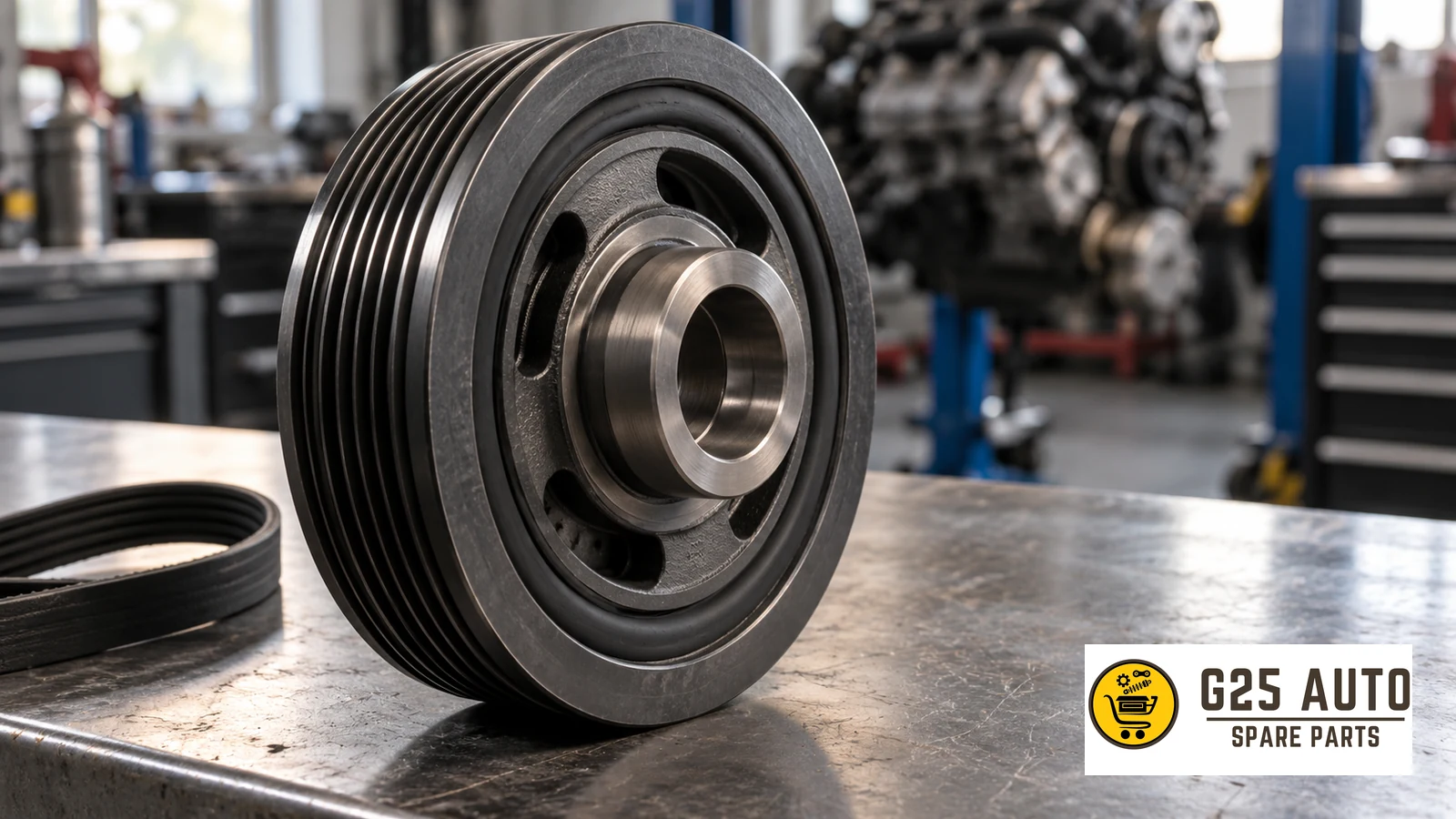
The crankshaft pulley and vibration damper sit at the front end of the crankshaft. They help control engine vibration and drive belt-operated accessories such as the alternator, air-conditioning compressor and, where fitted, hydraulic power-steering pump. A fault can cause engine noise, belt displacement and potentially further damage. Check the OEM reference, VIN, engine code and production date when selecting a replacement.
What Are the Crankshaft Pulley and Vibration Damper?
In many modern engines, the crankshaft pulley and vibration damper form one assembly with two functions. Crankshaft rotation produces torsional vibration; excessive vibration can stress engine components, belts and driven accessories.
In an elastomer-type damper, a rubber-based layer separates the inner hub from the outer metal section and helps absorb torsional vibration. The pulley section carries the V-belt or multi-rib belt that drives accessories such as the alternator and air-conditioning compressor. Damper construction varies by application.
Crankshaft Pulley and Vibration Damper Fault Symptoms
A problem with this component can produce several warning signs. Similar symptoms can arise elsewhere, so professional inspection is necessary to establish the cause.
Common Fault Symptoms
- Unusual engine-area noise: Rattling, buzzing or cracking sounds, particularly at idle or as engine speed rises.
- Increased engine vibration: Excess vibration felt through the steering wheel, dashboard or pedals.
- Belt displacement or excessive wear: Uneven accessory-belt wear or repeated belt replacement.
- Irregular engine operation: Reduced performance at certain engine speeds, which requires diagnosis rather than assuming a pulley fault.
- Visible damage: Cracks, separation, swelling or tearing of the elastomer layer.
- Uneven belt tracking: Crooked or irregular belt contact marks on the pulley.
- Electrical-system problems: A battery charging warning associated with disrupted alternator drive.
Checks Needed for Diagnosis
If these symptoms occur, professional checks should identify the actual source:
- Listen to the engine under cold and warm operating conditions.
- Visually inspect the pulley for cracking, separation and wear.
- Measure pulley vibration where appropriate using suitable equipment.
- Check belt tension and alignment.
- Assess crankshaft bearing condition if the diagnosis indicates a need.
- Check other accessories, including the alternator, air-conditioning compressor and belt tensioner pulleys.
Similar symptoms can result from a faulty belt tensioner, water pump, alternator bearing or crankshaft-related problem.
Causes of Crankshaft Pulley Failure
Several factors can contribute to failure:
- Ageing and normal wear: Elastomer material can lose flexibility over time.
- Excessive heat: Engine overheating can accelerate elastomer deterioration.
- Oil and chemical exposure: Engine oil, coolant or other chemicals may damage the elastomer.
- Incorrect installation: Wrong tightening torque or assembly sequence can cause damage.
- Excessive belt tension: An overtight belt places extra load on the pulley.
- Collision or impact: Front-end impacts can damage the assembly.
- Poor-quality components: Parts that do not meet the required specifications may fail prematurely.
Genuine and Aftermarket Parts Compared
When replacing a crankshaft pulley and vibration damper, workshops and parts buyers may choose between genuine and aftermarket parts. Both options require careful assessment.
Comparison Table
| Feature | Genuine Part | Quality Aftermarket Part |
|---|---|---|
| Application suitability | Check the vehicle manufacturer’s specified reference | Verify the declared application and relevant specifications |
| Quality standards | Review the manufacturer’s documentation | Check relevant supplier and manufacturer quality documentation |
| Supply time | Depends on the reference and supplier | Depends on the reference and supplier |
| Warranty coverage | Confirm the applicable manufacturer’s terms | Confirm the supplier’s applicable terms |
| Brand choice | Vehicle-brand supply channel | Potentially several manufacturers |
| Technical documentation | Obtain the relevant application and service information | Check that sufficient technical information is available |
For either option, the priority is a part that meets the vehicle’s requirements. When selecting an aftermarket component, choose a traceable product from a reliable manufacturer and supplier.
Checklist for Selecting the Correct Part
Check the following before ordering a crankshaft pulley and vibration damper:
- ☑ VIN: Use it to check the application against reliable catalogue information; it does not by itself guarantee fitment.
- ☑ Engine code: Different engines in the same model may use different pulleys.
- ☑ Production date: Part revisions may depend on the vehicle’s build date.
- ☑ OEM part number: Check the original reference on the existing component where available.
- ☑ Pulley type: Identify whether the application uses a V-belt or multi-rib belt.
- ☑ Number of grooves: Confirm the required groove count.
- ☑ Diameters: Check the specified outer and mounting dimensions.
- ☑ Damper type: Match the required damper design, whether elastomer-based or another application-specific construction.
- ☑ Additional features: Some assemblies incorporate a sensor ring or other features.
- ☑ Brand reliability: Assess the manufacturer’s reputation and supporting product information.
- ☑ Certificates: Verify relevant quality documents and their scope rather than assuming they prove fitment or durability.
- ☑ Warranty: Review the supplier’s stated terms.
Why Is This Information Important?
Even within one vehicle model, engine options, production years and equipment specifications can differ. Petrol and diesel versions may use different crankshaft pulleys. Revisions can also occur within the same engine code as production changes.
Installing the wrong part can lead to belt displacement, engine damage or a breakdown, with potential safety consequences. Verify the relevant information before placing a parts order.
What to Check When Buying an Aftermarket Part
The aftermarket contains a wide range of products, including parts with differing quality and traceability. Consider the following points:
Selecting a Reliable Supplier
Choose a supplier with relevant automotive experience and a reliable trading record. For G25Auto B2B orders serving Europe and the Balkans, compare the available product information and request the technical details, application data and relevant quality documentation needed to assess the part.
Quality Documents and Certificates
Check the manufacturer’s relevant quality-management and product documentation. A quality-management certificate such as ISO 9001 concerns the processes within its stated scope; it does not alone establish the suitability or performance of an individual pulley.
Product Warranty
Review any warranty offered by the supplier, including its duration, coverage and exclusions. Some terms cover manufacturing defects while excluding damage caused by incorrect installation. Warranty wording alone should not be treated as proof of product quality.
Installation and Replacement
Replacing a crankshaft pulley and vibration damper requires suitable technical knowledge and equipment. Professional workshop installation is recommended, following the service procedure for the particular engine.
Preparation Before Installation
- Position the vehicle on a level, secure surface.
- Allow the engine to cool before working.
- Disconnect the negative battery terminal where required by the vehicle’s service procedure.
- Remove the engine undertray if needed for access.
- Prepare the required replacement parts, such as the pulley, belt, tensioner and fasteners.
Installation Stages: General Overview
- Remove the accessory belt.
- Release the crankshaft pulley fastener using the specified holding tools and procedure.
- Remove the old pulley from the crankshaft; a suitable puller may be required.
- Clean and inspect the crankshaft mounting surface.
- Install the new pulley in the specified position.
- Tighten the fastener according to the engine-specific torque and, where specified, angle procedure.
- Fit the replacement belt and set its tension as specified.
- Run the engine for the prescribed operational checks once assembly is complete and safe.
- Recheck the assembly after the initial test, following the service instructions.
Important: Replace any pulley fastener designated as single-use by the manufacturer. Correct tightening is critical: insufficient tightening can allow movement, while excessive tightening can damage the fastener or crankshaft. Follow the exact procedure for the application.
Frequently Asked Questions
When Should a Crankshaft Pulley Be Replaced?
There is no universal replacement mileage for a crankshaft pulley and vibration damper. Replacement may be necessary when diagnosis confirms a fault, visible cracking or separation is found, the elastomer has deteriorated, or professional measurements reveal a problem. Follow any application-specific inspection schedule and account for operating conditions.
Can a Crankshaft Pulley Fault Damage the Engine?
It can lead to further damage. Reduced damping can increase torsional stresses and affect connected components. Pulley separation or belt displacement can interrupt accessory drive. The consequences, including any risk to other engine systems, depend on the engine layout and failure mode; engine stoppage or altered valve timing should not be assumed in every case.
Should Other Parts Be Replaced at the Same Time?
Assess the accessory belt when replacing the pulley, particularly if it has been damaged or contaminated. Inspect the tensioner and idler pulleys and replace them when their condition or the manufacturer’s instructions require it. Coordinating necessary work while the system is accessible may reduce repeat dismantling, but does not mean every component automatically needs replacement.
Is an Aftermarket Crankshaft Pulley as Durable as a Genuine One?
A suitable aftermarket pulley should be assessed against the required application specifications and available quality information. Similar appearance, a familiar brand or a certificate does not by itself establish equal durability. Buy a traceable product from a reliable supplier and check its documentation; poorly documented products carry greater uncertainty.
How Long Does Crankshaft Pulley Replacement Take?
The time depends on the vehicle model, engine layout and access requirements. Access is straightforward on some vehicles; others may require additional work around engine mounts or front wheels. A workshop should assess the relevant procedure before estimating labour time.
Does a Crankshaft Pulley Make Noise?
Unusual noise from the pulley area can indicate elastomer separation, cracking or wear, potentially allowing vibration or contact between components. However, the belt tensioner, alternator bearing or water pump can also produce noise. Professional diagnosis is needed to identify its source.
Conclusions and Recommendations
The crankshaft pulley and vibration damper contribute to engine operation by controlling torsional vibration and driving accessories. Although the assembly may appear simple, its condition matters for vibration control and the protection of connected systems.
Prompt investigation of unusual noise, vibration or belt behaviour can help prevent further damage. Diagnosis remains essential because several faults can produce similar symptoms.
Take time to identify the replacement correctly. Checking the VIN, engine code, production date and OEM reference helps reduce the risk of selecting an unsuitable part. Incorrect installation can create both repair costs and safety risks.
The choice between genuine and aftermarket parts depends on application requirements and purchasing priorities. For aftermarket sourcing, review product traceability, relevant quality documentation and any warranty terms with a reliable supplier. Clear product information helps B2B buyers compare suitable options.
Correct installation also affects service life. Follow the prescribed tightening procedure, assembly sequence and requirements for additional parts, including single-use fasteners where specified. Use an experienced workshop with the necessary tools and service information.
Maintain the engine according to its service requirements, investigate abnormal noise or vibration, and select parts whose suitability has been checked. These steps support reliable operation and help control avoidable repair costs.