
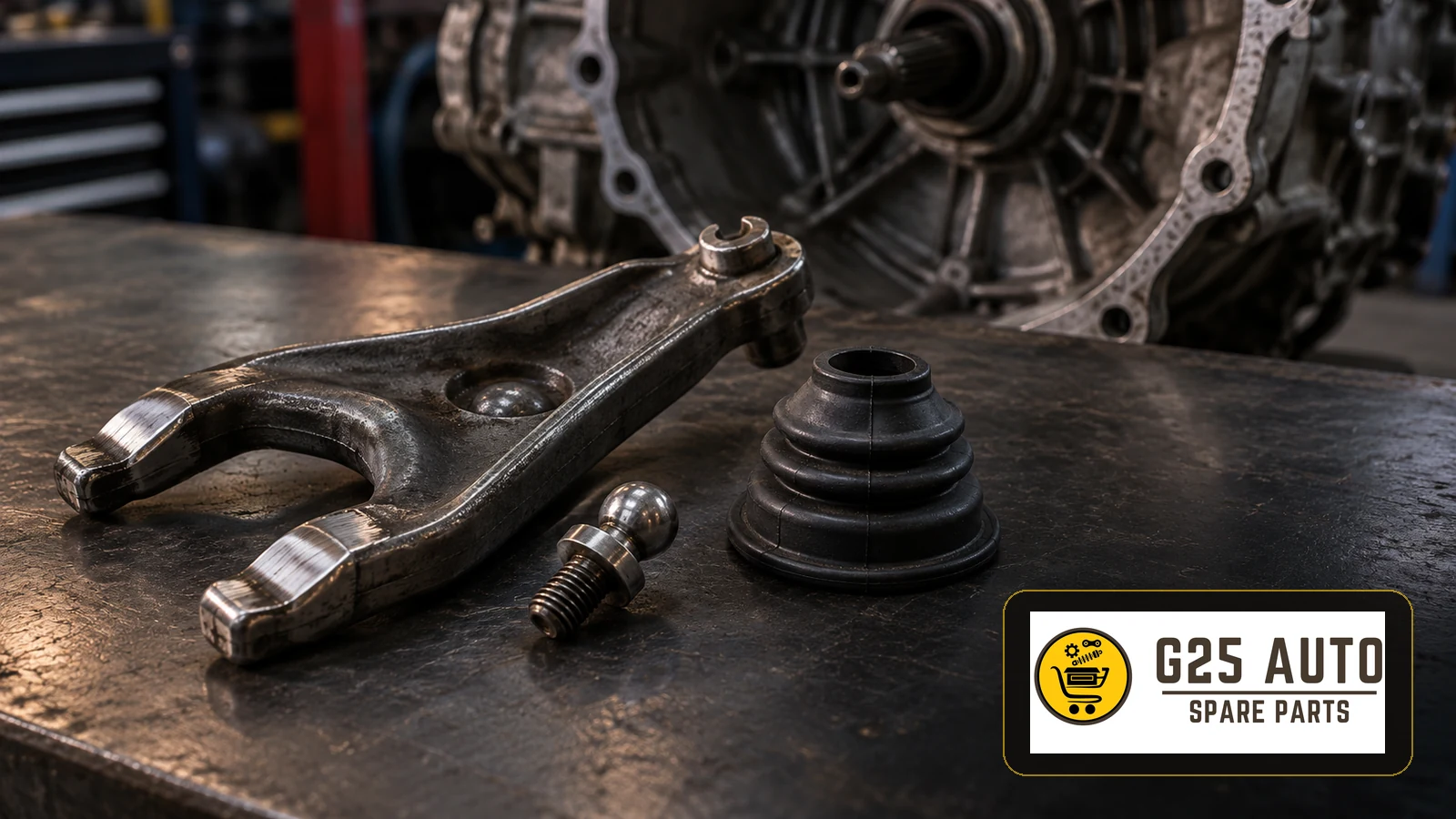
A clutch release fork, pivot ball and protective boot should be assessed as part of the complete release mechanism when pedal effort changes, noise develops or the clutch does not disengage correctly. Confirm the installed arrangement, inspect the contact surfaces and supporting components, and select replacements against the exact transmission application. These symptoms alone do not prove that the fork or pivot has failed. For workshops and parts distributors across Europe and the Balkans, the useful starting point is a documented inspection rather than an order based only on a vehicle model name.
Identify the release mechanism before ordering
In a fork-operated arrangement, the fork transfers movement from the actuation system to the release bearing. Some designs support the fork on a pivot ball or stud; others use a release shaft and associated supports. A concentric slave cylinder combines hydraulic actuation and the release bearing, so a separate fork-and-pivot arrangement must not be assumed. ZF describes conventional and concentric systems in its clutch actuation overview.
Where fitted, the flexible boot covers the opening around the release lever while allowing its movement. Identify this boot separately from a hydraulic cylinder dust boot or a shaft seal. Record a damaged boot as an inspection finding, but investigate visible fluid independently rather than assigning a leak to the boot.
Separate the complaint from the diagnosis
Noise, stiffness and incomplete disengagement
Ask when the noise occurs, how pedal effort has changed and whether the complaint followed earlier clutch work. Keep the driver’s description alongside the technician’s findings. A squeak is not enough to distinguish the bearing, fork contact or pivot, and difficult gear selection does not identify a single failed component.
Subaru’s release-bearing bulletin revised in January 2021 illustrates this diagnostic distinction. For its listed applications, it describes worn release-fork contact areas associated with squeaking and calls for inspection of the release components. This historical example is not a diagnosis or repair instruction for every manual-transmission vehicle.
Inspection and access
Plan access using the applicable repair information. State what can be inspected externally and what requires further disassembly. Avoid promising that the boot, fork or pivot can be replaced from outside the gearbox before checking the actual arrangement.
ZF’s clutch replacement guidance calls for cleaning the bellhousing and actuation components so wear can be identified. During the relevant inspection, assess the fork’s bearing contacts, pivot seat or shaft supports, retaining features and guide sleeve against the manufacturer’s criteria. Photograph cracks, deformation and visible contact wear. Record inaccessible areas explicitly instead of marking the complete mechanism satisfactory.
Match the fork, support and bearing as an assembly
Prepare the parts enquiry with vehicle identification, transmission details, existing references and clear photographs. Ask the supplier to confirm the catalogue application and any current replacement notes. An old fitted part helps identification but may reflect an earlier repair; it is not conclusive evidence that an identical-looking replacement is correct.
ZF’s February 2018 service information on a release-system change describes a specific Audi application where the release bearing and associated components must match. It also asks technicians to consider previous clutch repairs. Use this as a reason to check the documented system revision, not as a general conversion rule or a fitment list for other vehicles.
Keep the proposed fork, pivot or support, bearing, boot and retaining hardware on separate lines in the enquiry. Ask which items are supplied together and which are separate. A clutch kit description should not be treated as proof that every release-system component is included. Request clarification if the supplier’s proposal conflicts with the installed arrangement.
Workshop and distributor order checklist
- Record the vehicle identification and configuration required by the catalogue.
- Confirm the transmission application and actual release mechanism.
- Separate reported symptoms from confirmed inspection findings.
- Attach readable references and labelled photographs of the existing assembly.
- Check system revisions and previous repair history where available.
- Confirm the fork, support, bearing and boot application together.
- List supplied retainers and separately required installation hardware.
- Resolve application questions and obtain the relevant fitting instructions before installation.
For enquiries shared between regional distributors and workshops, retain the confirmed catalogue reference alongside the component description. Put substitutions and unresolved questions in writing. This gives the receiving workshop a clear record of what was proposed and why.
Set the repair scope and installation requirements
Base replacement decisions on the findings and applicable instructions. Do not assume that every fork, pivot and boot must be renewed together, or that fitting a new clutch makes worn release components acceptable. Distinguish a component rejected on inspection from an optional item in the quotation.
Obtain the specified lubricant, application points and fitting method for the actual mechanism. The Subaru bulletin’s lubrication guidance applies within its stated scope; it is not a universal grease prescription. ZF also stresses keeping clutch friction surfaces clean. Do not use an external spray application as a substitute for inspecting a suspected worn contact.
After assembly, complete the functional checks required by the repair information. Record the fitted references, relevant inspection findings and whether the original complaint has been resolved. If noise, pedal return or disengagement remains abnormal, continue diagnosis before closing the job.
Frequently asked questions
Does every manual gearbox use a pivot ball?
No. Establish whether the system uses a ball-supported fork, a shaft-supported mechanism or a concentric assembly before preparing the order.
Does a squeak prove the release bearing is faulty?
No. Inspect the relevant release components and correlate the findings with the complaint before naming the failed part.
Can a replacement boot fix an oil leak?
A damaged protective boot and visible fluid require separate assessment. Identify the fluid source and required repair instead of assuming that replacing the boot resolves the leak.
Should the fork and pivot always be replaced together?
Follow the inspection findings and application-specific instructions. Confirm whether the proposed replacement requires matching components or revised retaining hardware.