
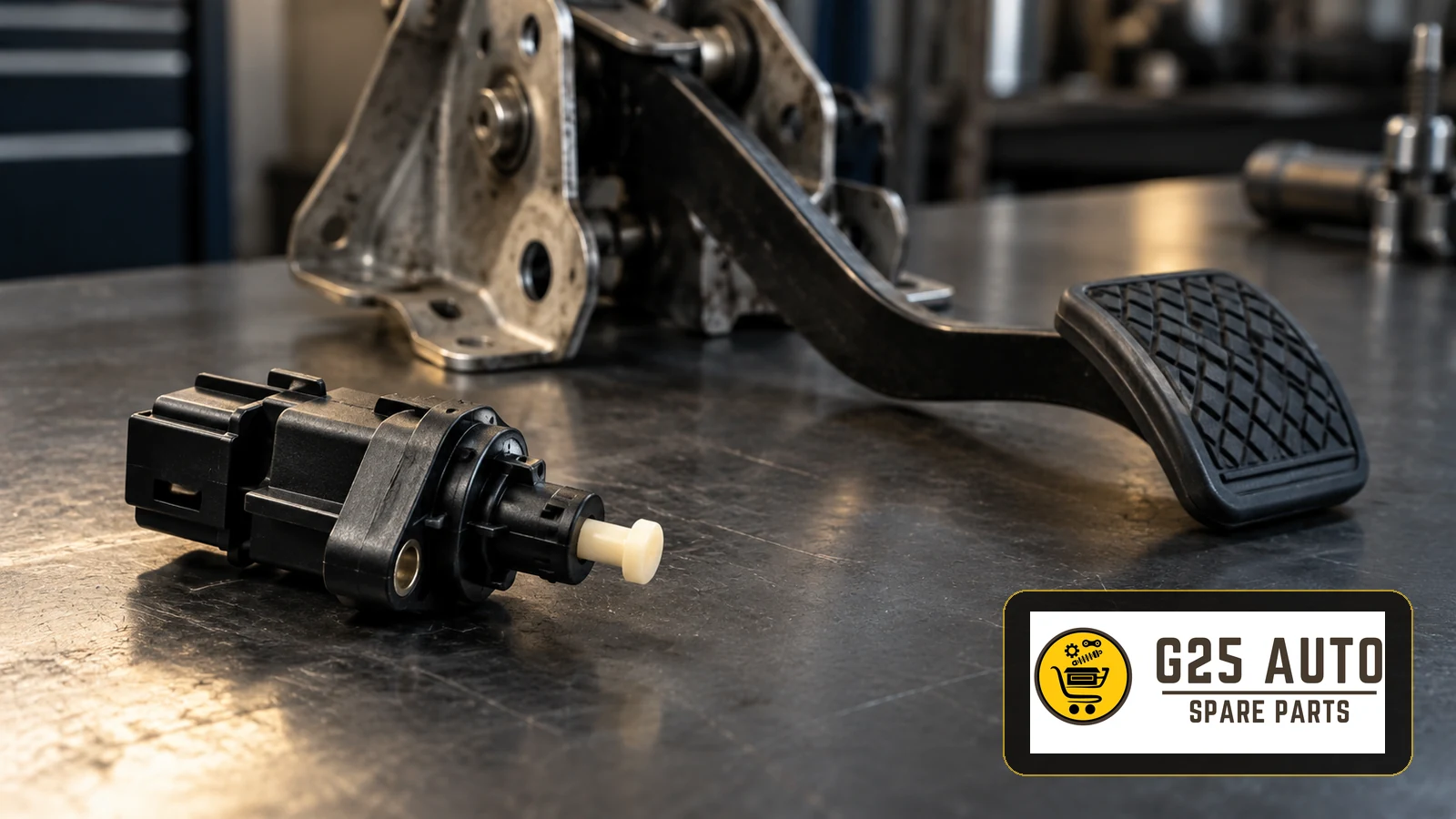
A clutch pedal switch reports pedal operation to the vehicle’s electrical control systems. Depending on the application, its signal can support starter authorisation, cruise control cancellation or other control functions. It is an electrical component, distinct from the pivot bush that supports pedal movement. For European and Balkan workshops, the first task is to identify which component and circuit the complaint actually concerns before ordering a replacement.
Identify the component before diagnosing the fault
Descriptions such as clutch sensor, pedal switch and pedal bush can become confused in parts enquiries. Record the component’s location and function rather than relying on a translated name. A photograph of the installed part, its connector and mounting arrangement helps the workshop and distributor discuss the same item.
A squeak, stiffness or sideways movement does not establish an electrical switch failure. Keep mechanical pedal complaints separate from signal complaints on the job card, and investigate both if they occur together. Replacing a switch without establishing the cause leaves the original concern unresolved.
Which symptoms justify checking the switch?
HELLA’s clutch pedal switch information describes starting and cruise control complaints associated with faulty switches. These are possible symptoms, not proof of failure or a feature list for every manual vehicle. Establish how the particular vehicle is intended to behave from its own documentation.
Ask whether the starter fails to operate, whether the complaint is intermittent, and whether pedal position changes the behaviour. Distinguish a starter that does not crank from an engine that cranks but fails to run. Record the driver’s description without converting it into a parts diagnosis. If starting interlock behaviour is abnormal, keep the vehicle out of normal service until the fault has been assessed and corrected.
A structured workshop assessment
Compare pedal movement with the reported signal
Use the diagnostic information and equipment specified for the vehicle. Fiat’s Panda clutch switch diagnostic page, for its stated application, compares the displayed pedal status with pedal operation and includes switch and electrical connection checks. It also identifies a Hill Holder function for that application. This illustrates why the relevant control system must be identified rather than assuming every switch only controls starting.
Record fault information and the observed status before disturbing the installation. Where supported, compare the relevant live data with actual pedal operation. Use the manufacturer’s expected states and test conditions; a label such as on or off is not a universal wiring rule. A fault description directs investigation and does not independently confirm that the switch must be replaced.
Inspect installation and the associated circuit
Assess the mounting, connector and accessible wiring using the vehicle’s repair instructions. Look for damage or insecure connections and document the findings. Test the switch and circuit only with the specified method and terminal information. Do not bridge a starter interlock or substitute a guessed electrical test simply to make the vehicle start.
Build a clear parts enquiry
For a workshop buying through a regional distributor, a useful enquiry separates confirmed identification from assumptions. Supply the VIN, transmission details and production information requested by the catalogue. Include legible markings from the removed component when available and explain whether the diagnosis concerns a switch, its mounting or the wiring.
Ask the supplier to confirm the application and any documented replacement reference in writing. Connector appearance, housing colour and a familiar model name are supporting observations rather than fitment approval. Keep unresolved catalogue differences open until the workshop and supplier have checked the applicable documentation.
Compare original and independent replacement offers using traceable application data and installation instructions. Do not assume equivalent function, quality or warranty from a product category alone. Agree how identification queries and returns will be handled before accepting a substitution; this is procurement practice rather than a technical specification.
Installation and verification depend on the design
There is no universal adjustment or reuse rule. Fiat’s Bravo right-hand-drive clutch switch procedure specifies a new switch after removal and describes a supplied pushrod position. That requirement belongs to the stated version; it must not be transferred to another vehicle.
Follow the current repair instructions for the actual application, including any setup and verification requirements. Document the installed reference, work performed and final findings. Release the vehicle only after the relevant pedal signal and affected functions have been checked through the prescribed process.
Workshop and procurement checklist
- Identify the electrical switch separately from mechanical pedal components.
- Record the complaint and conditions under which it occurs.
- Confirm the applicable circuit and vehicle repair information.
- Save relevant diagnostic observations before changing parts.
- Document connector, mounting and wiring findings.
- Resolve application and replacement-reference questions with the supplier.
- Check the specified installation, reuse and setup requirements.
- Retain the final functional check and parts identification in the service record.
Frequently asked questions
Is a clutch pedal switch the same as a pedal bush?
No. The switch provides an electrical signal; the bush belongs to the pedal’s mechanical support. Confirm which component an enquiry describes.
Does a starting complaint prove the switch is faulty?
No. Establish the starting symptom and follow the relevant diagnostic process, including the associated circuit checks.
Can a similar-looking switch be substituted?
Appearance alone is insufficient. Obtain documented application confirmation before accepting a replacement.
Does every replacement need adjustment?
The requirement depends on the design and supplied part. Use the applicable instructions rather than a generic adjustment method.