
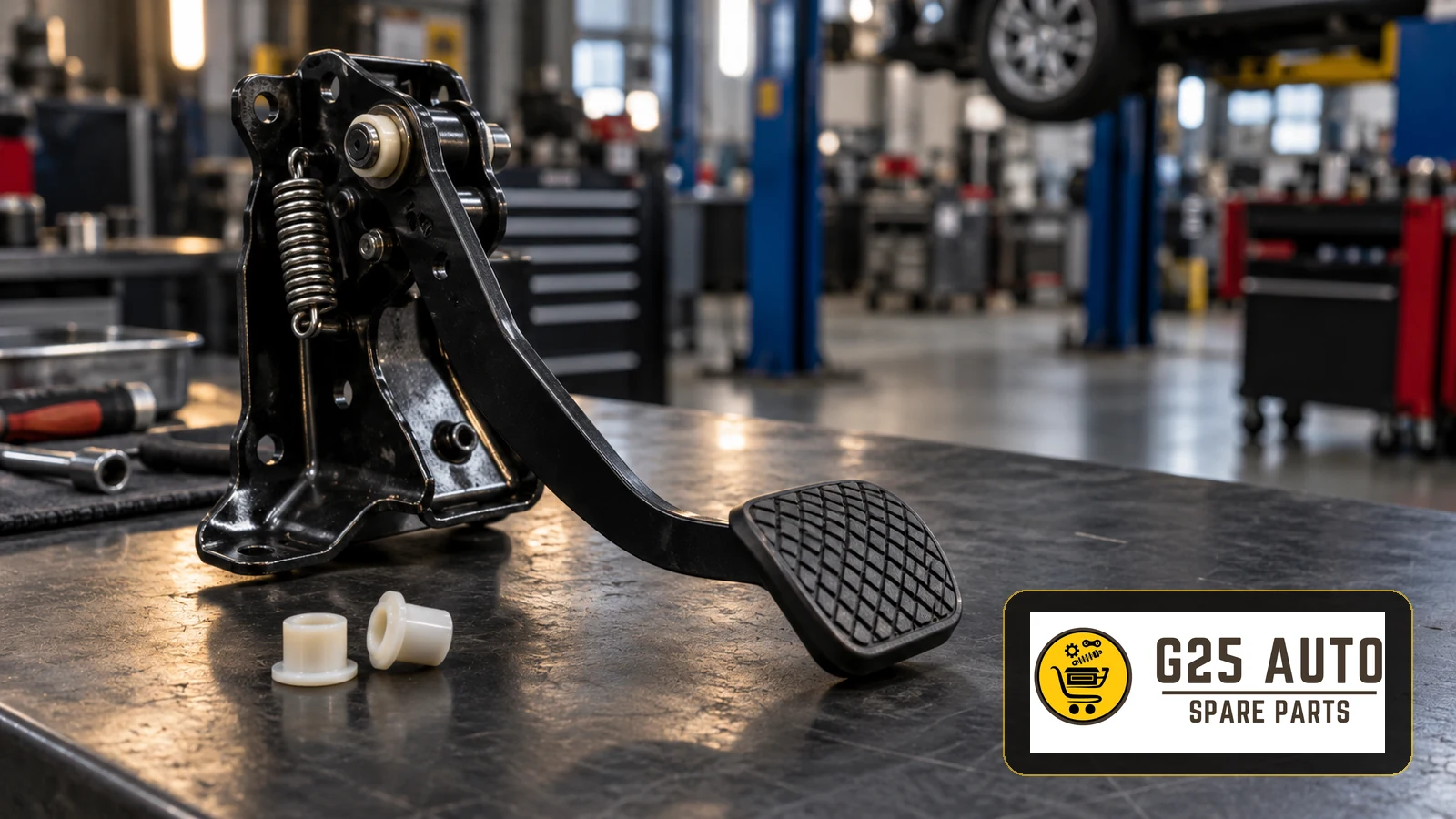
A clutch pedal return spring and pivot bush have different jobs: the spring forms part of the pedal’s operating mechanism, while the bush supports movement at its pivot. A pedal that sticks, squeaks or moves sideways needs diagnosis before either part is ordered. For European and Balkan workshops, the practical starting point is to identify the installed pedal arrangement, locate the fault and confirm the correct service parts through the vehicle’s current documentation.
Identify the spring, bush and surrounding mechanism
Do not treat every pedal spring as an interchangeable return spring. Some assemblies use an over-centre mechanism. Volkswagen’s 2014 Jetta and GLI reference book, for example, identifies an over-centre spring, bearing bushing and mounting pin in its clutch pedal overview. That is an application-specific example, not a parts list for every manual vehicle.
A parts enquiry should distinguish the pedal pivot bush from a spring support, pushrod connection or electrical pedal sensor. Photograph the installed assembly and identify the relevant item in the applicable illustration. A translated description such as pedal repair kit can otherwise conceal disagreement about what the workshop actually needs.
Symptoms guide inspection; they do not confirm the part
A pedal that returns slowly or stays down
Record whether the concern is constant or intermittent and whether it began after other work. A return complaint does not establish a broken spring. Inspect the pedal assembly and investigate the associated actuation system according to the manufacturer’s diagnostic process. Keep a vehicle with unreliable clutch operation out of normal service until the cause has been assessed and corrected.
ZF’s hydraulic clutch guidance explains that trapped air can change pedal travel, impair disengagement and make pedal feel imprecise. This is a reason to include hydraulic checks where relevant, not an instruction to bleed every vehicle with a pedal complaint. Use the vehicle-specific procedure when hydraulic work is required.
Noise, stiffness or sideways movement
Describe the observation precisely: where the sound appears to originate, when it occurs and which part visibly moves. Have a technician assess the pivot, spring supports, mounting and linkage using the applicable repair information. Avoid diagnosing a bush solely from a squeak or judging acceptable play by comparison with an unrelated vehicle.
Do not spray an unspecified lubricant into the assembly as a substitute for finding the cause. Check whether lubrication is permitted, which material is specified and where it belongs. A quieter pedal alone does not demonstrate that a damaged support or worn component has been repaired.
Prepare a clear workshop-to-distributor enquiry
For businesses sourcing across European and Balkan markets, a useful enquiry connects vehicle identification with the exact component required. Supply the VIN, transmission details and production information requested by the catalogue, together with the steering position and photographs. Include legible markings where available, but ask the supplier to resolve any conflict between the markings and current application data.
State whether the request concerns a spring, pivot bush, support or complete assembly. Ask what the supplied kit actually contains and whether related retainers or service parts are required by the installation instructions. A similar outline or matching vehicle name is supporting information, not confirmation of compatibility.
Compare original and independent replacement offers through documented application coverage, traceable identification and fitting information. Do not infer material quality, service life or equivalent function from the product category alone. Record the supplier’s application confirmation and agree how unresolved identification questions will be handled before accepting a substitution.
Replacement scope depends on the assembly
There is no universal rule to replace only the spring or always replace every bush. BMW’s April 2012 clutch pedal bulletin describes two brackets around an over-centre spring and requires those brackets to be replaced together when replacement is necessary. That historical bulletin illustrates why the repair scope must come from the relevant instructions; it does not prescribe a repair for other makes.
Access and retention also vary. Fiat’s Panda right-hand-drive pedal procedure identifies a return spring retainer and a master-cylinder pushrod connection. These details belong to that version. Obtain the correct procedure before disturbing a spring or connection, including any specified tools, replacement hardware and setup requirements.
Verify the repair before handover
Follow the manufacturer’s functional checks for the actual vehicle. Confirm that the original complaint has been resolved, the pedal returns as intended and the clutch operates correctly. Check any affected pedal signal or interlock through the specified process. Do not accept an altered pedal position or a new noise simply because a replacement part has been installed.
For fleet and trade work, retain the diagnosis, installed reference and final findings in the service record. A clear handover helps the next workshop distinguish a confirmed repair from a previous attempt to address the same symptom.
Workshop and procurement checklist
- Record the original complaint and its operating conditions.
- Identify the spring arrangement and exact bush or support involved.
- Check the relevant mechanical and hydraulic diagnostic information.
- Provide vehicle details, steering position and useful photographs.
- Resolve catalogue differences and obtain application confirmation.
- Confirm kit contents and the prescribed replacement scope.
- Follow the specified fitting, lubrication and setup requirements.
- Document the completed functional checks before releasing the vehicle.
Frequently asked questions
Does a pedal that stays down prove the spring is broken?
No. The pedal mechanism and relevant actuation system need diagnosis before a component is condemned.
Can a similar spring or bush be substituted?
Appearance alone is insufficient. Confirm the application and installation requirements through documented parts information.
Should the spring and bushes always be replaced together?
Use the assessed condition and the applicable service instructions. Some assemblies have specific paired-component replacement requirements.
Is lubrication enough to cure a squeak?
Establish the source first. Use only the permitted lubricant and locations, and verify the underlying fault has been resolved.