
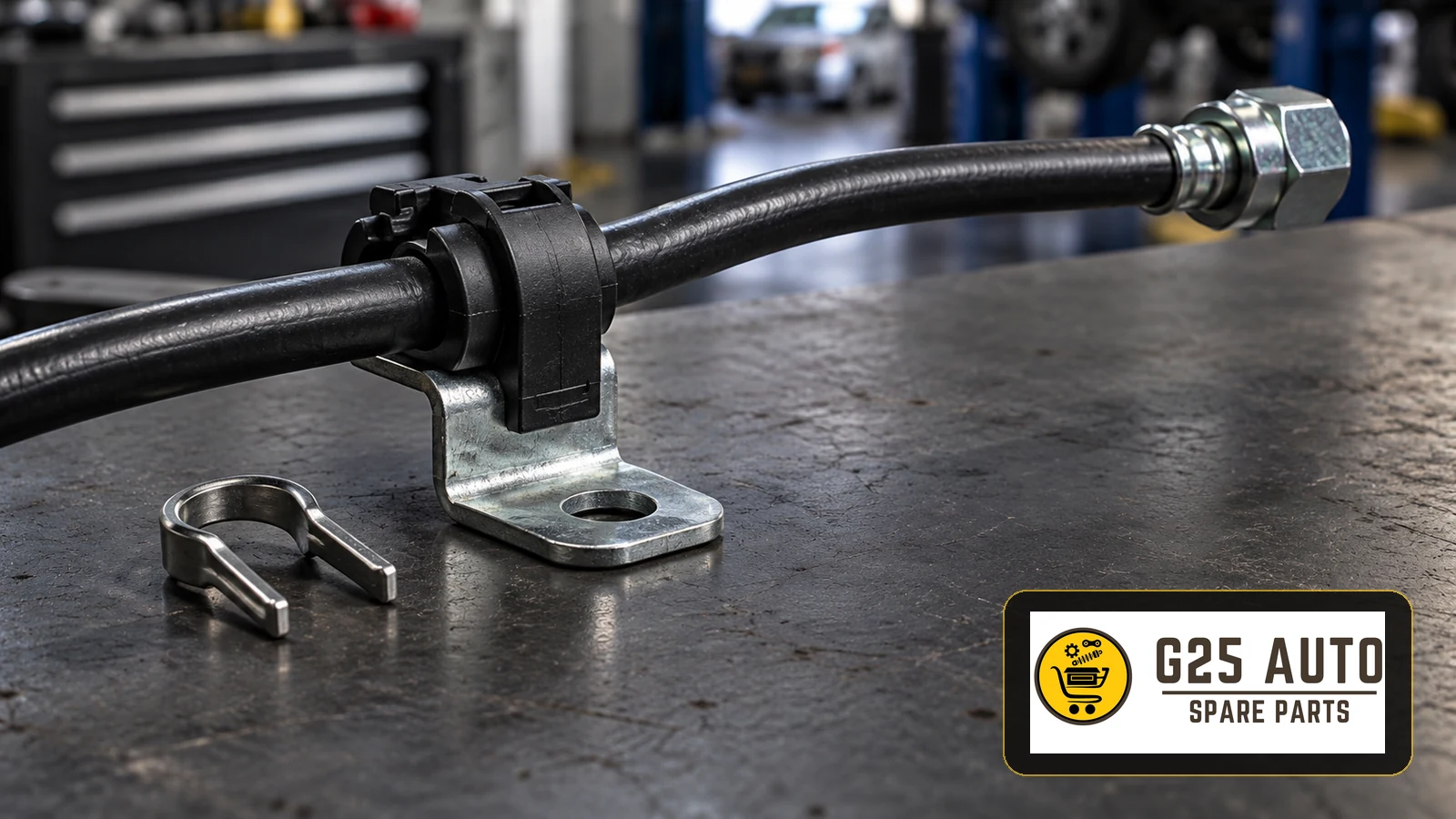
A clutch hydraulic pipe support clip holds the line in its intended route, while a connector retaining clip secures a hydraulic joint. Identify which component is damaged before ordering: a replacement support cannot repair a leaking connection, and a connector clip cannot restore missing pipe supports. For workshops and parts distributors across Europe and the Balkans, the correct enquiry combines vehicle and transmission identification with photographs of the clip, pipe and mounting location.
Distinguish the two types of clip
Pipe supports and routing retainers
These components position the pipe or hose along its specified path. Inspect the support together with its bracket or body attachment. A broken clip may leave a line displaced, but a new clip alone is insufficient if the mounting point is damaged or the pipe has already suffered wear. Check the complete supported section rather than treating the loose component in isolation.
Routing can affect more than appearance. Navistar’s 2019 hydraulic clutch routing bulletin describes a reservoir supply-hose arrangement that could trap air on specified North American trucks. It illustrates why the documented route matters; its revised clipping points and repair instructions are not a modification recipe for European passenger cars.
Hydraulic connector retaining clips
A retaining clip at a hydraulic connection locks the joined components together. Establish the connector design and the condition of its locking features and seals separately. Do not choose a retainer simply because its outline resembles the removed part.
ZF’s December 2018 service information on a modified CSC connection requires attention to the clip and associated connection arrangement. This is a specific replacement configuration, not evidence that all concentric slave cylinders use the same retainer or adapter.
Inspect the complaint before assigning a cause
Record the driver’s description of noise, altered pedal feel or difficult disengagement. Then document what the technician actually finds. A vibration or rattle does not establish that a pipe clip is the cause, and a missing support does not explain every hydraulic fault.
Inspect accessible line sections for displaced routing, rubbing marks, deformation and visible fluid. Examine the neighbouring bracket, attachment point and connector. Photograph damage before disturbing the arrangement, and identify any areas that cannot yet be assessed. If a line is wet, trace the leak rather than assuming it comes from the nearest clip.
Keep the findings separate on the job card: support condition, pipe condition and joint condition. This helps the parts desk distinguish a clip-only enquiry from a repair that also requires a line, connector or other component. Where leakage or impaired clutch operation is present, complete diagnosis and the required repair before returning the vehicle to service.
Build a precise parts enquiry
Provide the vehicle identification and configuration required by the catalogue, including transmission information where relevant. Add readable references from the existing components and photographs showing both the clip and its installed location. A vehicle model name or a photograph of a loose clip alone may leave important application questions unresolved.
Ask the supplier to confirm whether the required item is a routing support, bracket retainer or connector lock. Check whether it is available separately or supplied with another assembly. Record any replacement notes and required companion parts. The fitted component is useful evidence, but previous repairs mean it should be checked against current application information.
For an aftermarket proposal, request a documented application reference and fitting information. Do not treat a material description, company certification or an OE-supplier claim as proof of compatibility for this particular connection. If the proposed design differs, resolve the discrepancy before installation.
Workshop and distributor checklist
- Confirm the vehicle and transmission identification required for the application.
- Identify whether the clip supports the line or locks a hydraulic joint.
- Photograph the component, mounting point and surrounding pipe route.
- Record pipe wear, leakage and bracket damage separately.
- Check existing references against the current catalogue and replacement notes.
- Confirm which clips, seals, brackets or adapters are included in the proposal.
- Obtain the applicable installation and connection-check instructions.
- Retain the confirmed references and completed inspection findings with the job.
When a regional distributor relays an enquiry between languages, keep the catalogue reference alongside the component description. Mark unresolved questions explicitly and record any agreed substitution in writing. This gives the receiving workshop a traceable basis for accepting the supplied part.
Restore the arrangement and verify the repair
Follow the applicable repair information for access, clip release, installation and reuse decisions. Restore the specified routing and attachment points. Check that the line is supported as intended without being pulled into position by a mismatched clip. Do not improvise new mounting points or replace a connector lock with a general-purpose tie.
If the hydraulic circuit has been opened, obtain the required sealing and bleeding instructions. ZF’s hydraulic clutch bleeding guidance stresses manufacturer-approved fluid, cleanliness and the correct procedure. It also describes air-related pedal and disengagement complaints. Neither bleeding nor a new clip should substitute for investigating a damaged line or leaking joint.
Complete the specified connection, leak and functional checks. Record the fitted references and whether the original complaint has been resolved. An abnormal pedal response or continuing leak requires further investigation before the job is closed.
Frequently asked questions
Are all clutch pipe clips interchangeable?
No. Confirm the clip’s function, application and mounting arrangement. Similar appearance is insufficient evidence of compatibility.
Will a new support clip stop a fluid leak?
A support clip positions the line. Locate the leak and assess the pipe, connector and seals independently.
Must the complete hydraulic line be replaced?
Base that decision on inspection findings, parts availability and the applicable repair instructions. Do not assume either a clip-only repair or complete line replacement in advance.
Is there one installation method for connector clips?
No. Use the instructions for the actual connection, including its locking check and any replacement requirements.