
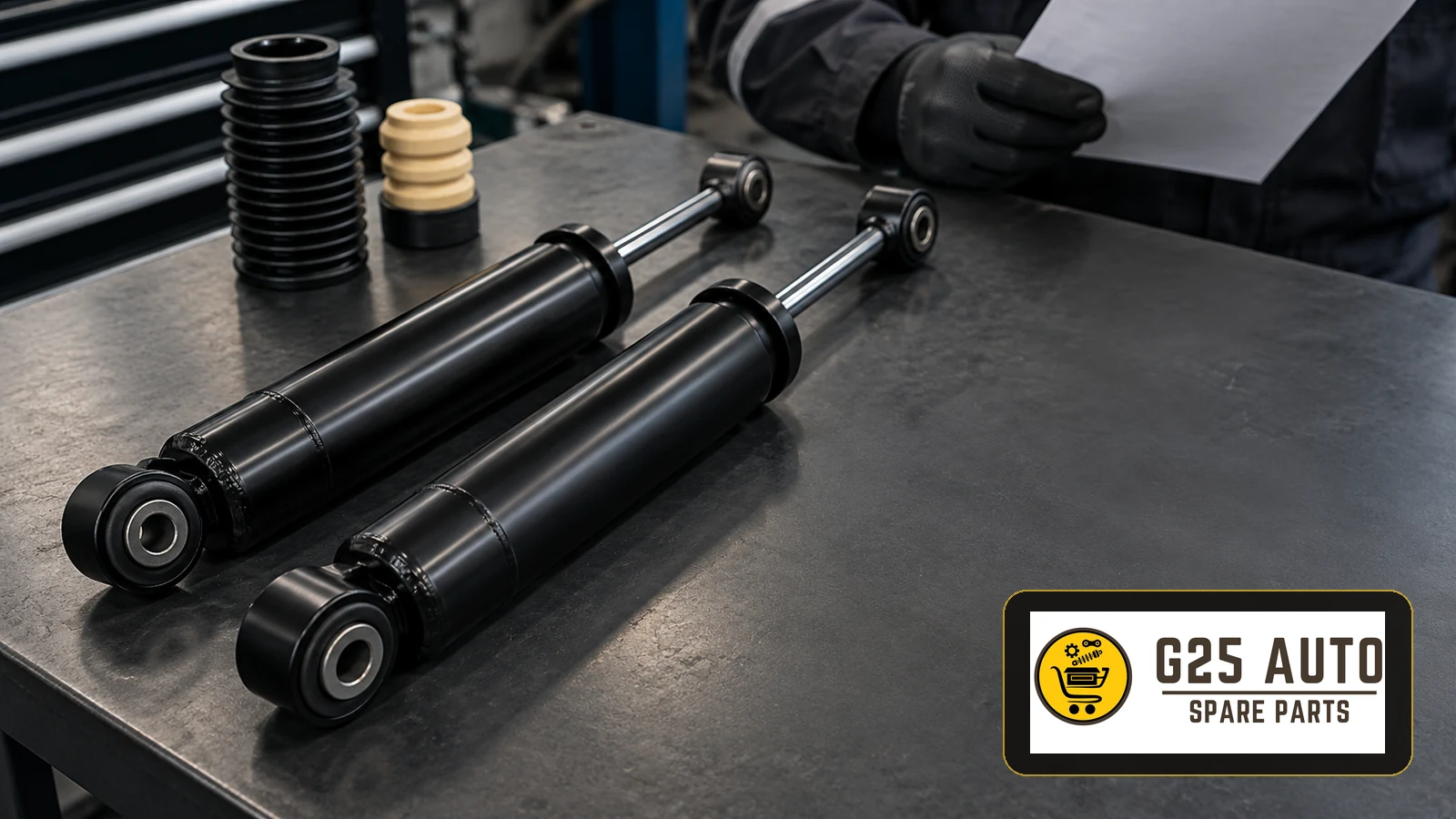
Choose a replacement shock absorber by confirming the vehicle’s exact suspension specification, installation position and manufacturer-listed application before comparing genuine and aftermarket offers. For European and Balkan workshops, fleet buyers and distributors, the useful comparison is a documented repair package: the correct dampers, associated components, fitting information and written commercial terms. A familiar brand or a similar-looking housing alone does not establish suitability.
Understand what the damper must control
A shock absorber controls suspension movement by resisting the flow of hydraulic fluid through valves. Gas-pressurised designs also use hydraulic fluid; the gas supports the design’s operation rather than replacing the oil. Springs support the vehicle’s weight, while dampers control oscillation. This distinction matters when a vehicle sits unevenly: the workshop must investigate the spring and supporting components instead of assuming that a replacement damper will restore ride height.
Monotube, twin-tube and electronically controlled units have different construction and diagnostic requirements. Their appearance is not a reliable guide to interchangeability. BILSTEIN’s failure-analysis guidance explains why technicians should identify the system before interpreting its symptoms.
Confirm the fault before requesting quotations
Repeated body movement after bumps, unusual tyre wear, noise and changes in handling justify a suspension inspection. These observations should accompany the job record, alongside the conditions in which they occur. Tyres, springs, mounts and other suspension components also need consideration. A driver report or a manual bounce check alone cannot identify the correct replacement part or establish the full repair scope.
Separate normal misting from leakage
A light oil film can occur during normal seal lubrication. Substantial wet oil traces or dripping require a different assessment. Inspect the unit when dry and distinguish damper fluid from external contamination. Follow the relevant manufacturer’s inspection criteria; Monroe’s weepage and leakage guide illustrates the difference. Record the finding rather than labelling every oily surface a failed shock absorber.
Use the vehicle’s service information and the measured condition to plan work. A universal age or mileage rule cannot establish the condition of every application. Where handling is unsafe, the workshop should determine how the vehicle can be moved and assessed safely before any road evaluation.
Match the complete suspension specification
Identify the vehicle and the installed system
Start with the VIN, model, production information and the suspension option identifiers required by the parts catalogue. Confirm front or rear axle and any left/right distinction. Resolve catalogue notes for standard, sport, raised or other suspension variants before ordering. An old part reference can support identification, but a previously fitted component may itself be incorrect.
Retain the catalogue result and its application notes with the quotation. If details conflict, ask the supplier to resolve them in writing. Photographs of mounting features and electrical connections can support that discussion. They supplement the vehicle data and catalogue lookup; they do not replace them. The KYB Europe catalogue is one example of a manufacturer application resource.
Keep electronic damping requirements explicit
For electronically controlled suspension, confirm the system and the replacement manufacturer’s listed application. Include electrical connections and any vehicle-specific diagnostic or commissioning requirements in the repair plan. A fault-free electronic scan does not exclude mechanical wear. ZF’s CDC workshop guidance describes the need for both mechanical assessment and electrical diagnosis. Obtain a documented technical solution for any proposed system conversion before considering an alternative arrangement.
Compare genuine and aftermarket offers on evidence
Ask each supplier to identify the exact manufacturer and product reference, confirm the intended application and provide the relevant fitting information. Read claims such as OE quality alongside the product documentation. They do not independently confirm that a particular reference matches the vehicle in the workshop.
For a workshop buying across European and Balkan markets, a comparable quotation should state what is included, what is supplied separately and who handles a technical query or return. Check warranty conditions, availability and delivery expectations directly with the supplier for that order. Keep the written response with the job. Do not infer those terms from the brand, country of sale or a previous purchase.
Specify whether the objective is restoration of the original suspension behaviour or a separately assessed modification. Descriptions such as comfort, sport or heavy duty need application-specific documentation. A driving-style preference alone is insufficient to select a different damper specification.
Purchase-order checklist
- Vehicle identity: VIN and catalogue-required production and suspension details recorded.
- Application: exact product reference, axle, side and all catalogue restrictions resolved.
- System: passive or electronically controlled damping confirmed.
- Axle package: matching replacement dampers specified as an axle pair.
- Associated components: springs, mounts, bearings, protective boots and compression stops assessed; replacements listed individually.
- Fitting requirements: required hardware, tools and current installation instructions identified.
- Completion: applicable geometry checks and electronic procedures included in the workshop scope.
- Commercial record: supplier confirmation, warranty terms and order-specific availability retained.
Plan installation and handover together
KYB recommends replacing shocks and struts in pairs to avoid different damping behaviour across an axle. Check surrounding parts as part of the repair: ZF identifies mounts, springs and protection components as relevant complementary suspension components. Confirm the replacement scope against inspection findings and fitting instructions.
The technician should follow the vehicle and component manufacturers’ procedures, including safe spring handling, specified tightening and any required alignment or electronic checks. At handover, retain the fitted references and completion record. This gives the workshop, fleet operator and distributor a shared basis for any later technical enquiry.
Frequently asked questions
Does a gas shock absorber contain oil?
Yes. Gas-pressurised dampers still use hydraulic fluid for damping. The gas description alone does not establish suitability for a vehicle.
Can I select a damper from a photograph?
A photograph can help resolve features, but selection requires the vehicle specification and the manufacturer’s application information.
Is every aftermarket alternative equivalent?
No blanket claim is appropriate. Assess the exact reference, documented application, fitting requirements and supplier terms for the proposed order.
Should the quotation include more than dampers?
Yes. It should identify the axle pair, associated parts justified by inspection or instructions, and the work needed to complete and verify the repair.