
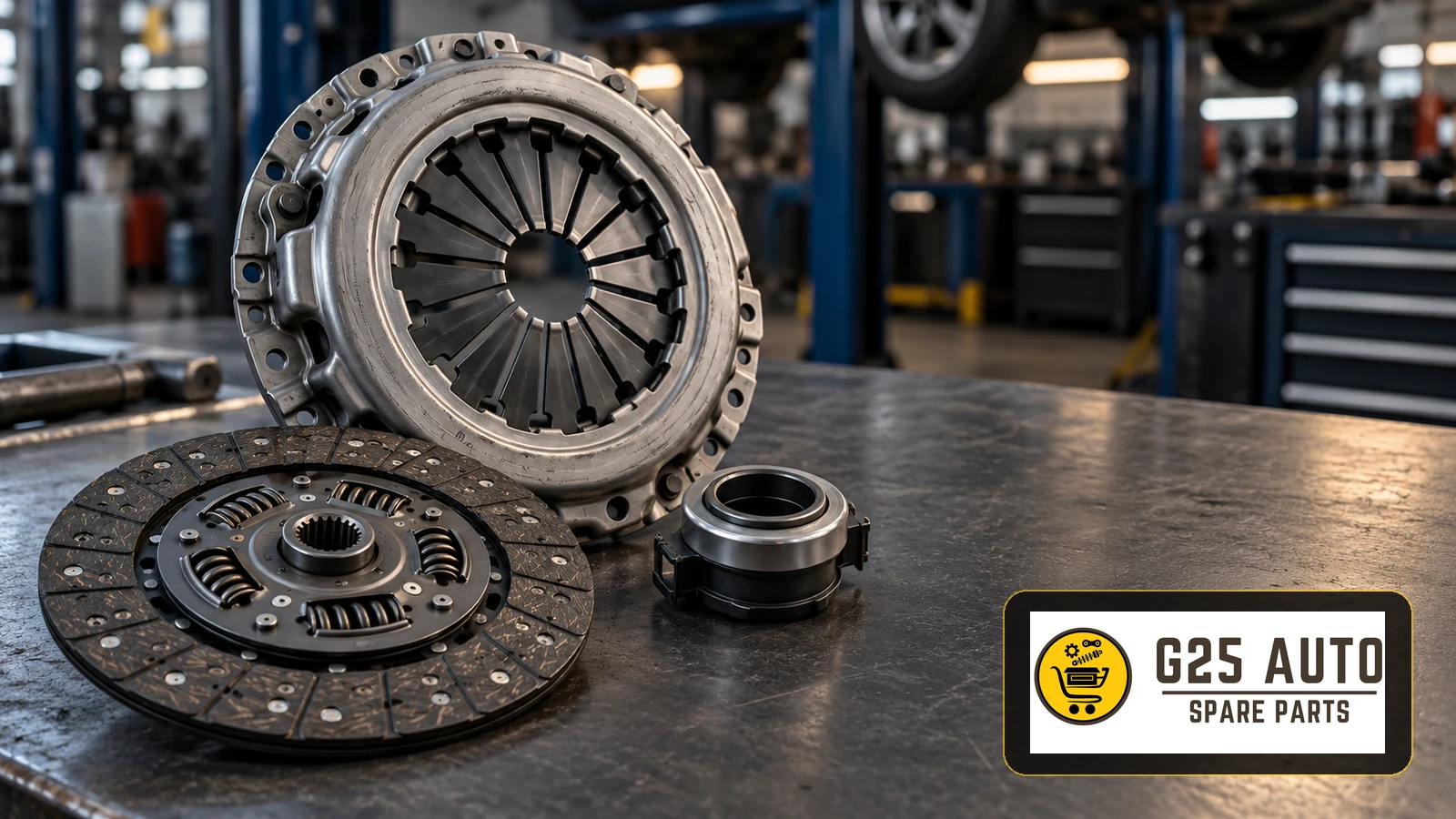
Choose a clutch kit by matching the vehicle’s engine, gearbox, flywheel and release system to the current parts catalogue, then confirm exactly what the box contains. Model name and engine capacity alone are insufficient. For European and Balkan workshops, distributors and fleet buyers, a clear application record should connect the vehicle identification, the selected kit and the repair instructions before an order is released.
Define the clutch assembly you are buying
Disc and pressure plate
In a conventional dry manual clutch, the disc works between the flywheel and pressure plate to transmit torque to the gearbox input shaft. The pressure plate provides the clamping action. Disc dimensions, hub splines and cover mounting geometry are application details to verify, rather than features to estimate from a photograph. A visually similar assembly can still be the wrong choice.
Release bearing or concentric slave cylinder
The release arrangement must also match. A separate release bearing and a concentric slave cylinder are different purchasing requirements: the latter combines the bearing and hydraulic slave cylinder in one assembly. ZF’s passenger-car clutch overview describes these arrangements and its different repair-kit options. Check the individual kit listing; the word “kit” does not establish whether a bearing, hydraulic unit, flywheel or fasteners are included.
Diagnose the complaint before specifying the kit
Record what happens, when it happens and what has already been checked. Separate slipping under load, difficulty disengaging, take-off vibration and pedal-related noise in the job record. These observations help the technician define the investigation; they do not establish a parts order by themselves.
ZF’s disengagement diagnosis guide identifies release-system faults, a jammed pilot bearing and installation problems among possible causes of incomplete disengagement. Replacing the disc and cover without addressing the confirmed cause can leave the original complaint unresolved. Ask the workshop to identify which findings support the proposed repair and which checks remain outstanding.
Build an application record that survives a handover
Start with the VIN, build information and engine and gearbox identification available for the vehicle. Check these against the catalogue’s application notes and production breaks. A VIN is an identification input, not evidence that every installed component is unchanged. Where earlier repairs or conversions are suspected, ask the technician to establish the installed configuration.
Record existing component references where readable and verify any replacement or supersession through the relevant catalogue. Treat an OE cross-reference as supporting information within that application check. It does not, by itself, explain the contents of a replacement kit or resolve contradictory gearbox information.
Keep the flywheel decision explicit
Identify whether the repair concerns a single-mass or dual-mass flywheel arrangement, and document the workshop’s assessment against the applicable instructions. Do not assume the flywheel is serviceable because a new clutch has been ordered. Equally, a buyer should not turn a noise report into an automatic flywheel replacement instruction. Leave inspection limits and replacement decisions to the relevant technical documentation and qualified assessment.
If a conversion has been proposed, request the exact application documentation for that engineered solution before approving a substitution. Keep that decision visible on the order rather than letting a supplier substitute components on appearance alone.
Pre-order checklist for workshops and distributors
- Vehicle identity: record the VIN, build information and the workshop’s engine and gearbox identification.
- Catalogue match: retain the selected application and any restrictions or unresolved discrepancies.
- Installed configuration: establish the flywheel and release arrangement, including evidence of earlier changes.
- Component match: verify the disc, cover and release-unit requirements using documented application data.
- Box contents: list the included parts and identify any separately required items.
- Repair readiness: confirm that the workshop has the relevant instructions and required tooling.
- Substitution control: require a documented application check before accepting an alternative kit.
- Traceability: connect the supplier reference, packaging identification and workshop job number.
Check the parts before the gearbox goes back
Inspect delivered packaging and components before installation, and resolve any discrepancy against the order. ZF’s clutch installation guidance highlights transport damage, disc runout checks, accurate centring, surrounding release-component wear and clean friction surfaces. Use the applicable specifications for the actual assembly; this is not a universal fitting procedure.
Self-adjusting covers deserve particular attention. ZF’s XTend service information distinguishes several passenger-car designs with different handling and tooling requirements. Do not transfer one design’s locking or adjustment instructions to another.
For a cross-border B2B handover, send the confirmed component references and relevant technical documents with the job record. Record inspection findings and the prescribed completion checks. This gives the receiving workshop, distributor and fleet contact a shared account of what was selected, installed and checked.
Frequently asked questions
Can I choose a kit using only the registration year?
Use it as a starting point. Complete the application check with vehicle, engine, gearbox and catalogue information before authorising the order.
Does every clutch kit include a release bearing?
Check the exact listing and parts list. Ask the supplier to resolve missing or ambiguous information before the workshop schedules installation.
Should the flywheel always be replaced with the clutch?
Base the decision on the applicable repair instructions and assessment of the installed flywheel. Record that decision separately from the kit selection.
What should a distributor do when two catalogue matches remain?
Hold the order and request the missing identification or technical clarification. Record the answer so the next person handling the enquiry can follow the selection.