
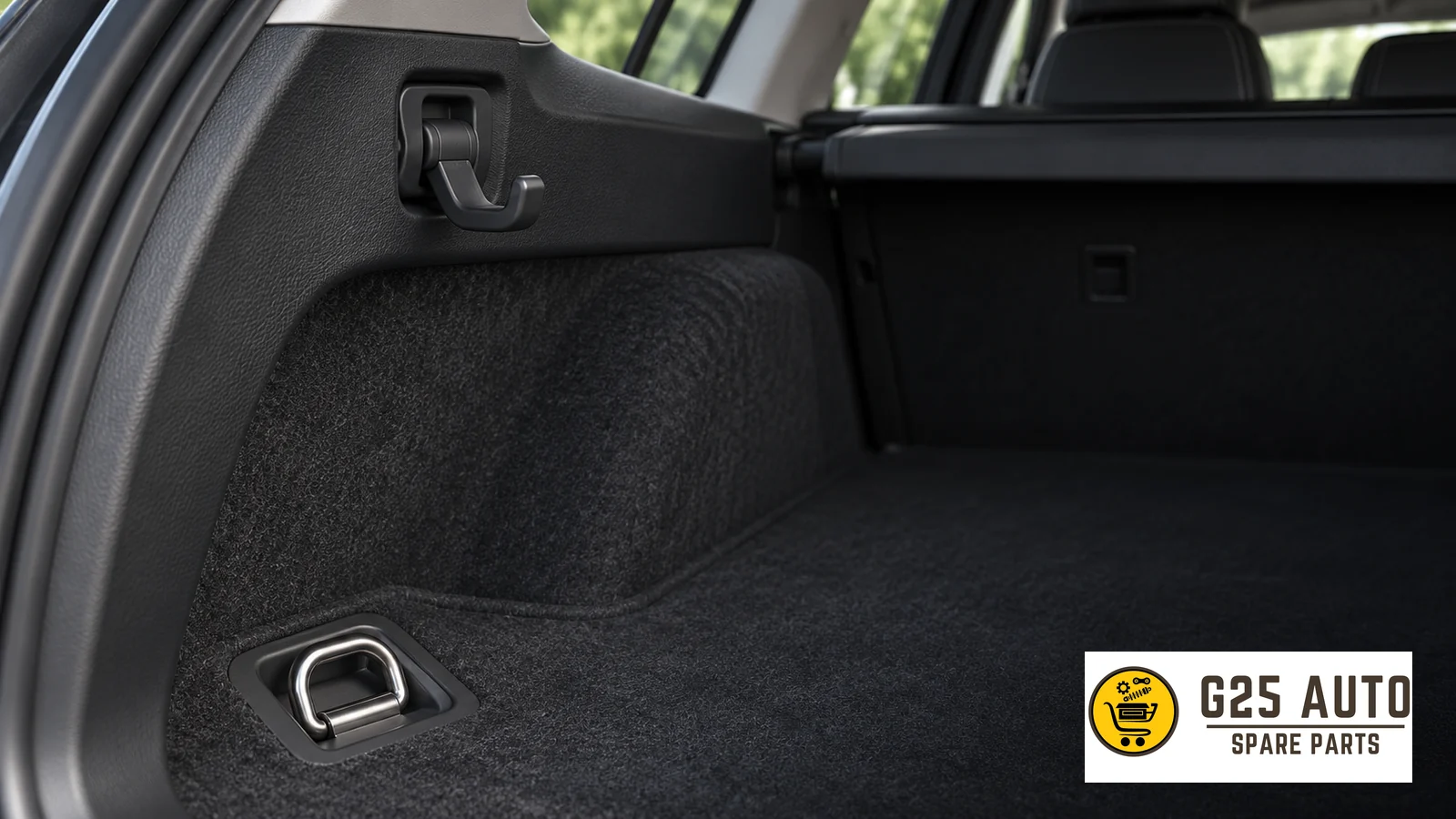
Short answer: Points shown as cargo tie-down rings in the vehicle owner’s manual are used to secure items with straps as the guide permits. The bag hook helps keep shopping bags upright as the manufacturer describes. Do not try to distinguish the two connections by looking only at their shape, material or location. Open the trunk diagram, find the points specific to your vehicle and follow the manufacturer’s instructions for the cargo to be carried.
How to understand the function of trunk parts?
A hook on the trunk side trim, a ring near the floor and different storage compartments may be found. Even though these parts are close to each other, their functions may be separate. In some Volvo vehicle owner’s manuals, rings near the floor for strap securing and side hooks to help prevent bags from tipping over are shown separately. Do not assume this layout is the same in all vehicles. Open the diagram corresponding to the model, year and trim of your vehicle.
In the owner’s manual, first go to the trunk or loading section. Compare the arrows in the diagram with the vehicle’s floor and side panel layout. When you cannot find a point in the diagram, there may be a trim difference or a different cover. Do not attach a strap to a protrusion that does not match the manufacturer’s description. A ring looking metal or feeling solid does not indicate its suitability for the load you plan to carry.
Difference between bag hook and cargo ring
| Part or area | Description to look for in owner’s manual | How to evaluate? |
|---|---|---|
| Cargo tie-down ring | Strap cargo securing point, usage condition and any limits | Verify the point shown in the guide and strap suitability |
| Bag hook | Function of keeping bag upright and maximum load if any | Evaluate hook only for documented use |
| Side pocket or under-floor compartment | Storage instruction manufacturer provides for compartment | Check whether separate securing is needed for trunk load |
| Trunk cover or separator net | Covering, dividing or separating function | Read its function separately from securing load with strap |
For example, when returning from the market, the vehicle’s bag hook may work for a bag prone to tipping. If you are considering attaching a tool bag or suitcase to the same hook, check the owner’s manual again. If the manufacturer has designated the bag hook for shopping bags, use the connection points and method shown in the guide to secure the item as cargo. If the bag’s contents do not meet the conditions in the guide, choose a different placement.
Repeat the check when trunk floor changes
In some trunks, the floor panel can be positioned in different locations or there may be a storage compartment underneath. When the floor position changes, the ring you previously used may not be visible. In this case, check the layout in the guide instead of switching to another nearby hook. If a strap connection point is covered by a trim piece, first find the manufacturer’s instructions for that configuration. Do not force the cover by guessing the location of a hidden part.
Sequence that can be followed before loading
- Separate the items. Handle each piece such as bags, closed cases and hard boxes. Plan which items need to be secured inside the trunk.
- Open the vehicle’s loading instructions. Read maximum load, placement, visibility and seat configuration warnings if any. Look for vehicle-specific limits in the document provided by the vehicle manufacturer.
- Find the correct point. Visually identify the points marked as cargo rings in the owner’s manual. Evaluate together the connection type permitted by the guide and the strap’s own instructions.
- Complete the placement. Follow the position and weight distribution directed by the manufacturer. Also read the warnings in the guide for placement of hard and pointed parts.
- Review before moving. Check the points where the strap is attached, the load placement and that the trunk closes properly. If the vehicle guide requires straps to be rechecked during the journey, do so at an appropriate stop.
Re-read the plan when rear seats are folded
Folding the seats to carry longer items changes the area where the load is placed. Instead of using the connection point and item position you chose for the previous configuration as is, check the owner’s manual section on loading with folded seats. Some manufacturers specifically emphasize strap securing in this situation. Evaluate which items can be placed where, together with the warnings given for passengers and visibility.
If the seats are to be returned to the upright position, perform this operation according to the vehicle owner’s manual. After the trunk configuration changes, check whether items or straps are touching moving parts. If carrying will continue, review the connections again in the new configuration. Saving a photo of the previous setup may be helpful, but checking the new placement is still done on the actual points on the vehicle.
Example preparation for two different items
Suppose you are carrying a shopping bag and a tool case with latched lid in the trunk. First look at how the bag hook is described in the owner’s manual. If the bag and its contents match this description, consider using the hook. Make a separate plan for the case. First find the area the manufacturer has indicated for placing the load, then the cargo rings permitted to be used. The case being closed does not by itself prevent it from moving inside the trunk. Apply the specified securing method to keep the case in place during transport.
Before departing, inspect the trunk from the rear again. Confirm from the diagram that the connection points belong to the correct parts. If an item is under a strap, compare how the strap should be threaded and the connection to be used with the product instructions. Keeping a strap in the trunk and using it correctly at the correct point are different steps. If a new item is added during the same journey, acknowledge that the load has changed and check the placement again.
In this example, the hook and ring being close to each other is not a selection criterion. The decision is determined by the item’s function, the vehicle’s owner’s manual and the described function of the connection used. Saving the descriptions of the two parts separately on your phone can make it easier to find the correct point when you return to the vehicle later.
Frequently asked questions
Can I attach a strap directly when I see a metal ring?
First find the same point in the diagram in the owner’s manual. After reading the manufacturer’s connection type and usage limit if any, select the appropriate strap. Material appearance alone does not provide usage information.
What should I do if I cannot see a load limit on the bag hook?
Check the owner’s manual for your model or the manufacturer’s support page. If the document does not provide a carrying limit, do not determine a value yourself. For a heavy item, follow the vehicle manufacturer’s cargo securing instructions.
Does the panel covering the trunk also secure items?
Read the panel’s function from the description in the guide. If the manufacturer describes it as a cover, plan the load securing separately. Apply the instructions given for cargo ring, strap and trunk cover separately.
Can ring placement from another vehicle be used as an example?
Another vehicle’s diagram can help you see how these parts are named. However, match the point you will use in your own vehicle’s guide and with the actual layout in your trunk.