
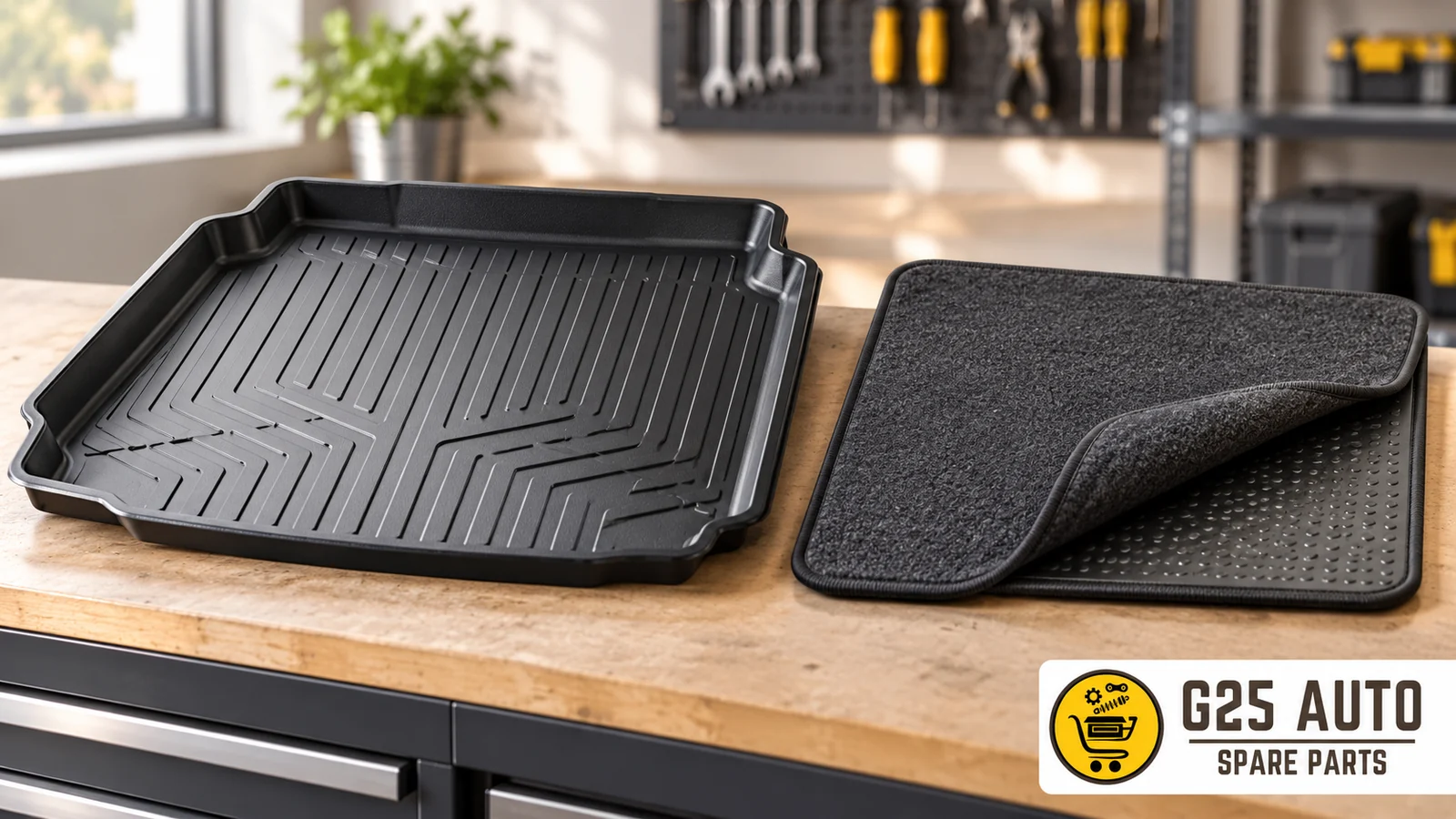
Short answer: When selecting a cargo liner or cargo mat, check the product name, full reference, and application description for your vehicle’s cargo configuration together. Do not treat a double-sided mat and a moulded cargo liner as the same product. Similar outlines in photos do not prove the correct reference. Request the package contents and offered option in writing from the seller; do not carry undisclosed features from another product listing.
Determine which product you are looking for your cargo area
Define your need before starting your search. Is the product you are looking for a mat for the cargo floor, a protector offered as a liner, or a specific part of an existing product? Instead of only telling the seller your vehicle model, explain which area in the cargo you are looking to cover. Do not use the generic name in the listing title instead of the full product description. Read the offer text and the shown product together.
If there are multiple options, also record the name of the option you selected. Do not assume all images appearing on the same page belong to a single package. Request the unfolded or unrolled state and label of the product shown folded or rolled. Ask whether the packaging visible in the photo and the reference in the listing belong to the same product. Information belonging to one product does not automatically fill the fields of another option; evaluate each offer with its own description.
Do not confuse product types distinguished by the manufacturer
Volvo’s official accessory page presents the double-sided cargo mat and the plastic cargo protector under separate headings. In the double-sided example, it is stated that one side is textile and the other side is plastic. This description belongs to the product example on the page; the same structure cannot be assumed for every product offered under the cargo mat name.
Do not read this example as a material selection requirement or general quality ranking. Determine which features are actually present in the description of the product you are examining. The seller writing only cargo liner does not indicate that the product is double-sided. The double-sided name also does not verify a specific vehicle application. Treating product type, application, and package scope as three separate questions enables you to make a clearer comparison.
Record vehicle and cargo configuration separately from the reference
Record your vehicle’s model and version information in one field and the full reference of the offered product in another field. If an option regarding cargo configuration is asked, answer it based on documentation for your own vehicle. Instead of naming a floor position from a photo, send the seller a photo of the current configuration and verified vehicle information. Clarify which product reference the seller associates the description with.
Do not transfer an application note valid for one option to another option. The presence of the same model name in the listing does not prove all versions are covered. If the code on the label is unreadable, request a clearer photo. Keep the seller’s stock code and the manufacturer reference separate; do not assume yourself that one code substitutes for the other. If different codes appear in the product description, ask the seller to explain why they are written together.
Examine product features as record fields, not claims
Note fields such as color, surface description, folding explanation, and coverage exactly as they appear in the offer text. Do not finalize undisclosed features by looking at the photo. An image of one side may not show what the other side is like; request necessary visuals separately. Record how the color name is specified by the manufacturer or seller. Do not evaluate the on-screen image alone as proof of exact color match.
If information about cleaning or care is needed, request the product’s own documentation. Do not transfer the method given for another mat to this product. If measurements are present in the sales description, check the source and which product they belong to; do not estimate missing measurements. This article does not recommend any cleaning agent, technical measurement, or service life. The purpose is to show which information is verified and which question remains open.
Compare offers with the same fields
| Verification field | Information to record | Action if missing |
|---|---|---|
| Product type | Liner or mat description | Ask for full definition |
| Reference | Code on label | Request readable visual |
| Vehicle application | Application in product documentation | Do not generalize from model name |
| Selected variant | Option ordered in offer | Clarify in writing |
| Package scope | Parts actually to be shipped | Do not assume from photo |
Add the offer link, discussion date, and seller who sent the description to the table. Do not copy a filled row from one offer to replace a blank field in another offer. Two products being offered for the same purpose does not mean all their features are identical. Specify which field is based on documentation and which on the seller’s written response. Leave rows awaiting response visible; do not add estimated information to complete the table.
Questions that can be asked before ordering
- What is the full product reference and selected variant of this offer?
- Can you share photos showing the label and the product in its unfolded state?
- Can you list the parts to be shipped in writing?
- On which document are you basing the application description for the vehicle and cargo configuration I shared?
- Can you provide the care and use documentation for the product?
Collect responses in a single order record. If the seller suggests a different product during discussion, record the new reference separately; do not transfer the features of the previous offer to the new product. When general answers such as it fits or same product arrive, ask which reference is meant. Do not finalize the record without clarifying which offer and which variant is the final choice.
At delivery, compare with the record instead of similarity
When the product arrives, compare its label and the parts actually shipped with the order record. Check the relationship between the description on the packaging and the selected variant. If you see a different reference or unclear scope, record it with photos and send the concrete question to the seller. The product resembling your expected form does not automatically verify other open fields. Add the received documentation to the same order record as well.
Frequently asked questions
Are cargo liner and double-sided mat the same?
Read the product definition in the offer. Do not derive equivalence from generic names; ask the seller to explain the structure and scope of the relevant product with documentation.
If the model name appears in the listing, is the application verified?
Check the full product reference and application documentation. Separately clarify that the selected variant covers your vehicle information.
Is a single photo in the listing sufficient?
Request readable visuals showing the label and necessary sides. Do not add features not visible in the photo by estimation; record the package scope in writing.
What is recorded if the option in the offer changes later?
First check with which option your order was created. Do not use a later-changed page description as if it were the content of a past order. Keep your order summary and the seller’s written response together. If the new offer contains a different reference, record it as a separate product and ask the same questions again. This way you can establish a clear relationship between the documentation you look at on delivery and the option you actually purchased. Do not mark as resolved differences not explained in the discussion either.
Source: Volvo Cars — Luggage Compartment Mats. Verification: October 31, 2026. The manufacturer example is limited to the product description on the relevant page.