
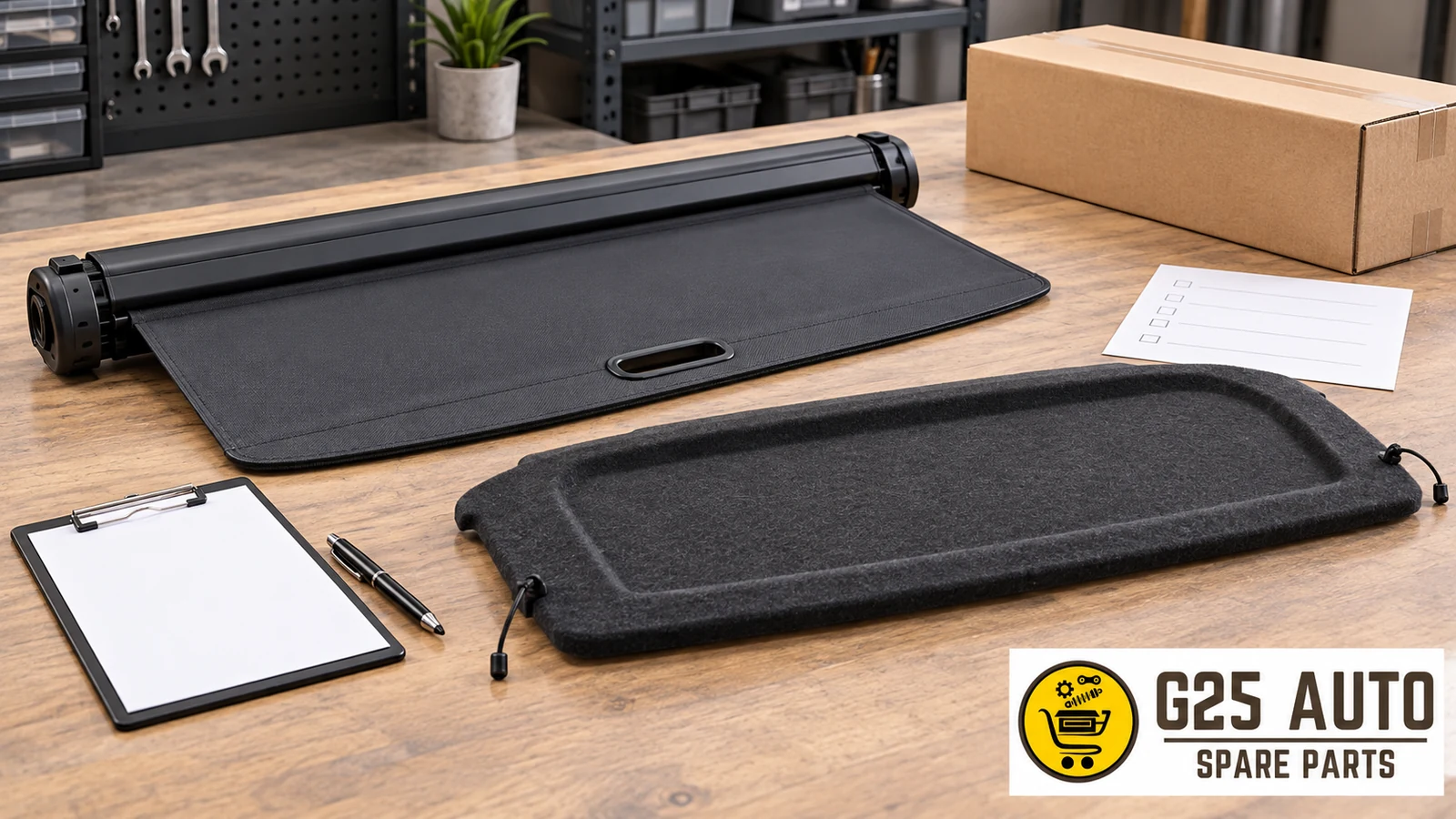
When sourcing a cargo cover and parcel shelf, you must systematically verify the product matches your vehicle body type, validate the reference number, and confirm complete package contents. The seller’s compatibility statement alone is not final approval; you must identify your own owner’s manual, compare product references, and record whether all mounting parts are included in the package list. Upon delivery, check documents against order details before use and archive seller responses.
Determining Vehicle Body Type and Owner’s Manual
The first step is to precisely determine your vehicle’s body type and the relevant owner’s manual variant. Do not accept general names such as station wagon, hatchback, SUV or crossover as proof of match. Instead of communicating only the model name to the seller, provide the body and equipment information you have verified for your own vehicle. Note your manual’s print date, section number, and for which engine or equipment package it was written. For example, the selected manual shown on the Volvo support page as V60 2021 explains the cargo cover’s full covering and loading positions, warns that objects must not be placed on the cargo cover, states that the loading position may obstruct rear visibility, and specifies that the cover must be either fully extended or fully retracted while driving. This information applies to that particular manual and variant; do not generalize for different years or versions.
Photocopy or save a digital copy of the relevant section in your manual. When contacting the seller, state which manual version you are using. Express your body type not just with a general category, but with the manufacturer’s official designation. Using the exact description from the manual rather than ‘station wagon’ reduces ambiguity.
Seller Product Naming and Reference Number Distinction
Sellers use different names for cargo cover and parcel shelf products: terms such as ‘cargo cover’, ‘parcel shelf’, ‘luggage compartment cover’, ‘retractable shade’ may appear. Do not assume these names represent universal designs. Each seller’s product name is specific to their own catalog system. What truly matters is the manufacturer’s reference number.
Request the complete reference number from the seller in writing. Record the entire code, including any separators and suffixes, without alteration. At the same time, show the seller the reference number you verified from the catalog for your vehicle and ask ‘Is this compatible with this reference?’ If the seller simply says ‘compatible’, that is not sufficient; learn on which document they base the compatibility. You may request the cross-reference table from their own records.
Apply the same method for the parcel shelf. Ask the seller whether the parcel shelf and cargo cover refer to the same product or separate products. If separate products are offered, record each reference; do not infer from the title that both parts will be delivered together.
Package Contents and Mounting Parts List
Separately inquire which mounting components are required besides the main part and which are included in the offer. End piece, clip, socket or bracket names are question examples below; do not assume these exist in every vehicle or come in every package. Request the package contents list from the seller in advance. This list should include:
- Main cargo cover unit (quantity and reference)
- If a separate parcel shelf panel is offered, its quantity and reference
- End caps or side mounting parts (left/right distinction)
- Fastening components (quantity, type code)
- Guide rail or socket parts (if applicable)
- Instructions for use or diagram
When you receive the list, confirm the quantity of each item. General statements such as ‘all necessary parts included’ are not sufficient. Rather than assuming whether end parts are included, you want to see them on the list. If the offer covers only the main unit, clarify how other required parts will be obtained before ordering.
Request photographs of the markings on the package from the seller. Visuals such as original manufacturer label, barcode, reference number print contribute to compatibility confirmation. However, even these visuals do not count as final compatibility approval; they are for record purposes. If you see damage, scratches or color differences on the product in photographs, record these separately, but do not attempt to diagnose the cause or effect of the damage. Report the condition you observe to the seller and request explanation.
Comparison Table for Two Different Offers
When you receive offers from multiple sellers, you need to make a systematic comparison. The following example table provides a realistic comparison, including unknown fields:
| Verification question | Offer A record | Offer B record |
|---|---|---|
| What is the manufacturer reference? | Awaiting response | Awaiting response |
| Is there vehicle-specific matching documentation? | Document to be requested | Document to be requested |
| What are the package items and quantities? | List to be requested | List to be requested |
| Are mounting parts included? | Not yet known | Not yet known |
| Was label photograph shared? | To be checked | To be checked |
| Was missing documentation question answered? | Response to be recorded | Response to be recorded |
Fields showing ‘Information unavailable’ or ‘Not specified’ in the table indicate unanswered questions. Submit these gaps to the seller as written questions and record the responses. If no response comes or it remains unclear, take this into account in your decision process.
Pre-Order Documentation and Question Records
Before placing an order, archive all correspondence with the seller. Record every question asked and response received via email, messaging platform or order notes with dates. When you receive ambiguous answers, ask again and request clarification. For example, if the seller says ‘Product is suitable for your vehicle’, ask ‘Can you specify based on which reference number or document it is suitable?’
Remember that the seller’s compatibility statement alone is not final approval. The seller may provide incorrect information or there may be catalog errors. Evaluate the usage warnings in the manual together with the vehicle-specific verified part reference; do not assume the manual will contain an order reference. Have seller responses added as extra notes to the order or associate them with the order number.
Receiving and Document Verification
When the product reaches you, perform the following checks before use:
- Observe whether there is damage, crushing or moisture marks on the package exterior. If so, photograph them, but do not make assumptions about internal damage.
- Open the package and compare against the package contents list. Count each item individually and check reference labels.
- Match the manufacturer label, reference number and barcode on the product with order details.
- Check whether installation instructions or assembly diagram are inside the package. If missing, request from seller.
- Verify left/right distinction of end parts and quantity count of fastening components.
- If you see any incompatibility, deficiency or unexpected difference, notify the seller before use and wait for resolution.
Keep the documents you receive upon delivery—invoice, shipping form, warranty certificate—together with order details and previous correspondence. You may need them in the future.
Archiving Owner’s Manual and Seller Responses
Even after installing the cargo cover and parcel shelf, do not discard your manual and seller correspondence. The usage positions, warnings and restrictions specified in the manual should remain as reference. Correspondence with the seller creates records you can refer to in case of possible incompatibility or deficiency in the future.
Create and back up digital copies. File paper documents in a way that prevents moisture and folding. If you experience any problem with the product, first refer to your own records to recall which reference you ordered, which package contents you received, and which compatibility statement the seller made.
Frequently Asked Questions
If the seller says ‘original equivalent’, do I not need to ask for the reference number?
Ask the seller what ‘original equivalent’ means in this offer; do not consider the phrase alone as product identification. You must absolutely request the manufacturer’s reference number. State that you want to see which document or cross-reference table the seller’s ‘equivalent’ statement is based on. Compatibility verification remains incomplete without a reference number.
What should I do if end parts are not specified in the package contents list?
Do not assume whether end parts are included. Ask the seller in writing ‘Are end caps or side mounting parts inside the package, or must they be ordered separately?’ Record the response. If separate ordering is required, learn the reference numbers and quantity count for these parts. If a deficiency occurs upon delivery, you can compare the order contents with your previous correspondence.
If the product I receive has a different code instead of the reference the seller specified, can I use it?
A different reference code is a discrepancy that needs clarification; do not treat this alone as definitive proof of incompatibility. Notify the seller of the situation before installing or opening the product and request explanation. Request a written response documenting why the code differs and its relationship to the ordered reference. If the explanation is insufficient, request in writing the return or exchange terms applicable to the order from the seller. Do not proceed with installation while ignoring the different code.
Source: Volvo V60 Selected Owner’s Manual – Cargo Cover Section (Accessed: October 31, 2026)