
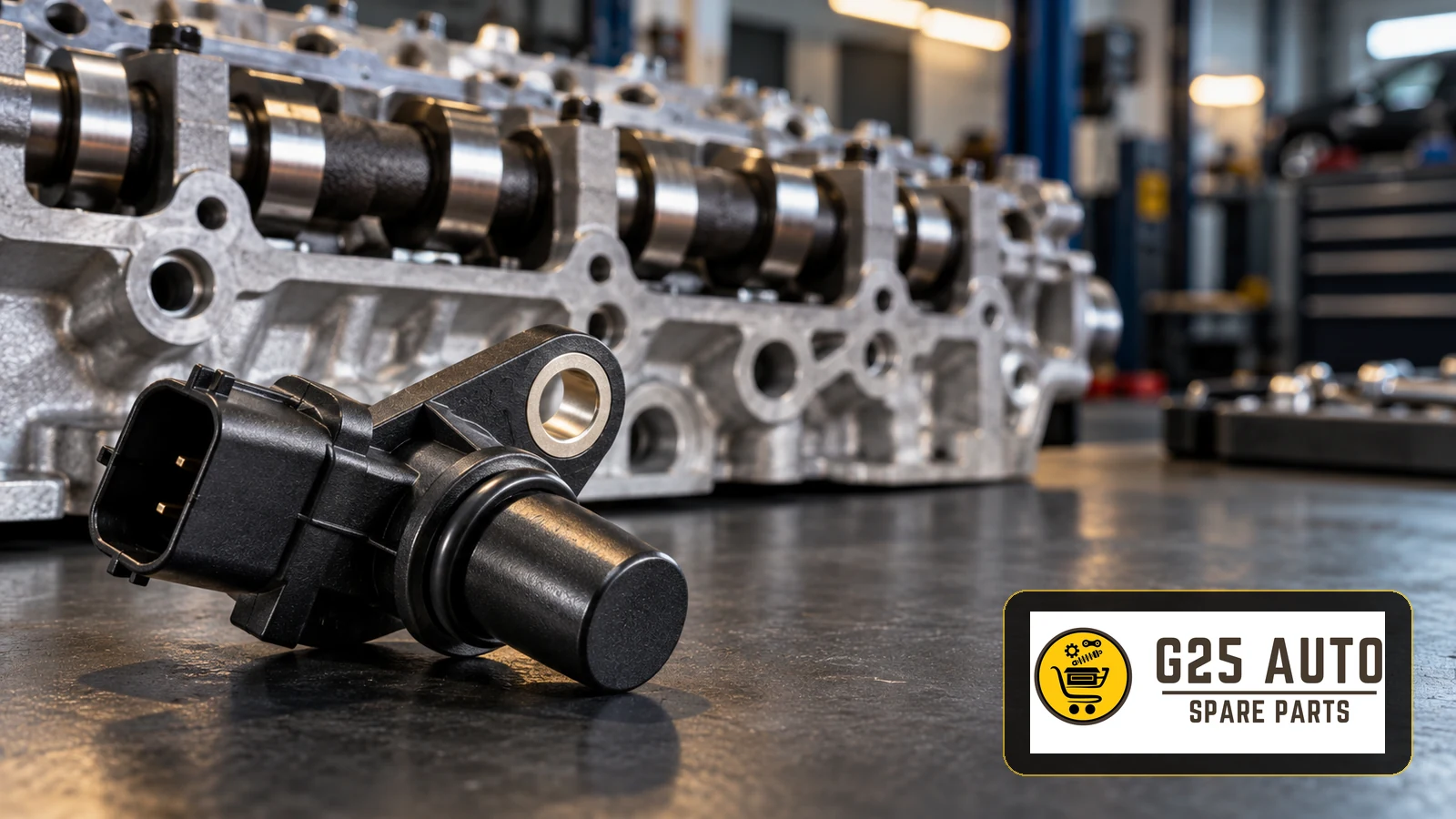
The camshaft position sensor sends camshaft position information to the engine control unit (ECU), supporting injection and ignition timing. A fault can cause reduced performance, difficult starting or stalling.
What Is a Camshaft Position Sensor and How Does It Work?
Usually located near the camshaft, this electronic component uses a magnetic or Hall-effect sensing principle to read a target or reference marks and report camshaft position.
It works alongside the crankshaft position sensor. Depending on engine design, the ECU uses these signals to coordinate injection, ignition and valve timing control.
Camshaft Position Sensor Fault Symptoms
Symptoms vary with the vehicle and whether the fault is intermittent or permanent:
Common Symptoms
- Engine warning light: The check-engine light may illuminate.
- Difficult starting: Extended cranking, sometimes after cold weather or prolonged parking.
- Unstable idle: Irregular running, vibration or stalling.
- Sudden power loss: Reduced power or uneven running while driving.
- Higher fuel consumption: Timing problems may reduce fuel efficiency.
- Increased emissions: Disrupted combustion may affect exhaust emissions.
- Acceleration problems: Delayed response or misfiring.
More Severe Faults
Some engines may not start. Others may enter a restricted-performance mode; its limits and behaviour depend on the vehicle.
Diagnosing a Camshaft Position Sensor Fault
These symptoms have several possible causes. Distinguish warning signs from a confirmed diagnosis.
Professional Diagnostic Methods
Fault-code reading: An OBD-II scanner retrieves stored codes. Interpret camshaft-signal codes using vehicle-specific diagnostic information; a code alone does not prove sensor failure.
Oscilloscope testing: Signal waveforms can help identify irregularities, including intermittent faults.
Resistance measurement: Use this test only where specified for the sensor type, comparing results with manufacturer data.
Wiring and connector checks: Broken wires, connector corrosion or short circuits can resemble sensor failure.
Original and Aftermarket Camshaft Position Sensors Compared
| Factor | Original part | Aftermarket part |
|---|---|---|
| Warranty | Check the applicable terms | Check supplier and manufacturer terms |
| Quality standards | Check the specified application | Review documented specifications |
| Compatibility | Verify the exact vehicle variant | Verify the application and electrical specification |
| Availability | Confirm for the reference required | Confirm for the reference required |
| Cost | Request a current quotation | Compare equivalent specifications and terms |
| Choice | Vehicle-brand parts channel | Alternative manufacturers may be available |
Checklist for Selecting the Correct Part
Before ordering a replacement, check:
- Vehicle details: Make, model, body type, engine capacity and engine code.
- VIN: Have the vehicle identification number ready for catalogue checks.
- Engine code: Different engines within one model may use different sensors.
- Production date: Changes can occur within a model year.
- Existing reference: Cross-check the sensor’s OEM or part number against application data.
- Electrical connector: Compare pin count and connector shape.
- Mounting details: Check dimensions and fixing points.
- Manufacturer references: Review the supplier’s technical documentation.
Why OEM and Part-Number Checks Matter
Vehicles sharing a make and model may use different sensors according to production date, engine or equipment.
What Is an OEM Number?
An original-equipment reference identifies a part for catalogue comparison. Related engines across brands may share references, but application data still requires checking.
Why the Part Number Matters
The existing reference helps compare original and aftermarket options. Similar-looking sensors can have different electrical characteristics.
VIN-Based Searches
A VIN lookup can help identify production details and equipment. Combine it with the engine code and current catalogue information; it is not an unconditional fitment guarantee.
Choosing an Aftermarket Sensor
Aftermarket options can broaden purchasing choices, but an incorrect specification can affect engine operation.
Assessing Aftermarket Quality
Review these points:
- Relevant manufacturer quality documentation.
- Detailed application lists and technical specifications.
- Clear warranty terms.
- Electrical characteristics appropriate to the application.
- Material and manufacturing quality.
Aftermarket does not automatically mean lower quality. Assess the particular product; a manufacturer’s original-equipment business does not establish equivalence for every sensor it sells.
Replacing a Camshaft Position Sensor
Access varies between vehicles. Some sensors are readily accessible; others require removal of surrounding components, potentially including the intake manifold. Follow the application-specific service procedure.
Checks After Replacement
Some vehicles require an adaptation or relearn procedure. Where specified, use suitable diagnostic equipment, clear fault codes after repair and confirm correct operation.
Frequently Asked Questions
Can a sensor fault make the vehicle unusable?
Some engines may not start; others may run with restricted performance using crankshaft data. Have the fault assessed promptly and determine whether continued driving is safe.
Can cleaning fix the fault?
Removing contamination may help in some cases, using the specified procedure. Cleaning cannot repair an internal electronic fault. Diagnosis should determine whether replacement is needed.
How often should the sensor be replaced?
There is no universal replacement interval. Follow vehicle maintenance information and replace according to confirmed condition. High-mileage vehicles may benefit from inspection.
Does an aftermarket sensor affect the vehicle warranty?
Check the vehicle warranty and repair terms before selecting a part. Correct specification and documented quality remain essential, including on vehicles outside warranty.
Should the camshaft and crankshaft sensors be replaced together?
Replace the component identified by diagnosis. Assess any additional replacement against the vehicle’s condition, service information and cost rather than assuming both are necessary.
Choosing a Reliable Parts Supplier
For European and Balkan B2B purchasing, assess technical support, product documentation and the applicable commercial terms.
Useful Supplier Checks
- Detailed product descriptions and specifications.
- VIN and OEM-reference checking support.
- Knowledgeable customer service and technical assistance.
- Clear warranty and return terms.
- Traceable packaging and relevant product documentation.
- Agreed shipping arrangements for the destination.
Conclusion
The camshaft position sensor supports engine management. Recognising symptoms helps, but professional diagnosis is needed before replacement.
Cross-check OEM references, part numbers, VIN, engine code and production date to reduce selection errors.
Compare original and aftermarket options through documented specifications and supplier support.
Prompt investigation of symptoms can help prevent a small concern from becoming a more disruptive repair.