
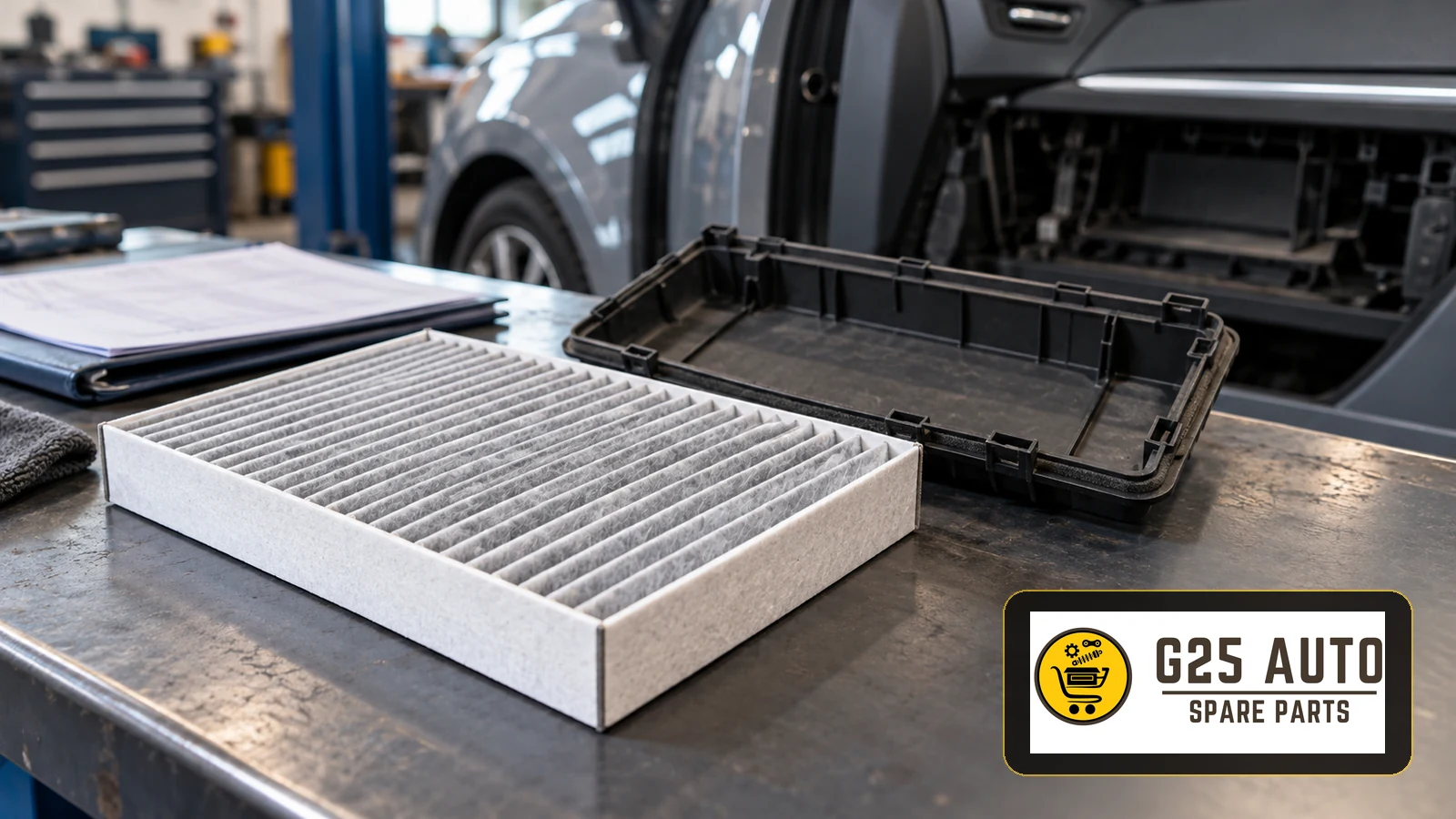
Short answer: Read the marking on the cabin filter together with the installation document for the relevant product. Do not apply the arrow direction you see in a photo to all vehicles. The marking indicating airflow and the diagram explaining part placement may carry different information. The correct reference, correct vehicle application, and the installation document for that application must be verified together.
Why is a photo of the old filter alone not sufficient?
Looking at how the old part was positioned during filter replacement creates a useful record. However, acting on the assumption that the previous installation was correct is not a reliable verification method. Moreover, the marking format of the new product may not be the same as the old product. If the writing on the old part is unreadable or the box is missing, find the current product document instead of installing by guessing the connection. Use the photo as a reminder; do not substitute it for the manufacturer’s instructions.
This guide does not state whether the arrow should point up, down, forward, or backward in a specific model. Such a direction cannot be generalized by looking at a photo from another vehicle. Installation documents published by MANN-FILTER for different references contain application-specific airflow markings. The fact that both documents belong to the same brand does not mean that a single diagram covers all vehicles. Finding the correct document is a step that must be resolved before installation.
First clarify the product reference
A filter box may contain similar-looking letters, numbers, or product family names. Record the exact reference of the product for ordering. Even if the seller’s description includes the same vehicle name, have them check the details in the application record. If production information or equipment distinction is shown, do not skip them. Instead of looking at the product’s dimensions and saying “it fits the slot,” access the application in the manufacturer’s catalog. Physical fit alone does not prove that the relevant product is the correct choice.
Check which part the document belongs to
Do not use the first installation image found in a search engine. Compare the reference in the document header with the reference on the box. If a document covers more than one product family together, ensure that the product in your hand is clearly included in this scope. If the housing in the image does not match the one in the vehicle, ask the service why. Bypassing uncertainty by saying “it must be the same model” can delay the detection of an application made with the wrong document.
Read the markings separately from each other
An arrow labeled AIR FLOW is information about airflow. A numbered arrow in an installation diagram may indicate the movement of a part, a connection, or a step to be followed. Do not separate these markings from their context. For example, it is possible to mistake an arrow showing the removal direction of a cover in a diagram for the filter direction. Review the document’s description and step sequence together; do not conclude by looking at only a single arrow marking.
If you see a placement expression like UP, verify what it defines from the relevant manufacturer’s document. Do not assume that different writings on old and new products are identical. If the marking is not visible, ask the service before writing your own direction with a pen. The purpose here is not to complete the installation by intuition, but to eliminate the ambiguity in the application instructions. Not finding the document does not lead to the conclusion that any direction is equivalent.
| Information seen | Check to be performed |
|---|---|
| AIR FLOW and arrow | Compare with the flow direction of the relevant application. |
| Numbered diagram arrow | Read which installation step it describes. |
| Product reference | Match box, order, and document. |
| Unreadable marking | Request manufacturer’s document instead of guessing direction. |
Record you can prepare before taking to service
Keep vehicle information, new filter reference, readable label of the old product, and a photo of the housing together. If you have a complaint, add when it started. Was it noticed before or after the filter replacement? Has any work been done on the housing or cover before? These are not direct fault diagnoses; they are information that helps the technician evaluate operations in the correct order. It is more useful to state that something is unknown rather than guessing missing information.
If the product came only without a box, request the exact reference and installation document from the seller. Do not consider a similar photo on the internet as product identification. If there is packaging, keep it until the procedure is complete; also note the address of the document. When a mismatch needs to be discussed later, it becomes easier for everyone to talk about the same product. This simple record can reduce unnecessary correspondence for correct identification of the new part.
What information indicates the installation is complete?
Ask the technician performing the work to check the correct reference, the direction according to instructions, and the closure of the housing. This text does not provide instructions for removing the glove box, disconnecting electrical connections, or shaping the filter. The method required for the vehicle and product must be obtained from the relevant service document. If the filter only fits with force or the cover does not close, do not accept this as normal; the part and application must be rechecked.
When picking up from service, learn which product was installed and what else was inspected for the complaint. If there is a problem related to odor, noise, or air blowing, do not act on the assumption that only filter direction is the definite cause. Buying filters one after another without an inspection result can turn into unnecessary expense. First document the current application and the work performed; make the next decision based on the inspection result.
Frequently asked questions
If the writing on the filter is upside down, is the installation wrong?
The reading direction of the writing is not a sufficient criterion alone. The meaning of the marking on the product and the installation document for that reference must be evaluated together. Do not look only at the direction in the packaging photo.
Does air flow in the same direction in all cabin filters?
Do not apply a single direction rule to different vehicle applications. Refer to the correct document for the product and the vehicle’s service information. A video of another model does not verify the application in your own vehicle.
If the old filter was in the correct position, can I install the new one the same way?
First check the product’s reference and marking format. Although the old position is a useful record, the new product’s own instructions must also be reviewed separately. Resolve uncertainty before installation.
What information should I send in case of suspected wrong product?
Share the box label, vehicle information, filter reference, address of the installation document, and photo of the discrepancy together. A concrete description like “cover does not close” is more explanatory than just saying “incompatible.”
Sources and scope
For application-specific markings, MANN-FILTER’s CU/CUK/FP 2345 and CU/CUK/FP 25 001 installation documents have been reviewed. Verification date: October 30, 2026. These example references are not a vehicle compatibility recommendation. Complete the general checklist with current instructions for your own product.
If you encounter two different markings
For example, suppose you see a short placement inscription on the edge of the old part, while on the new part there is an expression describing airflow. In this case, instead of aiming for the two arrows to apparently point in the same direction, find out what each expression describes in its own document. When asking the service, present the references of both products and photos of the markings side by side. Do not accept the answer only as arrow direction; also learn which document and which application it is based on. This creates an explanatory record that can be used in the next maintenance. This example does not describe the installation direction for a specific vehicle.