
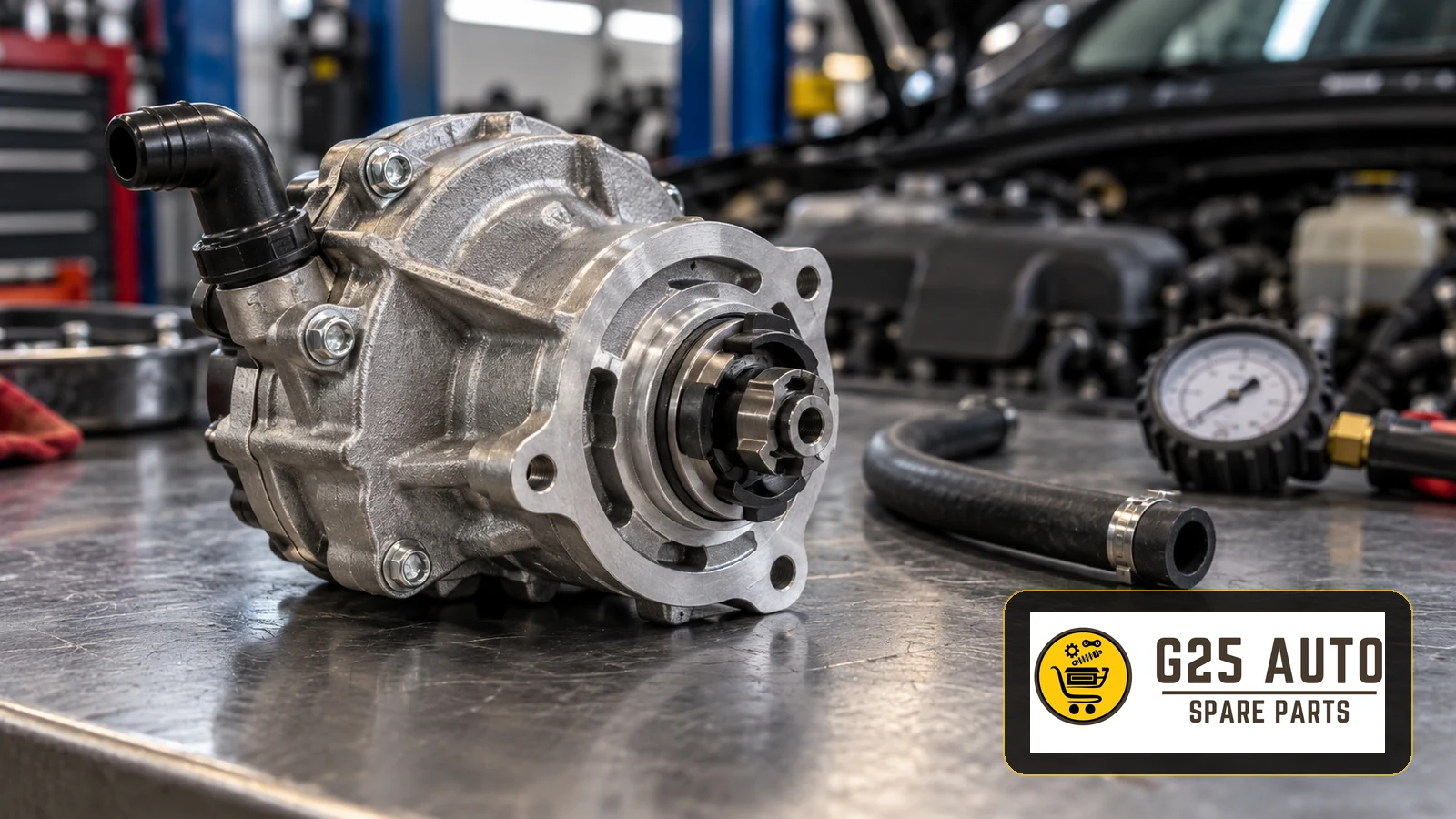
The brake vacuum pump supports safe braking. A hard pedal or increased stopping distance may suggest a problem with vacuum assistance. The pump supplies vacuum to help the brake booster reduce the pedal effort required from the driver. This guide covers its function, fault symptoms, diagnosis and replacement selection.
What Is a Brake Vacuum Pump and How Does It Work?
Brake vacuum pumps are used particularly in diesel vehicles and some petrol vehicles. Where intake manifold vacuum is insufficient for brake assistance, a separate pump supplies the necessary vacuum.
Driven mechanically by the engine or by an electric motor, the pump supplies the brake booster. Loss of vacuum assistance can greatly increase pedal effort and compromise braking safety.
Possible Symptoms of a Brake Vacuum Pump Fault
Vacuum assistance problems can appear in several ways. The following symptoms require investigation:
Brake Pedal Symptoms
- Hard pedal: Braking requires much more effort than usual
- Changed pedal feel: The pedal feels unusually firm or different
- Increased stopping distance: The vehicle takes longer to stop
- Delayed response: Braking response appears delayed
Engine and Performance Symptoms
- Engine speed changes: Abnormal speed reduction associated with braking
- Acceleration problems: Sluggish response or hesitation
- Idle problems: Irregular engine idle
- Increased fuel consumption: Higher consumption than usual
Audible and Visible Symptoms
- Hissing or air leakage: Noise when braking or with the engine running
- Dashboard warnings: A brake or engine warning illuminates
- Abnormal pump noise: Squeaking, rattling or knocking
Professional Inspection Is Needed to Confirm the Fault
These symptoms do not confirm pump failure. Engine and performance symptoms in particular have many possible causes. Similar complaints may involve:
- A faulty brake booster
- Leaking or damaged vacuum hoses
- Brake hydraulic system problems
- Master cylinder or drum brake problems
- A faulty check valve
Workshop diagnosis can include vacuum measurement, visual inspection, hose and connection checks, and diagnostic fault-code reading where applicable. Interpret the results using the vehicle’s service instructions.
Brake Vacuum Pump Diagnostic Checklist
- Assess pedal firmness with the engine running and stopped using the specified procedure
- Listen for air leakage with the engine running
- Inspect vacuum hoses visually
- Check dashboard warnings
- Report any increase in stopping distance to the workshop
- Observe idle quality
- Have system vacuum measured professionally
- Read applicable diagnostic fault codes
- Have the pump’s mechanical condition checked
- Have brake booster operation tested
Original Equipment and Aftermarket Vacuum Pumps Compared
| Feature | Original Equipment | Aftermarket |
|---|---|---|
| Compatibility | Verify the exact vehicle application | Verify application and cross-reference data |
| Cost | Request a current quotation | Compare quotations for suitable specifications |
| Supply Time | Confirm with the supplier | Confirm with the supplier |
| Quality Standards | Check the specified application | Review documented product specifications |
| Warranty | Check applicable terms | Check manufacturer or supplier terms |
| Range | Application-specific references | Different references for different applications |
Essential Checks When Selecting a Replacement
For a safety-critical component such as a brake vacuum pump, use the following checks:
Original Equipment and Part References
Record the reference on the existing part or in the vehicle documentation. Share it with the supplier and request a catalogue match before ordering.
Compatibility Checks Using the VIN
The vehicle identification number helps identify the relevant vehicle specification. Equipment variants within one model may use different pumps, so request an application check against the VIN.
Engine Code and Type
Check engine identification or vehicle documentation for the engine code. Different engines within the same model range may require different pumps.
Production Date
Manufacturers may change components during a model year. Confirm the production date from vehicle records or identification markings when checking the application.
Should You Choose Original Equipment or Aftermarket?
Both options require assessment against the vehicle’s needs:
Assessing Original Equipment
These parts are supplied or approved through vehicle manufacturer channels. Verify the application, applicable warranty requirements, quotation and availability.
Assessing Aftermarket Parts
Review documented performance, specifications and relevant product evidence. A general manufacturer certificate alone does not establish suitability for a particular vehicle. Confirm price and availability directly.
Which Option Suits the Situation?
Consider the vehicle’s condition, warranty terms, budget and urgency. Compare suitable options using confirmed application data and current supplier information.
For European and Balkan B2B enquiries through G25Auto, provide vehicle details and the existing part reference so that replacement options can be checked.
Points to Consider During Replacement
An experienced technician should replace the pump. Incorrect installation can cause brake system faults and serious safety risks.
Before Installation
- Recheck the replacement pump’s application
- Ensure the required seals and fasteners are available
- Inspect vacuum hoses and replace damaged items
- Keep the work area clean and suitable
After Installation
- Verify all connections are secured as specified
- Measure vacuum to assess system operation
- Check for air leakage with the engine running
- Assess brake pedal feel
- After stationary checks pass, have a technician assess braking under controlled conditions
Frequently Asked Questions
When Should the Pump Be Replaced?
Replace it when diagnosis confirms a fault or unacceptable performance. Condition and service requirements determine timing; there is no universal mileage interval.
Does Pump Failure Affect Driving Safety?
Yes. Loss of assistance can make the pedal very hard and braking difficult. Symptoms require prompt professional assessment before further use.
Can a Pump Fault Affect Other Components?
Assess the whole vacuum and braking system. Do not assume that a pump fault proves damage to discs, pads or engine components.
How Do Electric and Mechanical Pumps Differ?
Mechanical pumps are driven by the engine; electric pumps use an electric motor. Both supply vacuum, but their drive arrangements differ.
Is Replacing the Pump Alone Enough?
That depends on diagnosis. Check hoses and seals too, replacing damaged items and confirming that the original fault has been resolved.
Can an Aftermarket Pump Match Original Performance?
Assess documented performance against vehicle requirements. Reliable sourcing and correct application checks are essential; certification alone does not establish equivalence.
Conclusions and Recommendations
The vacuum pump supports brake assistance. A hard pedal, abnormal noise or reduced braking performance requires professional inspection.
Before replacement, provide the part reference, VIN, engine code and production date for application checks.
Choose between original equipment and aftermarket options using vehicle requirements, documented quality, warranty terms, budget and confirmed availability.
Use experienced technicians for diagnosis and installation. Regular inspections help identify developing problems.
For brake vacuum pump sourcing, begin with accurate vehicle and part information and confirm the proposed replacement with the supplier.