
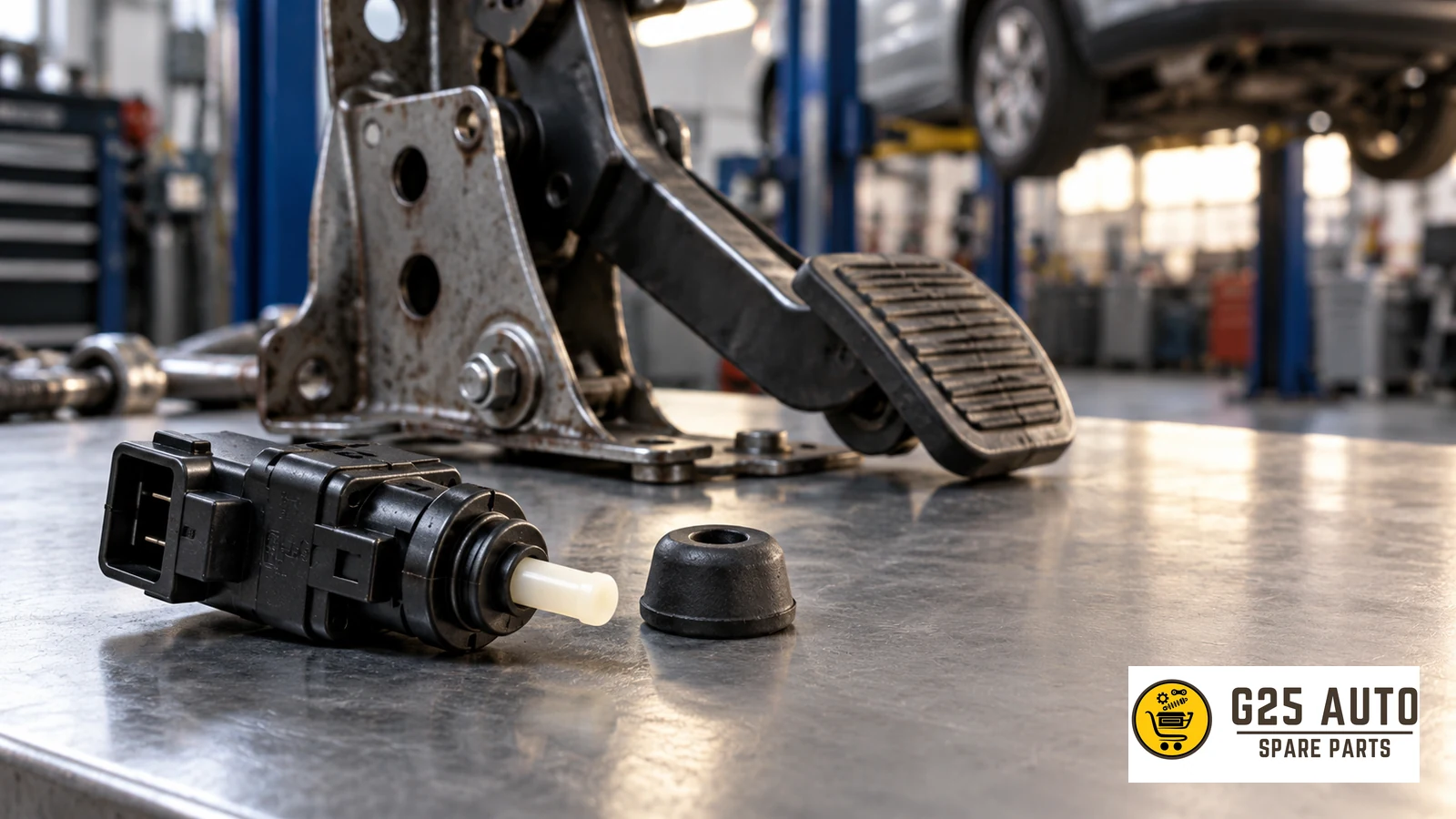
The brake pedal stopper is a small component between the pedal and brake light switch. The electrical switch activates the rear brake lights when the pedal is pressed. Together, they support correct brake light operation and road safety.
What Are the Brake Pedal Stopper and Brake Light Switch?
The stopper is a small plastic or rubber part on or near the pedal. It provides contact for the switch plunger so the brake lights turn off when the pedal is released.
The switch mounts on the pedal mechanism and signals the brake lights. Depending on the vehicle, it also supplies signals to ABS, stability control, brake assistance and cruise control systems.
Fault Symptoms and Diagnostic Differences
Brake Pedal Stopper Fault Symptoms
- Brake lights remaining on, even with the engine off
- A persistent dashboard warning
- Cruise control unavailable or disengaging
- Automatic transmission shift interlock problems
- Battery discharge from continuously illuminated lights
- Unusual clicking near the pedal
Brake Light Switch Fault Symptoms
- No brake lights when pressing the pedal
- Delayed or intermittent illumination
- One-sided failure requiring checks beyond the switch
- Cruise control deactivation
- ABS or stability control fault codes
- Shift interlock problems
Checks for a Reliable Diagnosis
Symptoms alone do not identify the failed component. An automotive electrician or workshop should check:
- Switch continuity with a multimeter
- Brake light bulbs
- Fuses
- Diagnostic trouble codes
- The stopper for cracks, damage or absence
- Switch-to-stopper contact and clearance
- Wiring and connectors for corrosion
Original and Aftermarket Parts Compared
| Feature | Original Part | Quality Aftermarket Part |
|---|---|---|
| Compatibility | Verify the correct reference | Verify the cross-reference and application |
| Material quality | Check component specifications | Varies by manufacturer |
| Warranty | Confirm supplier terms | Confirm supplier terms |
| Availability | Confirm for each order | Confirm for each order |
| Installation | Verify mounting and adjustment | Verify mounting and adjustment |
| Cost | Compare current quotations | Compare current quotations |
Checklist for Selecting the Correct Part
Correct identification matters when replacing either component. Use this checklist:
Before Selecting a Part
- Vehicle details: Make, model, year and engine capacity.
- VIN: Obtain the vehicle identification number.
- Engine code: Check the engine label or documentation.
- Production date: Parts can change within a model year.
- Existing reference: Record the old part’s OEM or part number.
- Electrical system: Confirm the vehicle voltage, especially for commercial vehicles.
- Equipment level: Switch versions can differ with vehicle equipment.
Why OEM References and VIN Checks Matter
Vehicles sharing a model name may use different parts according to production date, engine or equipment. Make and model alone may be insufficient.
What Is an OEM Reference?
An OEM reference identifies a component and helps with:
- Checking vehicle applications
- Finding an aftermarket cross-reference
- Reducing incorrect orders
- Handling returns and exchanges
Verification Using the VIN
VIN-based catalogue enquiries can help establish:
- Production information
- Manufacturing details
- Engine and transmission configuration
- Equipment and options
- The relevant part for production changes
Ask the supplier to cross-check the VIN and part reference, particularly for electrical components. This supports selection without guaranteeing universal compatibility.
Replacing the Pedal Stopper and Brake Light Switch
Replacement may be straightforward, but requires attention to the particular vehicle.
Preparation
- Park on level ground and apply the parking brake.
- Switch off the ignition; follow vehicle instructions for battery isolation.
- Provide good lighting.
- Prepare the appropriate tools.
Technical Points to Check
- Release the connector locking mechanism correctly.
- Install the stopper in the correct orientation.
- Test brake lights both on and off after installation.
- Check cruise control and shift interlock operation where fitted.
- Address fault codes and required resets where applicable.
What Matters When Choosing Aftermarket Parts?
Compare both options objectively against the vehicle’s requirements.
Reasons to Consider Aftermarket Parts
- Potential cost advantages
- Alternative sourcing options
- Manufacturer experience in original equipment supply, where documented
- Warranty terms offered by individual brands
Reasons to Consider Original Parts
- Applicable vehicle warranty requirements
- The specified original reference
- Expected service life
- Vehicle maintenance and value considerations
Consider vehicle age, mileage, use and budget. Whichever option is chosen, verify the reference and application.
Choosing a Reliable Supplier
A suitable parts supplier should provide:
- VIN and OEM reference checks
- Objective original and aftermarket comparisons
- Clear application information
- Clear return and exchange terms
- Technical support
For G25Auto B2B sourcing across Europe and the Balkans, prepare vehicle and part details before comparing supplier options.
Frequently Asked Questions
How long does a pedal stopper last?
Life varies with use and material condition. Plastic stoppers can wear or deteriorate.
Does a faulty brake light switch affect safety?
Yes. Following drivers may not recognise braking. Have the fault addressed promptly.
Can the vehicle be used without its pedal stopper?
A missing stopper can leave brake lights on and discharge the battery. Restore correct operation before use.
Can the switch be replaced at home?
Mechanical knowledge and careful electrical work are necessary. Seek professional help if uncertain.
Is an aftermarket switch as durable as an original?
Durability depends on the product and manufacturer; equivalent performance should not be assumed.
Which vehicles experience stopper problems more often?
Wear may be evident on high-mileage vehicles and deteriorated plastic stoppers. Inspect actual condition.
Conclusion and Recommendations
These small components matter for brake lights and related electronic systems. Faults can create safety problems.
Recognise symptoms early and obtain professional diagnosis. Verify replacement parts using VIN, OEM reference, engine and production details.
Original and aftermarket choices require the same attention to quality and application. A reliable supplier supports correct selection.
Accurate information supports informed purchasing and safe maintenance.