
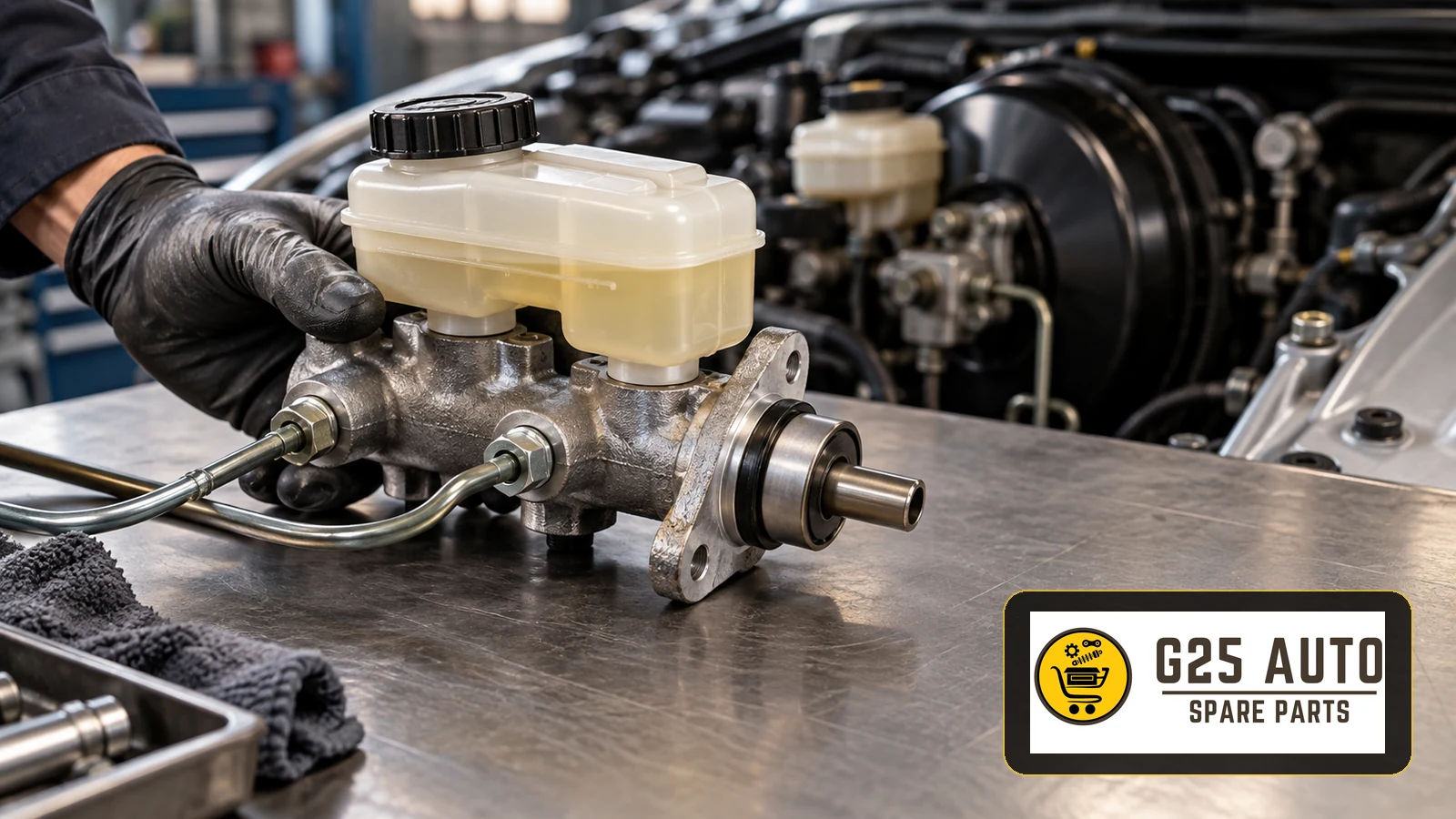
The brake master cylinder converts force from the brake pedal into hydraulic pressure for the wheel brakes. It is the starting point of the hydraulic system that slows and stops the vehicle.
What Is a Brake Master Cylinder and How Does It Work?
This hydraulic assembly is usually in the engine compartment, connected to a brake fluid reservoir. Dual-circuit systems retain some braking if one circuit fails, but braking performance is impaired.
Pressing the pedal moves pistons that pressurise brake fluid. Brake lines transmit this pressure to the wheel brakes, where pads contact discs or shoes contact drums.
Main Functions
- Convert pedal movement into hydraulic pressure.
- Supply pressure to the brake circuits.
- Work with the reservoir to supply brake fluid.
- Provide circuit separation in dual-circuit systems.
- Support controlled braking.
Brake Master Cylinder Fault Symptoms
These symptoms require professional inspection; none confirms a master cylinder fault alone.
Common Symptoms
- Soft or spongy pedal: Unusually soft feel or excessive travel.
- Fluid loss: A repeatedly falling reservoir level.
- Fluid near the pedal: Leakage requiring investigation; its origin depends on the installation.
- Longer stopping distances: Reduced braking effectiveness.
- ABS or brake warning lights: Brake-related dashboard warnings.
- Pedal vibration: Abnormal vibration during braking.
- Uneven braking: Pulling to one side.
Checks Needed for Diagnosis
A technician should select appropriate checks for the vehicle:
- Hydraulic pressure testing.
- Master cylinder and brake line leak inspection.
- Brake fluid condition and level checks.
- Pedal free travel and pressure assessment.
- Vacuum assistance checks, where fitted.
- Diagnostic fault-code reading for electronic brake systems.
Important: Hoses, calipers, air in the system or contaminated fluid can cause similar symptoms. Seek professional diagnosis.
Causes of Master Cylinder Failure
Several factors can contribute:
- Age and wear: Rubber seals harden or lose elasticity.
- Contaminated fluid: Moisture and particles can damage internal components.
- Corrosion: Moisture and contamination can affect the cylinder bore.
- Overheating: Sustained heavy braking can increase system temperatures.
- Neglected maintenance: Fluid changes missed against the manufacturer’s schedule.
Original Equipment and Aftermarket Master Cylinders Compared
Both options require application checks. Assess the individual product and supplier rather than assuming quality or fitment from its category.
| Factor | Original Equipment | Aftermarket |
|---|---|---|
| Compatibility | Check the specified vehicle application | Check the manufacturer’s application data |
| Quality control | Review product documentation | Review manufacturer and product documentation |
| Cost | Obtain an application-specific quotation | Compare quotations for suitable products |
| Warranty | Check applicable terms | Check brand and supplier terms |
| Availability | Confirm for the required reference | Confirm for the required reference |
| Choice | Application-dependent references | Manufacturer-dependent alternatives |
Which Option Suits the Application?
Consider warranty conditions, budget and vehicle requirements.
Original equipment may be considered when:
- Relevant vehicle warranty conditions need checking.
- A classic or specialist vehicle has limited alternatives.
- Long-term ownership informs the purchasing decision.
Aftermarket alternatives may be considered when:
- Budget requires comparison of suitable alternatives.
- A reliable manufacturer’s suitable product is available.
- Vehicle age and value influence the repair budget.
Safety requirements and verified suitability remain essential in either case.
Checklist for Selecting a Master Cylinder
Incorrect selection can create serious safety risks.
Before Ordering
- Confirm vehicle make, model and year.
- Have the VIN available.
- Identify the engine code.
- Check production month and year; specifications may change within a model year.
- Record the existing OEM or part reference.
- Identify ABS, ESP and other relevant brake equipment.
- Compare reservoir capacity and connection layout.
- Review supplier reliability and return terms.
- Check product warranty conditions.
- Identify additional fitting parts, such as seals and nuts.
Why Check Part References and VIN?
Different versions, engines and equipment levels may use different master cylinders:
- ABS and non-ABS versions may differ.
- Diesel and petrol variants may use different assistance systems.
- Mid-year production changes may affect parts.
- Vehicles intended for different markets may differ.
Use VIN, engine code and existing references alongside application data. Model year alone is insufficient; suppliers can assist with identification.
Master Cylinder Maintenance
Regular maintenance supports reliable operation:
- Fluid replacement: Follow the vehicle manufacturer’s schedule.
- Level checks: Check regularly in accordance with vehicle guidance.
- Leak checks: Inspect the cylinder and connections.
- Bleeding: Have trapped air removed using the specified procedure.
- Fluid specification: Use only the specification required for the vehicle.
Choosing a Reliable Aftermarket Supplier
For European and Balkan B2B purchasing, assess suppliers carefully when sourcing safety-critical parts such as master cylinders.
Check documented suitability and relevant quality information. Ask suppliers for identification assistance and available technical support.
Frequently Asked Questions
How long does a master cylinder last?
Service life varies with operating conditions, maintenance and component condition. Neglected maintenance or unsuitable fluid can shorten it; no universal mileage applies.
How long does replacement take?
Replacement and bleeding time depend on vehicle design and system complexity. Obtain a workshop assessment.
Does failure affect driving safety?
Yes. Stop using a vehicle with impaired braking and arrange professional assistance. Continuing to drive endangers road users.
What does a change in fluid colour mean?
Darkened fluid can indicate contamination and needs assessment. Colour alone does not establish serviceability. Follow the specified replacement schedule because moisture absorption also affects many brake fluids.
What if one circuit fails?
A dual-circuit system may retain partial braking, with reduced performance and increased pedal travel. Stop safely and arrange recovery and repair.
Are aftermarket master cylinders safe?
Assess each product’s suitability, manufacturer information and applicable safety requirements. Verify the application using VIN and part references; the aftermarket label alone provides no assurance.
Conclusion
The master cylinder is critical to braking. Prompt attention to symptoms, regular maintenance and correct replacement selection support safe operation.
Original equipment and aftermarket options both require careful product assessment.
Cross-check VIN, engine code, production date and existing references with application information. A reliable supplier can help resolve identification questions.
Have brake problems assessed professionally without delay.
Suitable parts and appropriate maintenance are central to braking safety.