
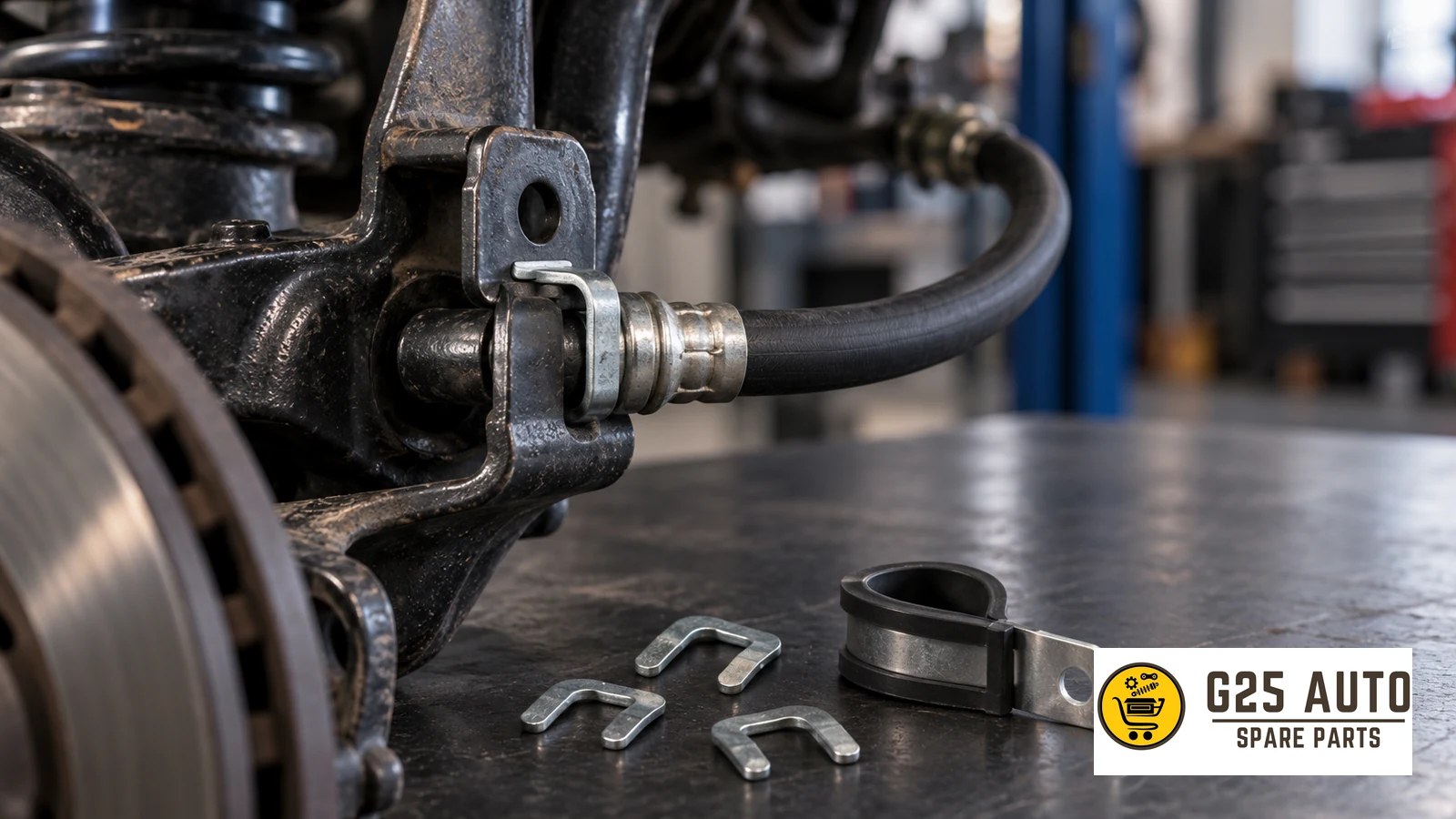
Brake hose retaining clips and brackets are small but important braking components. They secure hoses to the chassis, struts or other structures, helping prevent rubbing, tension and damage during movement. Correct installation and suitable clips support reliable operation.
What Does the Brake Hose Retaining System Do?
Metal or plastic clips and brackets secure hydraulic brake hoses at specified vehicle locations. Their main functions are:
- Keeping hoses away from moving components
- Preventing unnecessary tension during steering
- Limiting hose movement and vibration
- Preventing contact with tyres, wheels or suspension components
- Reducing wear and the risk of hose damage
Types of Retaining Clips and Brackets
By Material
Retainers use different materials:
- Metal clips: May use stainless or galvanised steel; durability depends on specification.
- Plastic clips: Lightweight and corrosion-resistant, with design-dependent heat limits.
- Coated metal clips: Combine a metal body with a protective coating.
By Mounting Method
- Bolt-on brackets: Attach to the chassis or strut with fasteners.
- Snap-in clips: Engage with the existing mounting structure.
- U-clips: Retain the fitting at its mounting point, depending on design.
- P-clips: Loop around the supported component and fasten at one point.
Signs of Retaining System Faults
Possible symptoms include:
- Clicking or squeaking near the brakes during steering
- Unusual wheel-area noises during turns or manoeuvres
- Visible hose wear, crushing or rubbing marks
- A hose hanging or moving loosely
- Broken, cracked or missing clips
- Abnormal hose tension or bends
Important: These symptoms can suggest a retaining fault; professional inspection is necessary for diagnosis.
Professional Diagnosis
A workshop inspection includes:
- Raising the vehicle and visually checking every mounting point
- Checking each clip and bracket for secure attachment
- Inspecting hoses for rubbing, crushing and wear
- Observing hose movement at full left and right steering lock
- Checking retainers for corrosion, cracks and breakage
- Comparing hose routing with manufacturer specifications
Original and Aftermarket Parts Compared
| Feature | Original Part | Quality Aftermarket Part |
|---|---|---|
| Compatibility | Verify the vehicle application | Verify references and application |
| Material quality | Check the specified material | Varies by manufacturer |
| Installation | Check mounting details | Check mounting details |
| Availability | Confirm with supplier | Confirm with supplier |
| Warranty | Check applicable terms | Check supplier terms |
| Cost | Request a quotation | Compare suitable alternatives |
Verification Guide for Part Selection
Check the following before selecting a clip or bracket:
OEM/Part Reference Verification
Manufacturer references identify applications. Check:
- Vehicle documentation where available
- An authorised service provider
- Markings on the existing part
- Electronic parts catalogues
Checking the VIN
A VIN-based catalogue lookup can help establish:
- Relevant production dates
- Equipment specification
- Original equipment details
- Model-specific variations
Vehicles sharing a model and year may use different retaining arrangements, making application verification important.
Engine Code and Production Date
These can affect compatibility:
- Engine variants may have different brake configurations.
- Production updates may change the required part.
- Pre- and post-facelift models may differ.
Original or Aftermarket? A Balanced View
Both options deserve consideration:
Reasons to Consider Original Parts
- Work governed by warranty terms
- A newer vehicle still under warranty
- A preference for the specified original reference
- Vehicle maintenance and resale priorities
Reasons to Consider Quality Aftermarket Parts
- Comparing costs for vehicles outside warranty
- Having the information needed to verify references
- Access to reliable suppliers
- Comparing confirmed availability
Either way, verify the part reference, VIN application and engine code.
Pre-installation Checklist
Before fitting a new retainer:
- ☐ Verify its reference against vehicle specifications.
- ☐ Check for physical damage.
- ☐ Check that all required bolts, nuts and washers are available.
- ☐ Clean and inspect the mounting point.
- ☐ Check the hose for wear, cracks or damage.
- ☐ Have the manufacturer’s installation instructions available.
- ☐ Prepare suitable tools.
Post-installation Checks
After replacement:
- Check hose clearance throughout steering movement.
- Confirm clips are seated securely without crushing the hose.
- Tighten fasteners to the specified torque.
- Check pedal operation as directed; pedal pumping alone cannot confirm the absence of air.
- Have a technician verify braking and investigate abnormal noises before returning the vehicle to service.
What to Check When Buying Aftermarket Parts
Assess the following:
- Manufacturer credentials: Choose an established, traceable source.
- Material information: Check documented specifications.
- Fitment terms: Review return and exchange conditions.
- Technical support: Check available assistance.
- User experience: Treat reports about the same application as supplementary information.
For G25Auto B2B procurement across Europe and the Balkans, specify verified references when requesting suitable parts.
Maintenance and Inspection Recommendations
Regular inspection helps identify deterioration:
- Inspect mounting points during servicing.
- Check clips and brackets during seasonal tyre changes.
- Follow the vehicle’s brake inspection schedule.
- Address road-salt contamination using suitable cleaning methods.
- Assess corroded retainers for replacement.
Frequently Asked Questions
Can a Vehicle Be Driven with a Broken Brake Hose Clip?
An unsecured hose can rub against moving parts and become damaged. Arrange professional assessment and replacement before continued use.
Should Plastic or Metal Clips Be Used?
Metal and plastic differ in corrosion and temperature behaviour. Follow the specified original arrangement and verify the replacement application.
How Long Does Clip Replacement Take?
Access determines the work involved. Some locations require wheel removal; there is no universal replacement time.
Should One Clip or All Clips Be Replaced?
Replace damaged retainers and inspect the others. Wider replacement may be appropriate if several are deteriorated.
Does a Different-looking Aftermarket Clip Cause Problems?
Appearance alone cannot establish suitability. Verify dimensions, mounting points, function and the application reference.
Conclusion
Brake hose clips and brackets support safe hose routing. Correct selection, installation and inspection help protect the braking system.
Verify the OEM/part reference, VIN application, engine code and production date. Incorrect selection can cause fitment problems and wasted workshop time.
Original or aftermarket selection depends on vehicle requirements and procurement priorities. Use reliable suppliers and verified specifications.
Brake work requires experienced personnel and appropriate service instructions. Regular inspection helps identify faults in these small but important components.