
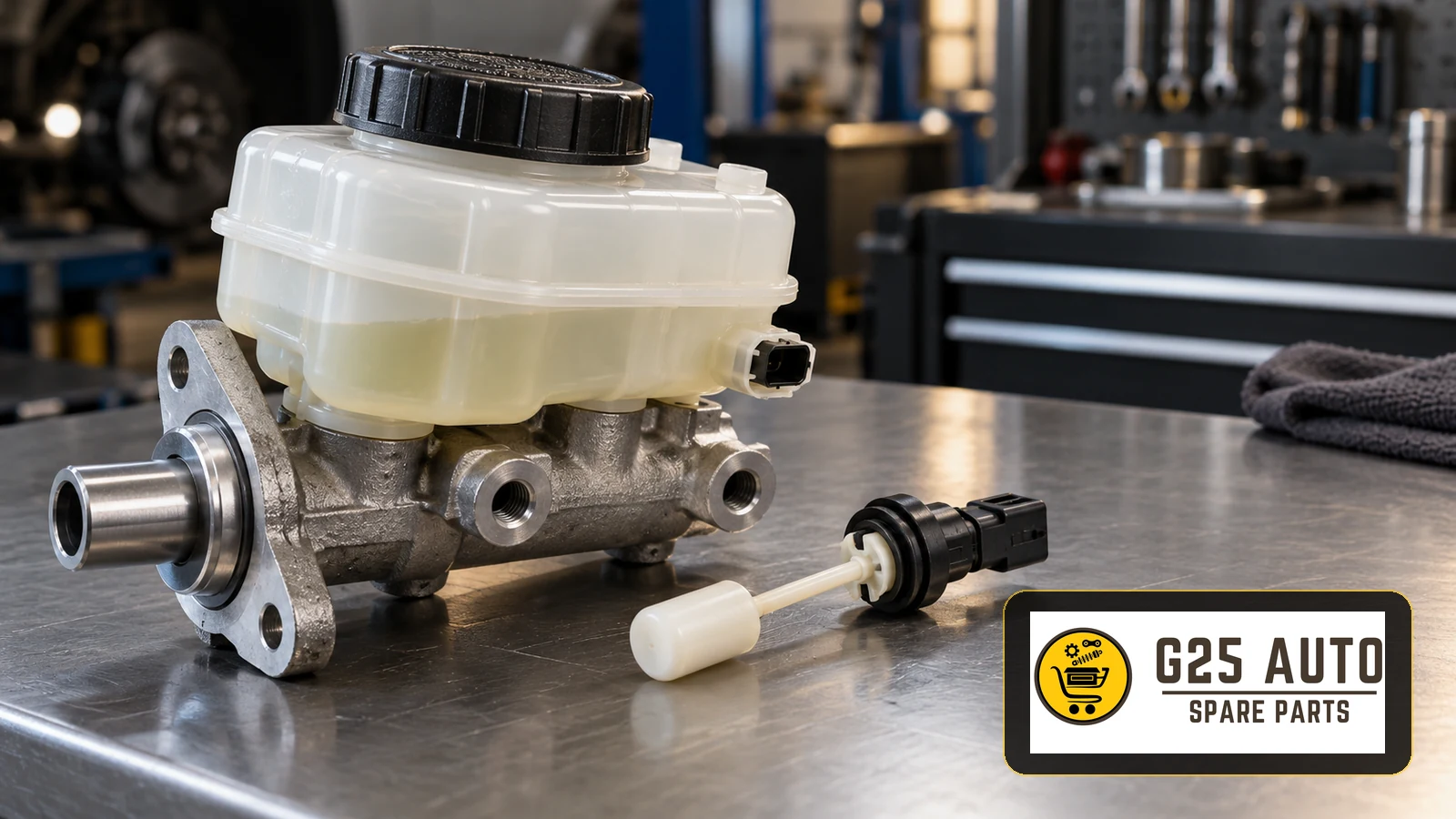
Brake fluid reservoir caps and level sensors support safe braking. The cap contains fluid and accommodates reservoir pressure changes; the sensor warns of low fluid. Faults can cause leaks or compromise warnings.
What Is a Brake Fluid Reservoir Cap and How Does It Work?
This apparently simple cap seals the reservoir while accommodating pressure changes within it.
The Cap’s Main Functions
Depending on design, a diaphragm or venting arrangement accommodates fluid-level changes as brake pads wear. Its function concerns reservoir conditions, rather than regulating braking pressure.
Cap construction varies. Protective outer sections and internal membranes help limit contamination and moisture exposure, relevant because brake fluid absorbs moisture.
Brake Fluid Level Sensors: Operating Principles
The sensor monitors reservoir fluid level. A float mechanism may be integrated into the cap or mounted in the reservoir, depending on design.
Sensor Types and Technologies
Two broad sensing arrangements are:
- Float sensors: A falling float changes an electrical contact state to trigger a warning.
- Electronic sensors: Capacitive or magnetic sensing may be used; durability and cost depend on design.
The warning reaches the instrument panel directly or through a control unit, depending on the vehicle.
Possible Fault Symptoms
Potential cap and sensor problems include:
Reservoir Cap Symptoms
- Fluid around the cap
- Unusual brake fluid odour under the bonnet
- A cracked or deformed seal
- A loose or incompletely secured cap
- Unexpected fluid-level loss
- Blocked vents, where fitted
Level Sensor Symptoms
- A persistent brake warning despite normal fluid level
- No warning despite low fluid
- Intermittent warnings
- Warnings on bends or slopes requiring investigation
- Corroded or damaged wiring
- A sticking float
Checks for a Reliable Diagnosis
Symptoms alone do not establish the cause. Professional checks may include:
Checking the Reservoir Cap
- Inspecting cracks, distortion and seal damage
- Checking sealing performance
- Checking the venting mechanism
- Checking the reservoir pressure-balancing arrangement
Diagnosing the Level Sensor
- Testing electrical behaviour with a multimeter as specified
- Checking wiring continuity
- Checking float movement
- Reading diagnostic codes where supported
- Examining live sensor data where available
- Inspecting connectors for corrosion
Cap and Sensor Comparison
| Feature | Reservoir cap | Level sensor |
|---|---|---|
| Main function | Sealing and reservoir pressure balancing | Level monitoring and warning |
| Failure tendency | Seals deteriorate over time | Depends on design and condition |
| Replacement | Access and procedure vary | May involve electrical connections |
| Variants | Vehicle-specific designs | Different sensing arrangements |
| Inspection | During scheduled servicing | During fault or warning investigation |
| Integration | Separate or sensor-equipped versions | Location depends on reservoir design |
Replacement Parts: Original or Aftermarket?
Both options require attention to specifications, suitability and supplier documentation.
Original Parts
Vehicle-manufacturer parts follow specified applications. Confirm the correct version and applicable warranty terms rather than assuming universal compatibility or compulsory use.
Aftermarket Parts
Independent manufacturers offer alternatives. Assess specifications and documented quality; equivalent performance or certification cannot be assumed.
Selection Checklist
- Check warranty terms
- Assess relevant quality documentation
- Review return and exchange conditions
- Check packaging authenticity and information
- Investigate unusually low prices
Why Compatibility Matters
Incorrect caps or sensors can create functional and safety problems.
Key Compatibility Checks
OEM references and part numbers: Record available markings on the existing cap or reservoir and cross-check application data. Matching references alone do not guarantee fitment.
Vehicle identification number: Use the VIN from vehicle documentation or identification markings to support catalogue checks.
Engine type and code: Different engine variants can have different brake-system applications. Confirm the relevant engine identification.
Production date: Technical revisions can change part requirements within a model range. Check production date rather than relying on first registration.
Cap and Sensor Maintenance Checklist
Regular checks help identify deterioration:
- Inspect around the cap for leaks during routine checks
- Check seal flexibility and replace deteriorated seals
- Check cap security after engine-bay cleaning
- Check warning-lamp operation using the vehicle’s specified procedure
- Check fluid level at recommended intervals
- Inspect sensor connections for corrosion
- Check vents for obstruction where fitted
- Include professional checks in scheduled servicing
- Inspect cap and seal during fluid changes
- Consider condition checks before seasonal changes
Common Mistakes and Prevention
Installation Errors
Seat the seal correctly without folds or distortion. Excessive force can damage the seal or reservoir neck.
Fully engage sensor connectors to avoid intermittent signals, and ensure the float moves freely.
Using the Wrong Part
Visually similar components can differ in sealing, venting or sensing characteristics. Appearance alone is insufficient.
G25Auto: B2B Sourcing Context
For European and Balkan B2B procurement, identify the required cap or sensor precisely before ordering.
Compare product descriptions and application information, and clarify uncertain specifications with the supplier.
Frequently Asked Questions
How Often Should the Cap Be Replaced?
Follow condition and manufacturer guidance. Cracks, distortion, leakage or hardened seals require attention; no universal replacement interval applies.
Can a Vehicle Be Driven with a Faulty Level Sensor?
A faulty sensor can remove an important warning. Investigate promptly; manual checks do not establish that continued driving is safe.
Are Aftermarket Caps and Sensors as Safe as Originals?
Assess the particular product’s application and quality evidence. A brand name, certificate or low price alone cannot establish equivalent safety.
Does Cap Replacement Require a Workshop?
Complexity varies, especially with integrated sensors and electrical connections. Seek professional help if the correct procedure is uncertain.
Should the Warning Lamp Be Disabled?
No. Investigate low fluid, sensor faults or other causes. Disconnecting the warning circuit conceals a potential problem.
Should the Cap Be Checked during Fluid Replacement?
Yes. Inspect the cap and seal during the specified fluid-service procedure, including deterioration that could contaminate fluid.
Conclusion
These small components deserve regular inspection, maintenance and replacement when needed.
Careful selection using part references, VIN, engine identification and production date helps reduce application errors.
Original and aftermarket options require verified suitability, quality evidence and clear supplier warranty terms.
Consistent checks and informed selection support reliable brake-system operation without guaranteeing fault-free performance.