
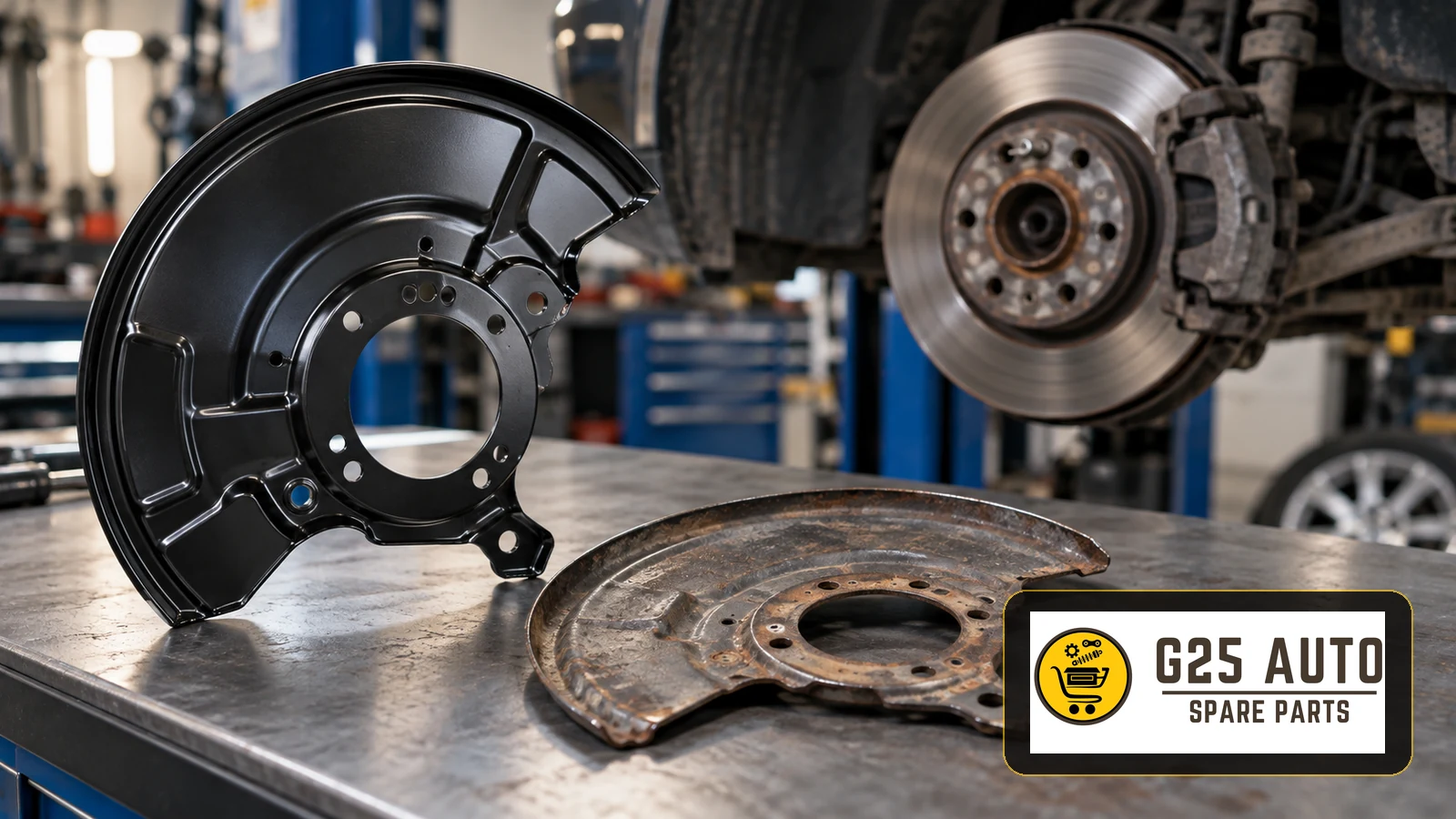
Brake disc shields and dust shields are protective brake system components. They help limit exposure to mud, stones and water, while shielding nearby areas from contamination. Usually made from sheet metal, they can deteriorate over time through corrosion, impact or fatigue. Their coverage and contribution to component life vary with the vehicle design.
What Are Brake Disc Shields and Dust Shields?
A disc shield is a metal barrier behind the brake disc, generally between the disc and hub area. It helps limit exposure to stones, mud, water and other foreign material. Its influence on temperature changes and disc life depends on the design.
Dust shield is also used for protective sheet-metal components around the brake assembly. Coverage of brake dust, bearings and surrounding parts varies; these shields do not completely contain pad dust.
Functions of Brake Disc Shields and Dust Shields
Main Disc Shield Functions
- Limit road contamination.
- Reduce direct water and mud exposure.
- Deflect stones and solid debris.
- Influence heat distribution, depending on design.
- Direct airflow where designed to do so.
Main Dust Shield Functions
- Limit dust reaching nearby areas.
- Help shield the hub and bearing area.
- Reduce contamination around braking components.
- Limit rainwater and salt spray exposure.
- Provide protective coverage around the brake mechanism.
Fault Symptoms and Visible Problems
Possible signs include the following; none identifies a shield fault alone.
Audible Symptoms
- Metallic scraping or rattling during rotation.
- Unusual clicking or squeaking when braking.
- Scraping when cornering or crossing speed bumps.
- Persistent rattling at low speeds.
- Irregular noise from one side.
Visible Symptoms
- Cracks or fractures.
- Rust or severe corrosion.
- Bent or distorted sheet metal.
- Broken or loose mounting points.
- Polished contact marks or wear.
- Unusual dust inside the wheel.
Performance Symptoms
- Dirtier wheels.
- Uneven disc wear.
- Abnormal heat around the bearing.
- Vibration during braking.
Professional Diagnosis
Professional inspection is needed to establish the cause, including other brake or bearing faults.
Professional Inspection Steps
Visual inspection: With the vehicle safely supported on suitable workshop equipment and the wheel removed, examine the shield closely for cracks, fractures, severe corrosion, deformation and mounting problems.
Contact check: Following the vehicle procedure, rotate the assembly manually and note contact with rotating components.
Security check: Inspect bolts, rivets or clips for secure attachment and loose mountings.
Corrosion assessment: Examine rust severity and determine whether the sheet metal has lost structural strength. Advanced corrosion can weaken attachment areas.
System assessment: Inspect the disc, caliper, hub and bearing area for related damage.
Choosing Original and Aftermarket Parts
Both original and aftermarket shields are available; assess the specific product.
Original Parts
Advantages: Manufacturer catalogue references can support selection. Fitment, durability and warranty conditions still require verification.
Considerations: Original parts can cost more. Check branded packaging and identification, and compare the reference with the vehicle catalogue rather than assuming compatibility.
Aftermarket Parts
Advantages: Aftermarket suppliers can provide alternative price points and sourcing routes. Some manufacturers may offer comparable specifications or design changes, but quality equivalence and claimed improvements require supporting evidence.
Considerations: Assess manufacturer reliability, relevant documentation and installation compatibility.
Comparison Table
| Factor | Original | Aftermarket |
|---|---|---|
| Compatibility | Verify catalogue application | Verify cross-reference and application |
| Cost | Compare quotation | Compare quotation |
| Availability | Supplier-dependent | Supplier-dependent |
| Quality | Check product specification | Check manufacturer documentation |
| Warranty | Check applicable terms | Check applicable terms |
| Installation | Confirm mounting configuration | Confirm mounting configuration |
Compatibility Checks for Correct Selection
Incorrect shields can create contact, damage and safety risks.
OEM and Part Reference Verification
Use the original part reference with vehicle catalogue information. A reference alone does not establish compatibility.
Different brake disc sizes within one model range may require different shields.
VIN Checks
A VIN-based catalogue lookup can help identify build details and production changes, including facelift or mid-year revisions. Confirm the actual brake configuration.
Engine Code and Production Date
Vehicles sharing a body designation may have different engines. Obtain the engine code from vehicle identification information or documents, where available. Record the production date too, since manufacturers can change parts within a model year.
Compatibility Checklist
- Record make, model and body designation.
- Record the VIN.
- Identify engine code and capacity.
- Check registration and production dates.
- Specify front or rear axle.
- Read the original part reference, if available.
- Confirm application with the supplier before ordering.
- Check aftermarket cross-references.
- Review relevant quality documents; generic certificates do not prove fitment.
Installation and Maintenance Recommendations
Installation Precautions
Access and replacement complexity vary. Competent technicians should follow the vehicle procedure.
- Inspect the new part for damage.
- Clean mounting points and remove corrosion appropriately.
- Check bolts or rivets.
- Check rotational clearance after installation.
- Tighten fasteners to the specified torque.
- Perform follow-up checks as required.
Routine Inspection
Include shields in relevant brake and vehicle inspections:
- During brake pad replacement.
- At scheduled servicing.
- After winter salt exposure.
- After an impact.
- Promptly when unusual noises appear.
Common Damage Causes and Prevention
Damage Causes
- Impacts associated with potholes or speed bumps.
- Stone strikes.
- Road salt and corrosion.
- Poor installation or loose fasteners.
- Incorrect or unsuitable replacement parts.
- Ageing and metal fatigue.
Prevention
- Drive appropriately for road conditions.
- Remove salt and dirt using suitable cleaning methods.
- Arrange post-winter inspection.
- Complete post-installation checks.
- Select suitable, documented parts.
Aftermarket Parts Sourcing
Work with reliable suppliers when sourcing brake disc shields, dust shields and related replacement parts. For European and Balkan B2B orders through G25Auto, provide vehicle details and part references. Review product descriptions and supporting documentation, and confirm the specific application with the supplier before ordering.
Frequently Asked Questions
Can a vehicle operate without its disc shield?
Do not assume removal is acceptable. Have missing protection assessed against the vehicle specification.
What happens if a dust shield is damaged?
It may contact rotating parts, cause noise or reduce protection. Prompt inspection helps identify associated damage.
Does replacement require a workshop?
Required access and tools vary. Professional installation and clearance checks are advisable.
Can a rusty shield remain in service?
Light surface rust does not necessarily require replacement, but condition must be assessed. Advanced corrosion affecting structural integrity increases the risk of cracks or breakage and may require replacement.
How does original and aftermarket quality compare?
Assess the specific manufacturer, specification and fitment. Branding or certification alone does not establish equivalent quality.
Are front and rear shields identical?
Usually they differ because front and rear brake layouts, disc dimensions and shield shapes can vary. Check the specific axle application.
Conclusion
Simple sheet-metal shields provide useful protection. Damage or missing sections can accompany noise and further component problems.
Inspect symptoms promptly. Use original references, VIN, engine code and production date when selecting replacements.
Compare original and aftermarket options using product evidence, supplier reliability, applicable warranty terms and installation requirements.
Even small protective components deserve attention within brake system maintenance.