
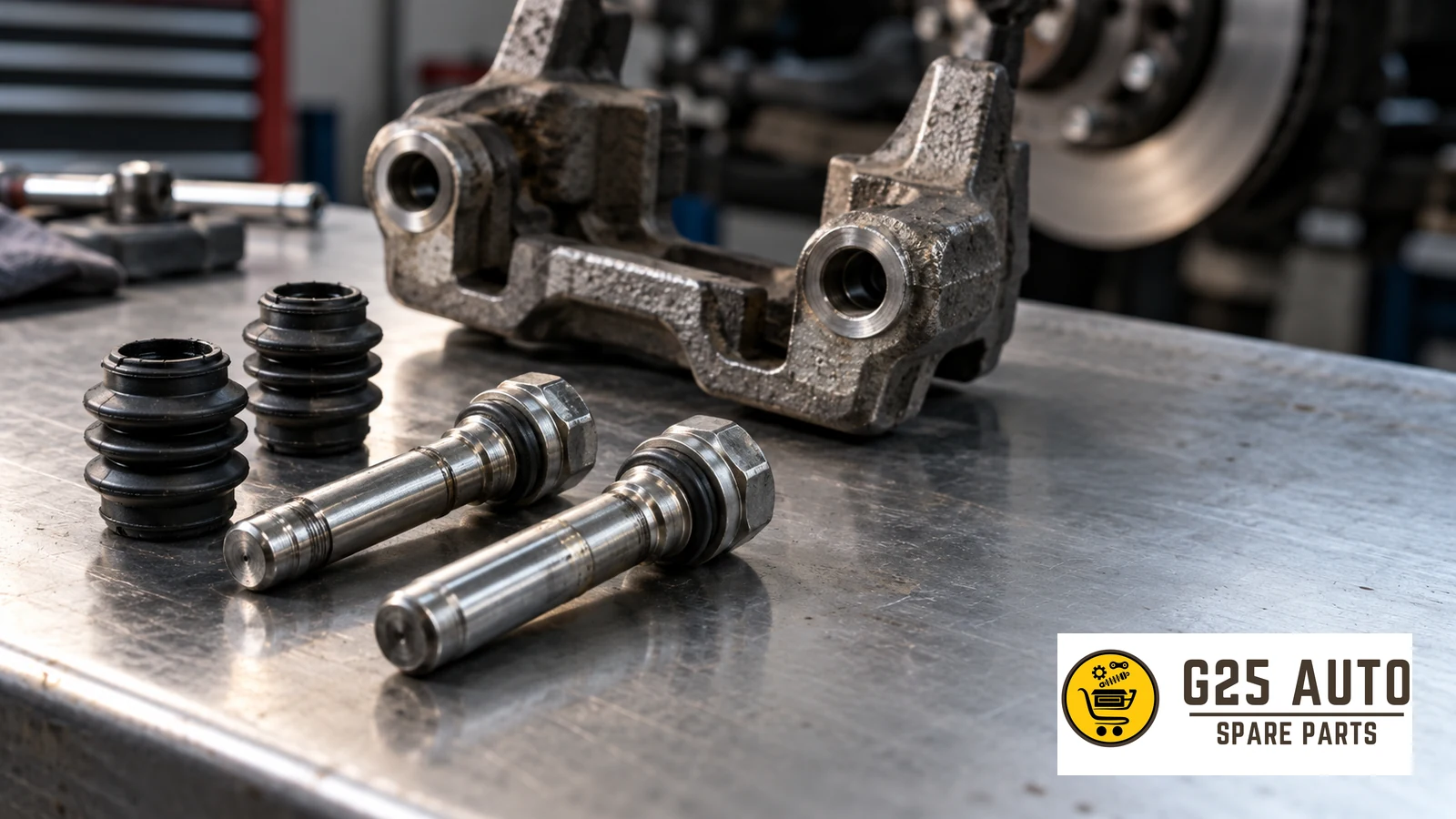
Brake caliper guide pins and protective boots are small but important parts of the braking system. The pins allow a floating caliper to slide, while the boots protect them from dust, moisture and dirt. Damage can restrict caliper movement and affect braking.
What Are Brake Caliper Guide Pins and Boots?
A guide pin is a metal component used in floating brake calipers. It guides the caliper as it moves relative to the disc, helping the pads apply pressure evenly when the brake pedal is pressed.
The boot is a protective rubber or thermoplastic cover. It shields the pin and lubricant from contamination. A torn boot can allow moisture in, leading to corrosion and sticking.
Functions of Guide Pins and Boots
Main Guide Pin Functions
- Guide smooth, parallel caliper movement
- Help the pads apply pressure evenly to the disc
- Support stable caliper movement during braking
- Allow the caliper to move freely when braking is released
- Help limit uneven wear in the brake assembly
Protective Functions of the Boot
- Shield the pin from dust, dirt and road debris
- Limit moisture reaching the pin surface
- Help retain the lubricant around the pin
- Reduce exposure to corrosion
- Support smooth pin movement
Fault Symptoms: What Should You Watch For?
Guide pin and boot faults may cause several symptoms, although other brake problems can produce similar signs:
Common Warning Signs
- Pulling during braking: A sticking pin can contribute to uneven braking.
- Changed pedal feel: Investigate the whole braking system rather than assuming a pin fault.
- Uneven disc wear: Restricted movement can contribute to uneven contact.
- Excessive wheel heat after braking: A sticking caliper may leave a pad dragging.
- Uneven pad wear: Pads may wear differently when the caliper cannot slide properly.
- Squealing or rubbing: Corrosion or restricted movement may accompany abnormal noise.
- Increased fuel consumption: Brake drag increases rolling resistance.
Checks Needed for Diagnosis
These symptoms require professional inspection to identify the cause:
- Remove and visually inspect the caliper as required
- Check guide pin movement
- Inspect boots for tears, cracks and damage
- Check pin surfaces for rust and corrosion
- Assess lubricant condition and coverage
- Inspect the caliper carrier for distortion
Guide Pin and Boot Types
| Feature | Standard Pin | Coated Pin | Stainless Steel Pin |
|---|---|---|---|
| Material | Steel or alloy steel | Steel with a specified coating | Stainless steel, where specified |
| Corrosion resistance | Depends on finish and protection | Depends on coating and condition | Depends on grade and operating conditions |
| Friction | Depends on design and lubrication | Depends on coating and lubrication | Depends on design and lubrication |
| Durability | Application dependent | Application dependent | Application dependent |
| Maintenance | Follow service instructions | Inspect coating and lubrication | Follow service instructions |
Choosing Original or Aftermarket Parts
Both original and aftermarket replacements require attention to specification, quality and application.
Original Parts
- Specified by the vehicle manufacturer for an application
- Made to the relevant original specification
- Intended to retain the specified operating characteristics
- Check applicable warranty conditions
Aftermarket Parts
- Available in different quality and price categories
- Some manufacturers also supply original equipment
- May offer a cost advantage
- Require verification against the required specification
For G25Auto B2B sourcing across Europe and the Balkans, cross-check the VIN, engine code, production date, original part reference and caliper details before ordering. These identifiers support selection without guaranteeing fitment individually.
Part Selection Checklist
- Record the vehicle identification number (VIN)
- Record the engine code and production year
- Identify the existing part reference where available
- Confirm the caliper design and guide pin arrangement
- Identify the front or rear axle application
- Identify the caliper manufacturer, such as ATE, TRW or Bosch
- Check whether pins are supplied individually or as a kit
- Confirm whether boots are included
- Check the specified lubricant
- Review the supplier’s return and warranty terms
Why Part References and Technical Verification Matter
Ordering solely by vehicle model is a common mistake. Different brake systems may be fitted within the same model range.
Why Check the Original Part Reference?
- Production variations: Caliper types may differ within a model year.
- Engine variants: Brake specifications may vary with the engine.
- Market differences: Vehicles for different markets may use different systems.
- Equipment levels: Standard and sport specifications may differ.
- Model updates: Production changes may require different parts.
VIN Verification
The VIN supports identification through the relevant manufacturer or parts catalogue. Check the available records for:
- Production date
- Original equipment specification
- Engine and transmission codes
- Brake system details, confirmed against the installed assembly
Maintenance and Inspection Recommendations
Inspection Intervals
Regular inspection helps identify damage before it develops into restricted movement:
- Follow the applicable vehicle maintenance schedule
- Inspect guide pins during brake pad replacement
- Pay particular attention to boots around winter use
- Consider more frequent checks in demanding conditions
Maintenance Precautions
- Use the lubricant specified for the pin, boot material and caliper
- Replace removed boots when required by condition or instructions
- Avoid excessive force when fitting guide pins
- Seat the boots correctly in their grooves
- Check free caliper movement after assembly
Frequently Asked Questions
How long do caliper guide pins last?
Service life varies with conditions and maintenance. Boot damage can allow corrosion to develop; there is no universal replacement mileage.
Can I replace only the boot?
Possibly, if the pin remains undamaged and the service instructions allow it. Inspect for corrosion and wear first.
Can a guide pin be cleaned and reused?
An undamaged pin may be cleaned and lubricated where permitted. Scoring, pitting or corrosion requires assessment and appropriate replacement.
Is replacing one side enough?
Inspect both sides for balanced operation. Decide the replacement scope from their condition and the applicable repair instructions.
Which grease should be used?
Use the specified lubricant compatible with the caliper and boot material. A generic high-temperature or brake grease is not automatically suitable.
What matters when fitting boots?
Avoid twisting, folding or trapped air that distorts the boot. Ensure it seats fully according to the assembly instructions.
When Is Replacement Needed?
A professional inspection should assess the following conditions and determine the necessary repair:
- Torn, cracked or punctured boots
- Rust, corrosion or pitting on the pin
- Peeling surface coating
- Restricted or seized pin movement
- Carrier wear or distortion
- Dried, degraded or contaminated lubricant
Conclusions and Recommendations
Guide pins and boots support effective caliper operation. Neglect can reduce braking performance and contribute to further damage.
Regular inspection and appropriate maintenance help preserve these parts, particularly by keeping the boots intact.
Use the VIN, part reference and technical specification together when selecting replacements. Manufacturing quality, verified application and professional installation matter for both original and aftermarket parts.
Have any suspected brake problem assessed by a qualified workshop.