
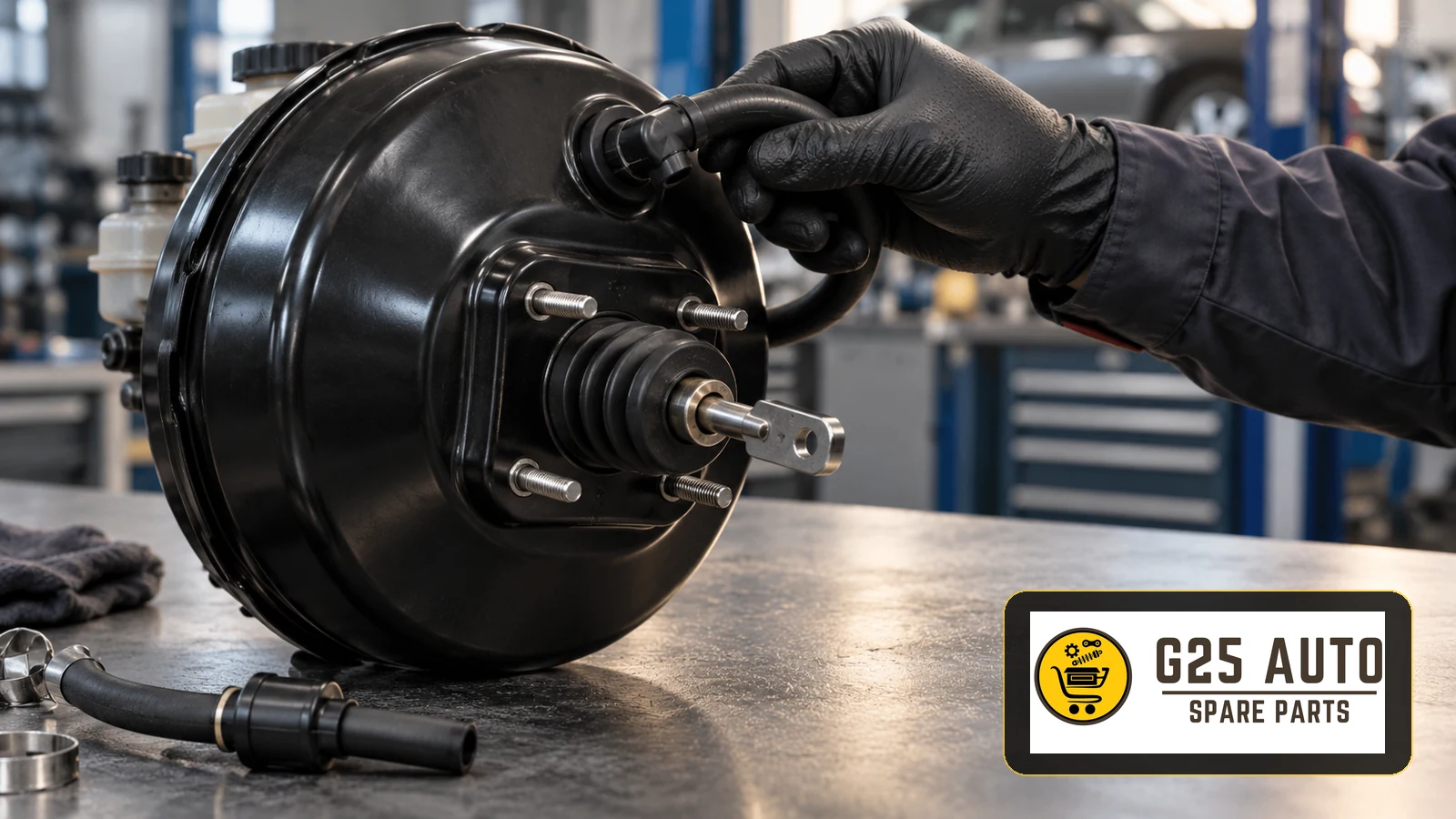
The brake booster, also called a vacuum servo, supports the force applied at the brake pedal. Using vacuum supplied by the engine or a vacuum pump, it assists the master cylinder and reduces the driver’s braking effort.
What Is a Vacuum Brake Booster and How Does It Work?
Mounted between the brake pedal and master cylinder, the booster usually has a round metal housing containing a flexible diaphragm and valve mechanism. Vacuum from the intake manifold or a pump enables a pressure difference between its chambers.
When the driver presses the pedal, the valve mechanism allows this pressure difference to move the diaphragm. The resulting assistance supports the master cylinder, reducing the effort needed to generate hydraulic braking pressure.
Brake Booster Fault Symptoms
Recognising symptoms matters, but they do not prove that the booster is faulty. Professional diagnosis is essential:
Common Symptoms
- Hard brake pedal: Unusually high effort may indicate insufficient vacuum assistance
- Changed pedal height: The pedal sits higher or lower than before
- Longer stopping distance: The vehicle appears to take longer to stop
- Uneven engine idle: Engine speed falls or running becomes irregular when braking
- Hissing: An air-leak noise comes from the booster area
- Pedal behaviour with the engine off: Repeated applications normally exhaust retained assistance; unusual behaviour requires assessment
Conditions Requiring Further Inspection
- Visible damage or corrosion on the housing
- A cracked or loose vacuum hose
- Brake fluid leakage near the master cylinder connection
- A faulty control valve
- A damaged diaphragm
How Is a Fault Confirmed?
Symptoms alone do not mean replacement is necessary. Diagnosis should cover the following:
Professional Assessment
A qualified workshop should perform these checks:
- Vacuum measurement: Measure system vacuum using suitable equipment
- Leak testing: Check the booster and connections for leakage
- Mechanical inspection: Examine the pushrod, connections and mounting points
- Assistance testing: Assess pedal effort using the vehicle’s specified procedure
- Hoses and connections: Inspect vacuum hoses, clamps and the check valve
Checklist: Distinguishing Booster Problems
- A firmer pedal after retained vacuum is exhausted with the engine off can be normal
- A very hard pedal with the engine running may indicate an assistance problem
- A hard pedal also requires assessment of the master cylinder and hydraulic system
- Idle changes associated with suspected vacuum leakage require professional investigation
- Unexpected pedal behaviour after repeated engine-off applications requires diaphragm and valve checks
Aftermarket or Original Equipment: Choosing a Brake Booster
When replacement is needed, both original equipment and aftermarket options require careful assessment.
Original Equipment Parts
These parts are approved or supplied through the vehicle manufacturer’s channels:
- Check the manufacturer’s approval and warranty terms
- Verify the exact vehicle specification
- Review the current quotation
- They are commonly used in authorised workshops
- Confirm availability with the supplier
Aftermarket Parts
Alternative manufacturers supply replacement parts intended to perform the same function:
- Assess documented performance against vehicle requirements
- Compare quotations for equivalent specifications
- Confirm availability through the relevant supply channel
- Review available testing and certification documentation
- They are commonly used in independent workshops
Comparison: Original Equipment and Aftermarket
| Feature | Original Equipment | Aftermarket |
|---|---|---|
| Performance | Check the specified application | Review documented specifications |
| Compatibility | Verify the exact vehicle variant | Verify application and cross-reference data |
| Warranty | Check manufacturer terms | Check supplier or brand terms |
| Supply | Manufacturer’s supply channels | Alternative supply channels |
| Installation | Follow vehicle service instructions | Follow applicable installation instructions |
How Do You Select the Correct Part?
Correct selection is essential for safety-critical components. An unsuitable booster can create risks and additional removal and installation costs.
Verification Using the Original Part Reference
Use the reference on the existing part or in the vehicle catalogue to check application data:
- Record the old part’s reference
- Ask the supplier to check the match
- Confirm the replacement reference or documented alternative
Why the VIN and Engine Code Matter
Vehicles of the same model and year may use different boosters depending on engine, production date and equipment:
- VIN: Identifies the vehicle; check its documents and identification markings
- Engine code: Obtain it from vehicle documentation or engine identification
- Production date: Parts can change during a production year
Give these details to the supplier for application checks before choosing either option.
Part Selection Checklist
- Prepare the VIN
- Identify the engine code
- Record production year and month
- Find the existing part reference
- Provide these details to the supplier
- Request documented compatibility confirmation
- Check warranty and returns terms
- Arrange professional installation
Sourcing Parts with G25Auto
Reliable sourcing supports efficient part selection. For European and Balkan B2B enquiries through G25Auto, provide the relevant vehicle and part details.
For boosters, master cylinders, brake pads and other safety-critical components, compare documented specifications and applications before ordering.
Installation and Subsequent Checks
Booster installation requires precise adjustments and brake-system knowledge. Professional installation is recommended because:
- Pushrod adjustment is critical
- Vacuum hose connections must seal correctly
- Fluid handling and bleeding may be required
- Braking must be assessed after installation
- Pedal free play needs checking
Post-installation Testing
After stationary checks pass, a qualified technician should assess braking under controlled conditions:
- Check low-speed braking
- Assess pedal feel
- Investigate abnormal noise or vibration
- Verify braking performance using the prescribed procedure
Frequently Asked Questions
When Should a Brake Booster Be Replaced?
Replacement depends on confirmed faults rather than a universal interval. Pedal hardness, hissing or reduced braking performance require inspection.
Are a Vacuum Pump and Booster the Same?
No. The pump generates vacuum, while the booster uses it to assist pedal force. They perform different functions within the system.
Can a Vehicle Be Driven with a Faulty Booster?
Loss of assistance can greatly increase pedal effort and compromise braking. A suspected fault requires professional assessment before further use.
Are Aftermarket Boosters Safe?
Assess suitability against the vehicle’s requirements. Request applicable product documentation, compatibility information and warranty terms from the supplier.
Can Replacing Only the Hose Solve the Problem?
It may if the fault is confined to a leaking hose. Diaphragm or internal valve faults may require booster replacement. Professional diagnosis determines the remedy.
Conclusion
The booster is essential to brake assistance. Investigate symptoms systematically.
Confirm the fault professionally, then verify replacement applications using the VIN, engine code and part reference.
Evaluate aftermarket performance through documentation and use a reliable supplier and experienced installer.
Seek professional advice whenever braking is uncertain. Correct part selection starts with accurate information.