
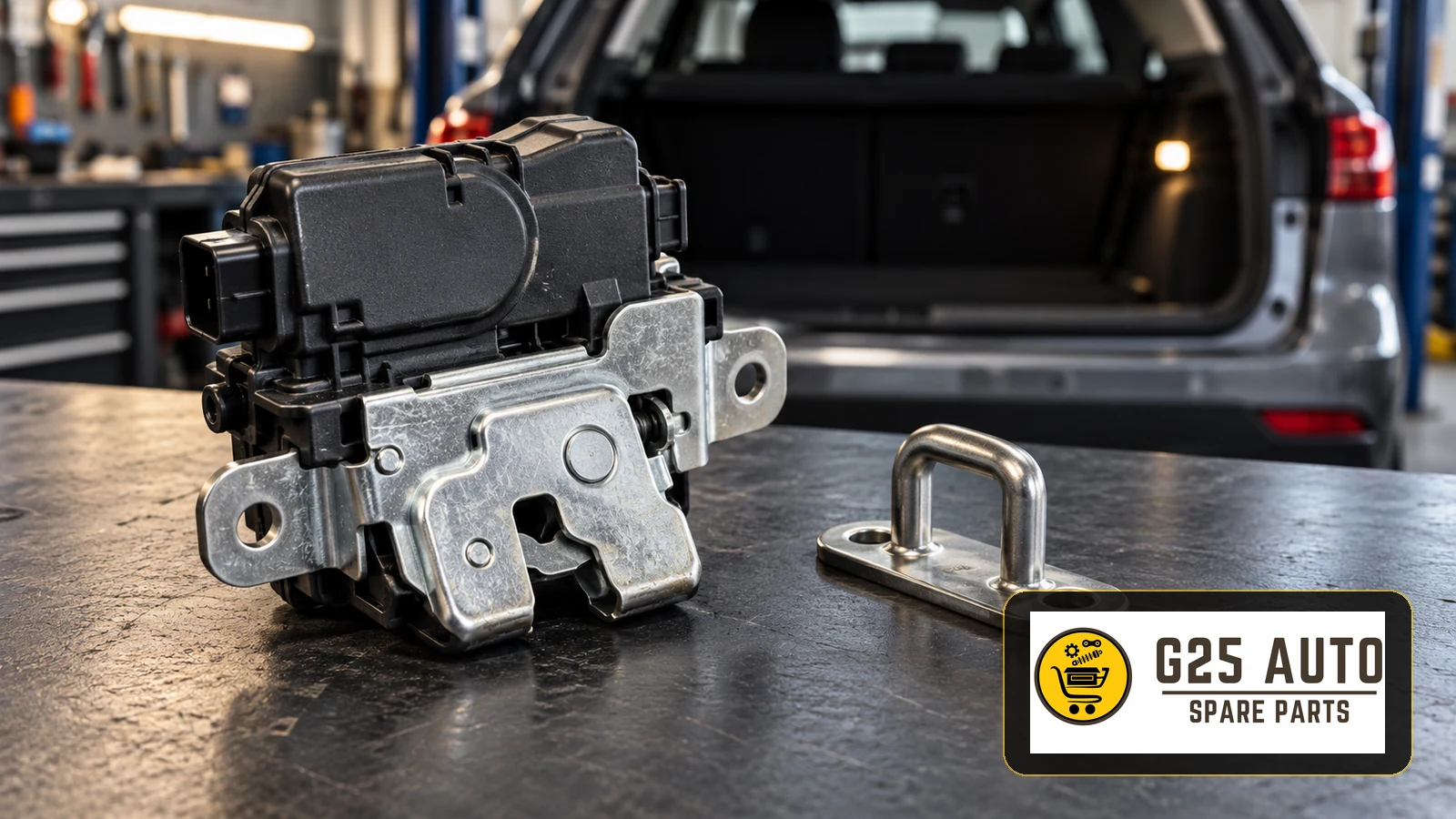
A boot or tailgate that will not unlock needs a check of the release command, electrical supply and mechanical latch before an actuator is ordered. Silence, clicking or intermittent operation alone cannot identify the failed part. For workshops and parts distributors across Europe and the Balkans, the useful starting point is a documented fault and an application check that distinguishes the locking mechanism from the powered equipment that lifts the lid.
Identify which part of the system is failing
The locking actuator converts an electrical command into mechanical movement at the lock. Depending on the design, it may be part of a latch assembly or act through a separate linkage. The powered lift mechanism moves the lid itself and should be treated as a separate diagnostic question. HELLA describes the electrical-to-mechanical role and common supply, blockage and transmission faults in its body actuator overview.
Describe the complaint without naming a replacement
Write down whether the lid fails to release, releases but does not lift, or closes without securing correctly. Record which controls were used and whether the complaint depends on lid position or weather. Ask about previous repairs and body damage. These observations form a test plan; they do not prove that a motor, switch or control unit needs replacement.
If secure closure cannot be confirmed, keep the vehicle out of normal service until the closure fault has been assessed. Use the vehicle manufacturer’s access and emergency-release instructions for a stuck lid. Avoid forced entry, repeated slamming or improvised attempts to bypass the lock.
Build a diagnostic record before ordering
Inspect the mechanical connection
Check the accessible latch, striker and any linkage using the application-specific procedure. A useful example is Mercedes-Benz’s bulletin on a rear-door opening complaint: for its stated Model 463 application, a displaced connecting rod is the cause and replacing the lock is ineffective. This is evidence for checking the connection, not a repair instruction for other vehicles. Consult current manufacturer information before acting on any bulletin.
Trace the command and supply
For powered hatch systems, HELLA recommends visual and functional inspection, fault-memory review, available parameters and electrical checks using the system’s wiring diagram. Its hatchback diagnostic guide also identifies flexing harnesses and corroded connections as possible fault sources. Apply those principles with the correct vehicle information; the guide does not establish a universal latch pinout or test value.
Record the test conditions, specified checks and actual results. Do not apply battery power to unidentified terminals or assume that a connector’s shape establishes its electrical function. Use manufacturer-approved test methods and equipment. Where the evidence remains incomplete, keep the order provisional rather than substituting a new component for diagnosis.
Prepare a clear parts enquiry
For a distributor or fleet workshop, a useful enquiry combines vehicle identity, the installed assembly’s identification and the repair scope. Provide the VIN, build information where available, relevant equipment details, legible markings and photographs of the mounting and connector interfaces. Ask the supplier to confirm the intended application and any documented replacement reference through its catalogue.
Treat a matching photograph or reference number as supporting information. Request clarification if the proposed part differs from the removed assembly or the catalogue description. Establish whether the supply is a complete latch, a separate actuator or another component, and whether any clips, seals or linkage pieces must be ordered separately. This also gives the receiving team a concrete description to check against the delivery.
Purchasing and job preparation checklist
- Record the exact release or closure complaint and the controls tested.
- Attach the diagnosis and identify the component actually requiring replacement.
- Provide vehicle identity and relevant equipment information for catalogue confirmation.
- Retain readable installed-part markings and photographs with the enquiry.
- Confirm the proposed assembly, interfaces and included accessories in writing.
- Check the applicable installation information and any required diagnostic routines.
- Agree traceability, warranty and return terms with the supplying business.
- Define the final function checks and retain the results on the job record.
Control installation and handover
Use the manufacturer’s procedure for safe access, preventing unintended movement, electrical isolation where specified, removal, fastening and adjustment. Establish the required tools and replacement fasteners before starting. Do not transfer a torque setting, lubricant recommendation or adjustment method from a different vehicle.
Check whether the actual repair requires coding, initialisation or another diagnostic routine. Requirements for a powered lift actuator should not automatically be assigned to a replacement latch. Keep the movement area clear and follow the procedure’s precautions during testing.
At handover, document the prescribed checks for release, secure closure and the displayed lid status where fitted. Confirm the relevant controls work under the specified conditions, and record any unresolved symptom. For fleet maintenance, retain the supplied part identification, diagnostic findings and completed checks together so a later complaint can be compared with the original repair.
Frequently asked questions
Does a silent lock prove the motor has failed?
No. Supply or wiring problems can also leave an actuator unresponsive. Diagnose the circuit and mechanism before selecting a replacement.
Can the same part be ordered for every vehicle of one model?
Do not assume this. Request confirmation for the actual vehicle and installed system, including any documented replacement reference.
Should every latch replacement be programmed?
Check the applicable service procedure. Do not infer a programming requirement from another vehicle or from instructions for its powered lifting mechanism.
What maintenance interval should the workshop recommend?
Use the vehicle manufacturer’s maintenance guidance and approved products. Avoid promising a universal service life or prescribing a routine spray treatment for every latch and connector.