
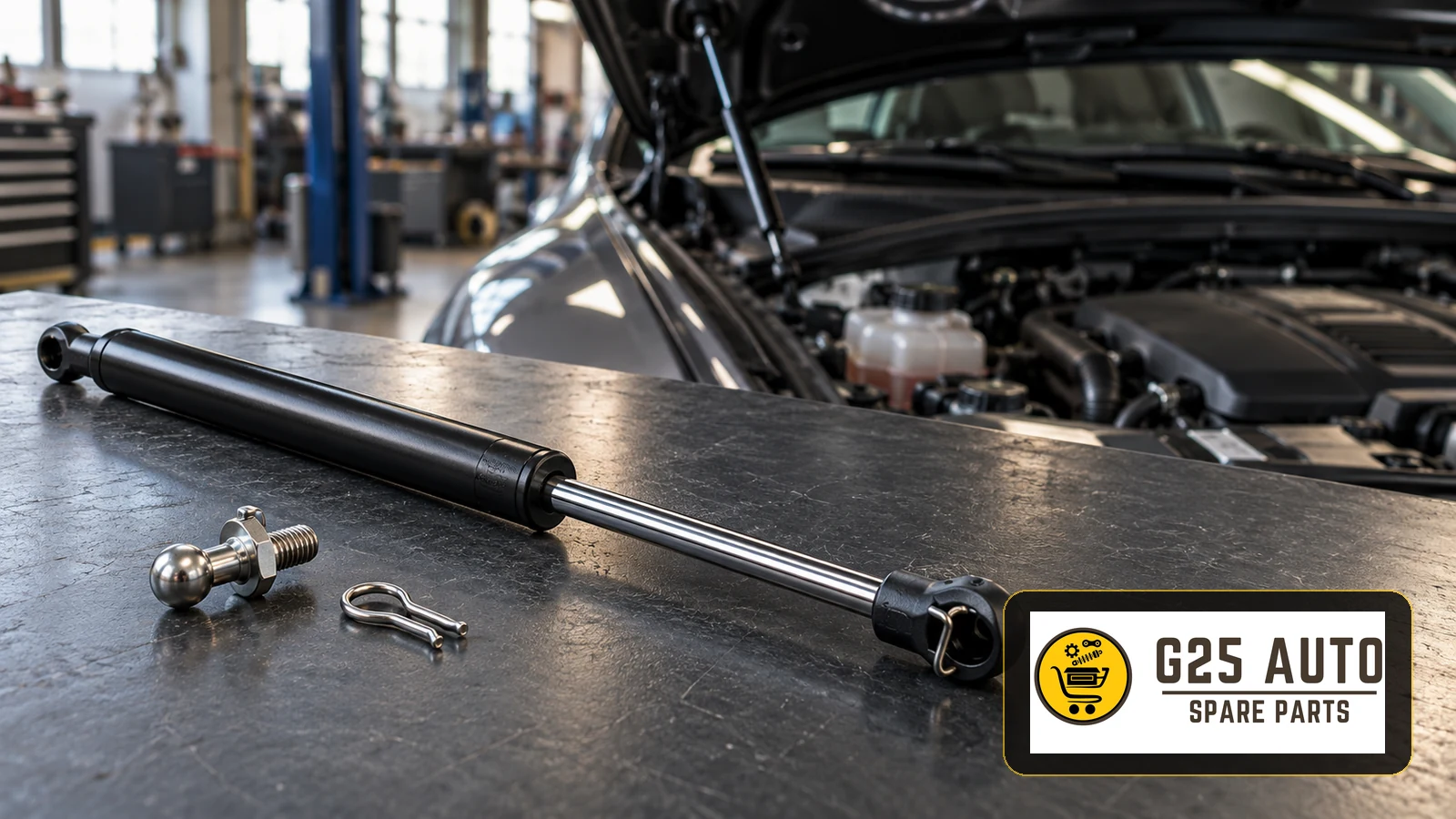
A bonnet support strut is a cylindrical component that helps hold the engine bonnet open. Gas pressure and damping characteristics depend on its design. Retaining clips are metal or plastic fasteners that secure the strut connections to the bonnet and body. A falling bonnet can cause serious injury and vehicle damage, making regular inspection and timely replacement important.
Bonnet Support Struts: Functions and Importance
The bonnet support strut is an easily overlooked safety component. When the bonnet opens, it helps counterbalance its weight and control movement, while supporting it in the open position as designed.
Some vehicles use a metal prop rod, while others have gas struts. A correctly functioning strut system offers convenience when working under the bonnet, keeping both hands free and helping prevent unexpected closure.
How the Bonnet Support System Works
These struts use a cylinder and piston rod, with pressurised gas providing support and damping depending on construction. As the rod extends, the strut helps support the bonnet. Opening behaviour and holding force must match the vehicle specification.
Retaining clips secure the end connections at the bonnet and body mounting points. Spring or locking arrangements help keep the strut attached in the correct position; the precise design varies by application.
Fault Symptoms: When Is There a Problem?
Recognising bonnet support problems early is important for safety. The following signs may indicate a fault:
- The bonnet moves unusually quickly instead of opening or closing in a controlled way
- The bonnet slowly closes by itself from the open position
- Extra effort is needed to keep the bonnet open
- Oil leakage or an unusually wet appearance on the strut body
- Looseness or play at the mounting points
- Broken or cracked retaining clips
- Abnormal noises, such as squeaking or rattling, when opening the bonnet
- Sticking during piston rod movement
How Is a Fault Confirmed?
Symptoms can indicate a problem, but a systematic inspection is needed to establish the cause. A professional assessment should cover the following points:
Visual inspection: Check the strut body for cracks, deformation or leakage. Examine the retaining clips closely for breakage, cracks and deterioration.
Function check: With the bonnet safely supported against falling, have a competent technician assess opening movement and holding performance according to the vehicle procedure. Do not assume that pressing the bonnet down and releasing it is a reliable or safe universal test.
Connection check: Inspect both mounting points for play. Clips must be correctly seated and securely engaged.
Carry out checks with the engine off and cool, using suitable independent bonnet support. Assistance can be helpful, but does not replace secure support. If the diagnosis is uncertain, consult a qualified workshop or experienced technician.
Selecting the Right Part: OEM References and Fitment Checks
The most important step when replacing a bonnet strut or retaining clip is identifying the correct application. Even within one make and model, different production years, engines or equipment levels may use different parts.
Why OEM and Part References Matter
An OEM, or Original Equipment Manufacturer, reference helps identify a part and its listed applications. Check the reference against current catalogue information and the vehicle specification rather than treating the number alone as a fitment guarantee.
The existing part may carry a readable reference. Record it for comparison when ordering. Different references can sometimes relate to revised versions, but any supersession and backward compatibility must be verified rather than assumed.
Checking the Vehicle Identification Number
The VIN identifies the vehicle and supports a catalogue lookup of relevant production and specification details. Not every equipment detail is necessarily encoded directly in the number itself.
Before ordering, provide the supplier with the VIN and request an application check. This helps reduce ordering errors, alongside checking the required strut and connection specifications.
Engine Type and Production Date Differences
Different engine or equipment variants within the same model may have different bonnet support specifications. Do not infer bonnet weight or the required strut force from engine type alone; verify the listed application.
Production date also matters. Manufacturers can introduce design changes during a model year, so the year of registration or model year alone may be insufficient. Check the relevant production information.
Original and Aftermarket Parts Compared
The replacement parts market offers original parts through OEM/OES supply channels and aftermarket alternatives. Both categories have advantages and points that require attention.
| Feature | Original Part | Aftermarket Part |
|---|---|---|
| Fitment | Verify the manufacturer’s listed application | Verify the supplier’s documented application |
| Quality specification | Check the vehicle manufacturer’s specification | Specification varies by manufacturer and product |
| Warranty coverage | Check applicable product and vehicle warranty terms | Check the manufacturer’s and supplier’s terms |
| Availability | Confirm with the supplier | Confirm with the supplier |
| Range of options | Application-specific references | Options vary by manufacturer and specification |
| Cost | Request a current quotation | Compare quotations for technically suitable options |
What to Check When Choosing Aftermarket Parts
When considering an aftermarket part, assess the manufacturer and its reputation. Production quality and compliance with the required specification should be supported by documentation rather than general claims of OEM equivalence or superior technology.
Consider the following points:
- The manufacturer’s industry reputation and experience
- Relevant product documentation and any claimed certification, including its scope
- Warranty duration and conditions
- Supplier reliability and customer support
- Credible product feedback, assessed alongside technical documentation
A suitable aftermarket part may provide the required performance and an alternative procurement option. Make the decision using verified application and documented specifications rather than the original or aftermarket label alone.
The Replacement Process and Points to Consider
Bonnet strut replacement requires appropriate mechanical knowledge and careful handling. Because the bonnet can fall during the work, seek professional assistance if the correct procedure or safe support arrangements are uncertain.
Pre-replacement Checklist
- Prepare the vehicle’s VIN and full model details
- Record the OEM reference on the existing strut, where legible
- Where two struts are fitted, assess both and follow the manufacturer’s guidance on paired replacement
- Check the retaining clips and obtain replacements if needed
- Make sure all required tools are available
- Prepare a safe working area
- Provide suitable independent support to prevent the bonnet falling
Safety Precautions
The main risk during bonnet strut replacement is sudden bonnet closure, which can cause serious injury. Secure the bonnet independently before disconnecting any support component, and arrange assistance where needed.
Struts are pressurised components. Protect your face and eyes, follow the prescribed removal procedure and do not open or damage the cylinder. Dispose of old struts through an appropriate waste route according to local requirements.
Retaining Clips: Importance and Selection
Although small, retaining clips are critical to safe bonnet support. A broken or worn clip can allow a strut to detach and the bonnet to fall.
Types of Connection
Connection designs vary by vehicle manufacturer and model:
- Spring clips: A spring retaining element secures the connection
- Locking clips: A mechanism locks by pressing or turning, depending on the design
- Screwed connections: Some applications use screw-secured fittings
- Sliding clips: A retaining element slides into its locking position
Inspect the clips during strut replacement and replace them where necessary. Plastic components can become brittle through heat, exposure and ageing.
Maintenance and Service Life
Bonnet strut service life varies with frequency of use, environmental exposure and condition. Regular inspection and appropriate care can help identify deterioration before support is lost:
- Visually inspect the bonnet support system regularly, following the vehicle’s maintenance guidance
- Keep the piston rod clean, using a clean dry cloth where permitted by the manufacturer’s instructions
- Check mounting points for rust or corrosion
- Open and close the bonnet gently, avoiding sudden movements
- Avoid directing high-pressure water at the struts when cleaning the engine compartment
- Do not force open a bonnet that is frozen shut
Frequently Asked Questions
When Should a Bonnet Support Strut Be Replaced?
Follow the vehicle manufacturer’s instructions and the component’s condition. Replace a strut when it shows faults or no longer provides the required support. Service life varies with use and operating conditions, so a universal lifespan is unreliable.
Is Replacing Just One Side Enough?
Some bonnets use two struts. When one fails, the other may also show deterioration. Inspect both and follow the manufacturer’s guidance on replacing them together for balanced operation.
Can a Prop Rod Replace the Strut?
A vehicle designed for gas struts should have its intended support system restored. Suitable temporary workshop support can secure the bonnet during repair, but an improvised permanent substitution may create safety risks.
Can the Strut Work with a Broken Retaining Clip?
A clip secures the strut connection. If it is broken, the strut may detach and the bonnet may fall. Do not rely on the affected support; arrange prompt repair with the correct replacement component.
Which Brands Should Be Considered?
Assess reputable manufacturers and reliable suppliers using documented quality and application information. Request a VIN-based application check and verify the relevant part specifications before ordering.
Reliable Parts Sourcing
Reliable suppliers are important when sourcing bonnet struts and retaining clips. An incorrect or unsuitable part can create safety risks and lead to repeated replacement work.
Provide the VIN and full vehicle details when ordering. Ask the supplier to help verify the application. On arrival, compare the reference on the packaging with the existing part and any verified replacement reference.
For G25Auto B2B procurement in Europe and the Balkans, apply these identification checks to bonnet struts, retaining clips and other replacement parts. Confirm the required application and product documentation with the supplier.
Conclusion
Bonnet support struts and retaining clips deserve careful attention. Although relatively small components, their failure can cause serious injury and vehicle damage.
Regular inspection, early recognition of warning signs and timely replacement matter. When replacing parts, verify the VIN application, engine variant and production date, comparing OEM references as part of the selection process.
Original and aftermarket parts both require assessment. Choose reliable suppliers, verify product suitability and quality, and seek professional assistance when the work requires specialist knowledge.
Vehicle maintenance extends beyond the engine and brakes. Bonnet support components also contribute to safe servicing. Regular checks, informed selection and correct maintenance help keep the system dependable.