
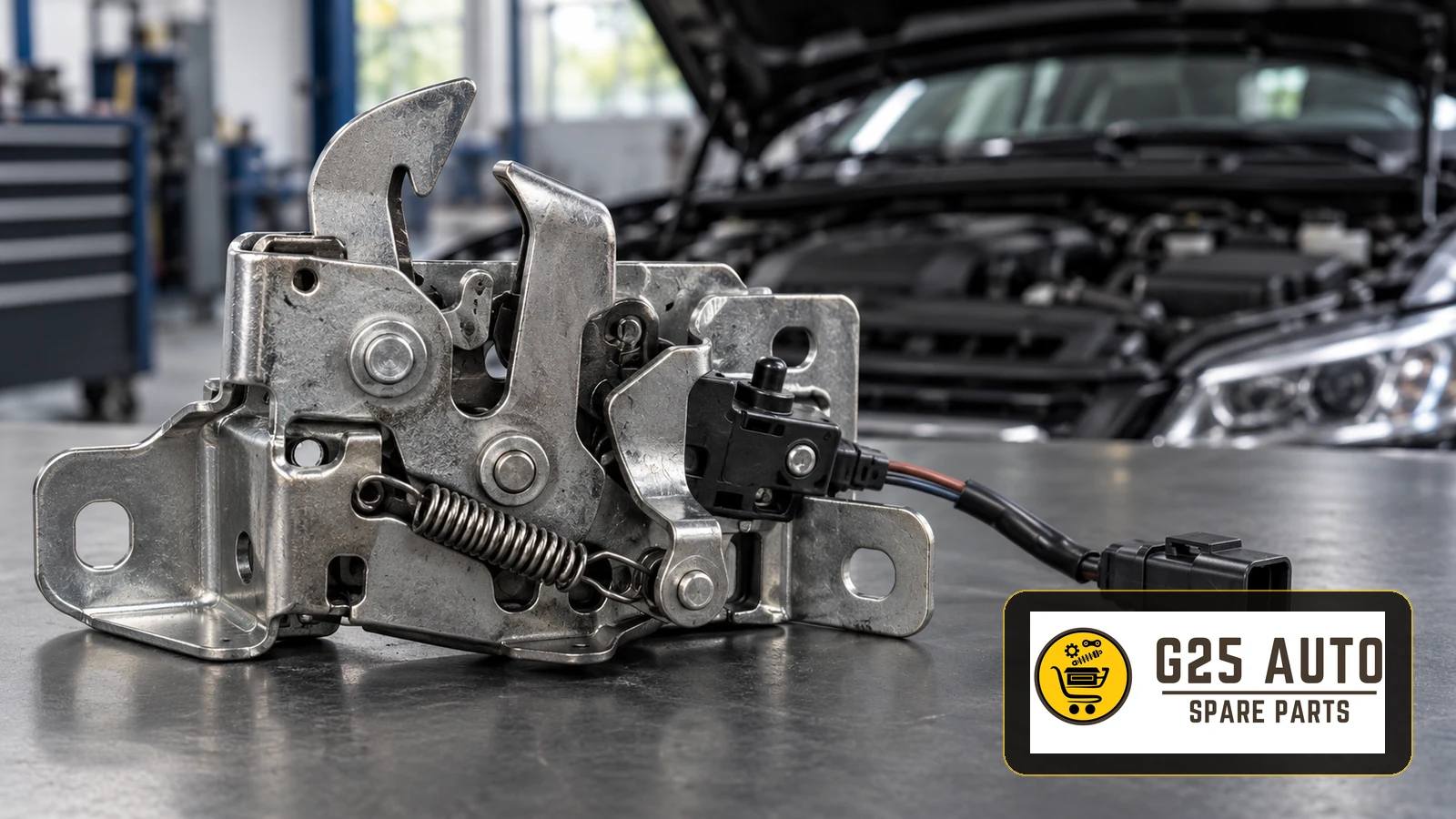
The bonnet latch keeps the engine compartment securely closed. A bonnet latch sensor detects the bonnet’s open or closed state and can inform the driver and the vehicle’s alarm system. If either component develops a fault, the bonnet may fail to close securely or a dashboard warning may appear. Check the part reference, vehicle identification number and production date when choosing a replacement.
What Is a Bonnet Latch and How Does It Work?
The bonnet latch is a mechanical system that secures the bonnet to the vehicle body. It combines a latch mechanism and a corresponding striker; their mounting arrangement depends on the vehicle. When the bonnet closes, the striker engages with the mechanism to retain it.
Many designs include a main latch and a secondary safety catch. These work together to help prevent unintended opening. Their precise operating sequence and adjustment must be checked against the vehicle’s instructions.
The sensor complements the mechanical system by reporting the bonnet position to the vehicle electronics. Depending on the design, this information operates the dashboard bonnet-open warning. An electrical indication alone does not establish that the mechanical latch is secure.
Bonnet Latch and Sensor Fault Symptoms
Several symptoms may indicate a problem with the latch or sensor. Recognising them helps with early investigation and repair:
Mechanical Fault Symptoms
- The bonnet does not close firmly or feels loose.
- Opening or closing requires more force than usual.
- Unusual squeaking, clicking or metallic noises occur during closure.
- The bonnet vibrates or moves while driving.
- The release lever sticks or does not operate correctly.
- Pulling the release lever fails to open the bonnet.
- Corrosion, breakage or wear is visible.
Electrical and Sensor Fault Symptoms
- A persistent bonnet-open warning appears despite the bonnet being closed.
- The alarm system does not operate correctly.
- Related security functions may be unavailable, depending on the vehicle; other system warnings require separate diagnosis.
- The vehicle records bonnet-sensor-related fault codes.
- Remote locking problems occur on systems that use bonnet-position information.
Fault Diagnosis: Basic Inspection Checklist
Professional diagnosis is recommended for latch and sensor problems, although basic visual checks can help describe the fault:
Inspection Checklist
- Open the bonnet safely and visually inspect the latch mechanism.
- Check the striker and latch opening for wear or damage.
- Look for dryness, rust or signs that specified lubrication needs attention.
- Visually examine sensor wiring and connectors.
- Observe latch movement during opening and closing in accordance with the vehicle instructions.
- Note how the dashboard warning behaves.
- Read relevant fault codes with suitable diagnostic equipment, if available.
- Check the release lever’s travel and resistance.
Original and Aftermarket Parts Compared
When a latch or sensor requires replacement, original and aftermarket options may be available. Compare the following points using evidence for the particular product:
| Feature | Original Part | Aftermarket Part |
|---|---|---|
| Compatibility | Confirm the specified vehicle application. | Verify the cross-reference and vehicle application. |
| Quality standards | Check the vehicle manufacturer’s requirements. | Check documented specifications; equivalence must be demonstrated. |
| Cost | Obtain a current quotation. | Compare current quotations for suitable products. |
| Supply time | Confirm availability with the supplier. | Confirm availability with the supplier. |
| Warranty coverage | Check applicable vehicle and product terms. | Check the product terms and any relevant vehicle warranty conditions. |
| Range | References depend on the vehicle application. | Product ranges and specifications vary by manufacturer. |
Checking Part References and Vehicle Details
Ordering solely by vehicle make and model is a common mistake. Even within one model, different years, equipment levels and production dates can require different latches or sensors.
Why Does the Original Part Reference Matter?
The original part reference helps identify the specified component. Using the correct reference can help you:
- Identify a replacement for the verified vehicle application.
- Reduce the risk of ordering an incorrect part.
- Find a relevant aftermarket cross-reference.
- Communicate clearly with the parts supplier.
Verification Using the VIN
The vehicle identification number, or VIN, supports a vehicle-specific catalogue lookup. Suppliers can use it to check relevant production and equipment details and the specified part application. Do not assume that a general model description or a reference alone guarantees compatibility.
Engine Code and Production Date
Engine code and production date can be relevant when selecting electrical components such as a bonnet latch sensor. Different configurations within one model may use different parts, and production changes can occur during a model year. Check these details against the application information.
Bonnet Latch and Sensor Maintenance
Appropriate maintenance can support reliable operation and help identify deterioration:
Mechanical Latch Maintenance
- Clean the mechanism at the intervals and by the method specified for the vehicle.
- Use lubricant only where and as specified by the manufacturer.
- Inspect for rust or corrosion.
- Have latch alignment and adjustment checked as required.
- Pay attention before winter where frost and ice may affect operation.
Sensor Maintenance
- Visually inspect the sensor and wiring connections.
- Look for moisture or corrosion in connectors.
- Check for moisture after engine-compartment cleaning, following the vehicle’s care instructions.
- Clean electrical components only using an approved method and compatible product where specified.
Tips for Finding the Correct Part
Have the vehicle’s technical details ready when searching for a latch or sensor. Use the following steps when reviewing supplier listings:
- Start with the original part reference if available.
- Keep the VIN ready.
- Enter the make, model, year and engine information accurately.
- Read the product’s application information carefully.
- Ask the supplier to clarify any uncertainty.
- Compare product photographs with the existing part as a supporting check.
Installation and Replacement Checks
An experienced technician should replace a bonnet latch or sensor. Understanding the checks can help you assess whether the work has been completed properly:
Bonnet Latch Replacement
- Clean the mounting points after removing the old latch.
- Check the required adjustment procedure before fitting the replacement.
- Set the latch height and position correctly.
- Repeat the closure test as required by the service procedure.
- Check the secondary safety catch.
Sensor Replacement
- Follow the specified electrical isolation procedure before work.
- Avoid damaging wiring while removing the old sensor.
- Check that the new sensor and connections are secure.
- Address the cause of fault codes and clear them as specified.
- Check warning operation after repair; any road test requires confirmed secure bonnet closure.
Frequently Asked Questions
Does a Bonnet Latch Sensor Fault Affect Vehicle Use?
A sensor fault may cause a persistent dashboard warning and can affect alarm or remote-locking functions on some vehicles. Establish whether the bonnet is mechanically secure and have the fault repaired promptly; do not assume a warning is only electrical.
Can I Repair the Bonnet Latch Myself?
Basic care may be possible where covered by the vehicle instructions. Replacement, adjustment and significant repairs require appropriate competence; professional assistance is recommended because incorrect work can compromise safe closure.
Is an Aftermarket Bonnet Latch as Safe as an Original Part?
Safety depends on verified suitability, documented specifications and correct installation. A cross-reference or general certification claim alone does not establish equivalence. Choose a traceable product from a reliable manufacturer and verify its application.
How Often Should a Bonnet Latch Be Replaced?
There is no single replacement interval for every vehicle. Follow the manufacturer’s guidance and assess actual condition. Fault symptoms or damage require investigation and replacement where necessary.
Does Every Vehicle Have a Bonnet Latch Sensor?
No. Sensor provision depends on the vehicle’s design and equipment, including its alarm or security system. Some vehicles use a mechanical latch without a bonnet-position sensor; check the particular application.
Where Can I Find the Original Part Reference?
Check the existing part’s label where legible, relevant service information or an authorised parts supplier. A supplier can also use the VIN to identify the specified reference.
Conclusion
The bonnet latch and its sensor both contribute to safe vehicle operation. Faults can create a safety risk and persistent warnings. Recognising symptoms and obtaining a correct diagnosis helps ensure appropriate repair.
When comparing original and aftermarket options, consider the vehicle’s condition, operating requirements and budget. Verify the selected product’s suitability and specifications before making a purchasing decision.
The part reference, VIN and production date are central to selection. Keep these details ready when contacting a supplier; incomplete vehicle information increases the risk of ordering an unsuitable component.
Regular checks, appropriate latch care and clean, sound sensor connections support reliable operation. Seek professional assistance when faults arise, and follow the vehicle-specific maintenance instructions.
Take even a small bonnet latch or sensor problem seriously. Arrange timely inspection and confirm secure closure before using the vehicle.