
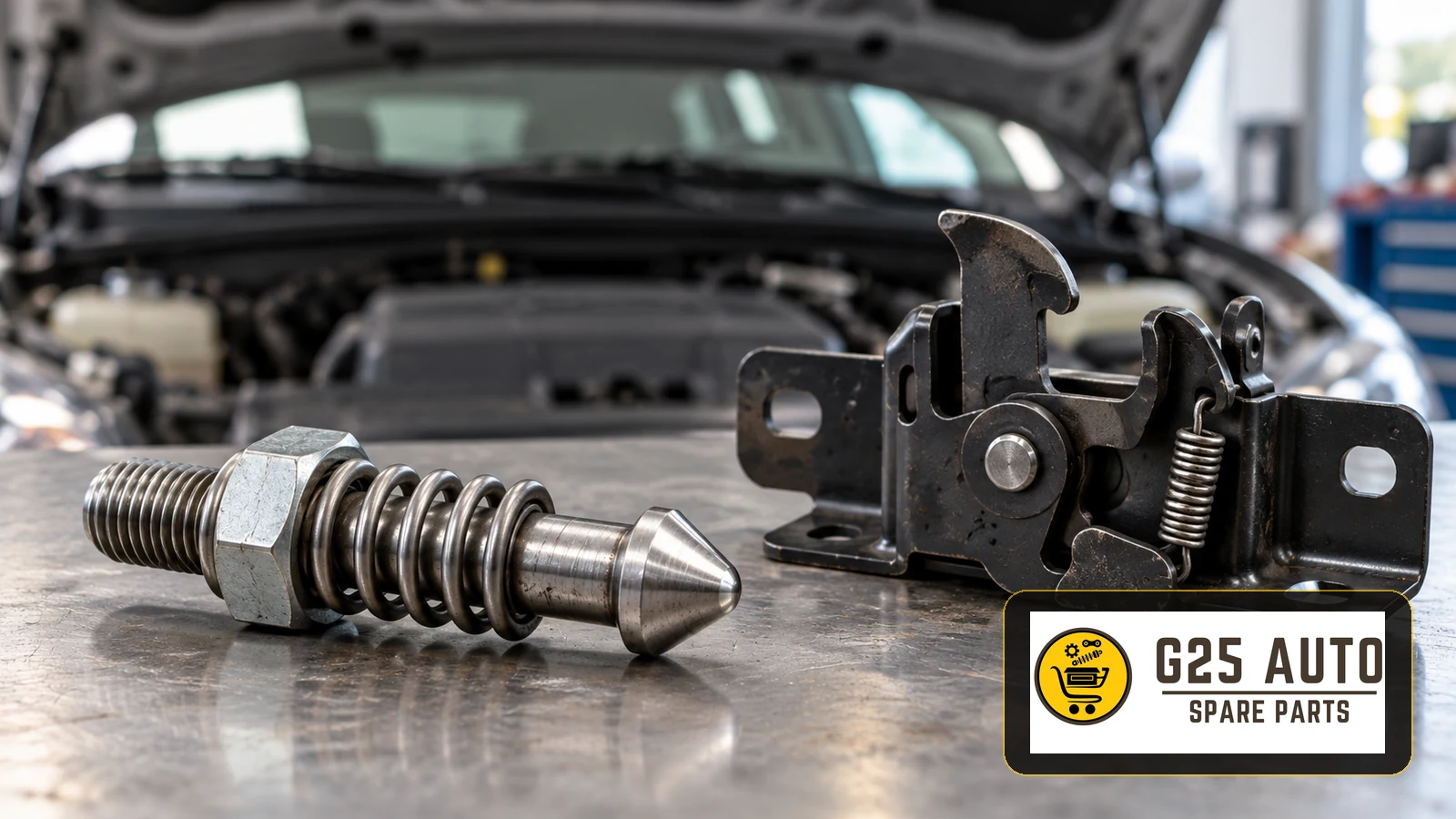
The bonnet latch striker pin, spring and adjustment nut help the bonnet close securely and remain latched. In arrangements that use these components, the striker engages with the latch, the spring supports the mechanism’s movement and the adjustment nut allows the striker position to be set. This guide covers their functions, possible fault symptoms, part selection and fitting considerations.
Structure and Functions of the Bonnet Latch Striker Mechanism
A bonnet latch system contains several components with distinct roles. Where a striker pin, spring and adjustment nut are fitted, they must work together as intended for that vehicle.
Function of the Striker Pin
The striker pin is the metal component that engages with the latch when the bonnet closes. Its shape may be cylindrical or tapered, depending on the design. As the bonnet closes, the pin enters the latch and is retained by the mechanism.
Correct engagement helps retain the bonnet against movement and the forces encountered in use. Material and corrosion protection depend on the specified component; appearance alone does not establish its strength or suitability.
Importance of the Spring
The spring is a moving element in the mechanism. Depending on the arrangement, it provides spring force during operation and helps the relevant components return to their intended position when the bonnet opens.
A missing, broken or incorrect spring can affect operation. Selecting the specified spring matters because spring characteristics and its role vary between mechanisms.
Role of the Adjustment Nut
The adjustment nut is a threaded component used to set the striker pin position where the design permits adjustment. It supports alignment between the bonnet striker and latch, including during installation or correction of an alignment problem.
Follow the specified adjustment and tightening procedure. Incorrect adjustment may leave the bonnet loose or prevent it from closing correctly.
Fault Symptoms and Diagnosis
Problems in the bonnet striker mechanism may produce recognisable symptoms. Identifying them early allows the cause to be investigated before further damage develops.
Common Fault Symptoms
- The bonnet does not close fully or opens again.
- Unusual squeaking or impact noises occur during closure.
- One side of the bonnet sits higher than the other.
- The release lever feels unusually resistant or slack.
- The bonnet vibrates or moves while driving.
- Closing requires more force than usual.
- The spring is visibly broken or missing.
- The pin shows excessive wear, corrosion or distortion.
Checks to Establish the Cause
Symptoms alone do not identify which component is faulty. Use the following checks as part of the assessment:
- Park on level ground and apply the parking brake.
- Operate the bonnet release and observe the initial response.
- Open the bonnet fully and visually inspect the mechanism.
- Check the striker for cracks, breaks or excessive wear.
- Check that the spring is present, correctly located and unbroken.
- Inspect the adjustment nut for looseness.
- Observe the mechanism during careful opening and closing.
- Check alignment between the striker and latch.
Choosing Genuine or Aftermarket Parts
When replacement is necessary, genuine and aftermarket components may be available. Compare their documented application and product information rather than assuming suitability from the category alone.
Characteristics of Genuine Parts
Genuine parts are supplied under the vehicle manufacturer’s parts system. Select the reference specified for the exact vehicle configuration.
Check the application and warranty terms before ordering. Price, availability and delivery time require a current supplier quotation; genuine branding alone does not resolve an incorrect reference.
Aftermarket Alternatives
Aftermarket parts are supplied by independent manufacturers. A suitable component must meet the requirements of the relevant mechanism and vehicle application.
Compare current quotations and availability. Assess the manufacturer’s reliability and verify any quality documentation rather than assuming that every alternative has equivalent specifications or certification.
Comparison Table
| Feature | Genuine Part | Aftermarket Part |
|---|---|---|
| Compatibility | Verify the specified vehicle reference. | Verify the application and cross-reference. |
| Cost | Request a current quotation. | Compare quotations for suitable products. |
| Supply time | Confirm with the supplier. | Confirm with the supplier. |
| Quality standard | Check the relevant product specification. | Check the particular manufacturer’s documentation. |
| Warranty | Read the applicable product terms. | Read the manufacturer and supplier terms. |
| Availability | Check the specified reference with the parts supplier. | Check the required application with the supplier. |
Key Checks When Selecting the Correct Part
Choosing the correct striker pin, spring and adjustment nut matters. An unsuitable component can cause fitting difficulties, unreliable closure and additional expense.
OEM and Part References
An OEM reference identifies a component within the original equipment parts system. It supports identification when checked against the appropriate catalogue and application details.
Look for a legible reference on the existing part, its packaging or relevant parts documentation. Give the supplier that information and have the application confirmed before ordering.
Verification Using the VIN
The vehicle identification number, or VIN, is a starting point for checking vehicle records and catalogue information. It supports identification of the relevant configuration but is not an unconditional guarantee of fitment.
Locate the VIN using the vehicle documentation or identification markings. Supply it to the parts specialist together with the existing component reference and any relevant configuration details.
Engine Type and Production Date
Vehicles in the same model range may have different engines or production specifications. Engine details and production date can help distinguish catalogue applications where those differences are relevant.
Check the vehicle documentation and identification labels for the required information. These details can be useful around production changes and model updates.
Checklist Before Purchasing
- Prepare the vehicle make, model and production-year details.
- Note the VIN.
- Identify the engine code where relevant.
- Check the existing part reference.
- Photograph the component and its condition.
- Assess the supplier’s reliability.
- Read the product warranty terms.
- Check return and exchange policies.
- Ask whether the specified installation requires special tools.
- Compare current quotations for suitable components.
Installation and Adjustment
Fitting a bonnet striker pin, spring and adjustment nut requires care and accurate positioning. Use the vehicle’s repair procedure to establish the correct assembly and settings.
Preparation Before Installation
Prepare the working area and specified tools. Level ground, adequate lighting and appropriate hand tools help provide suitable working conditions.
Remove the existing parts carefully and note their assembly order. Photographs can provide a useful reference. Clean the relevant components using the specified method and inspect the replacement parts before fitting.
Adjustment and Testing
Where adjustment is permitted, use the nut to set the striker position according to the repair procedure. Carefully check closure and opening after securing the assembly as specified.
The bonnet should close and latch correctly without an alignment defect or unwanted movement. Make further adjustments only within the specified procedure. Resolve any uncertainty about secure closure before driving; a road test does not replace checking latch engagement.
Maintenance and Service Life
Inspection and appropriate maintenance help identify deterioration in the bonnet striker mechanism. The required work depends on the vehicle, component condition and operating environment.
Regular Inspection
Follow the vehicle’s maintenance guidance rather than a universal time or mileage interval. Look for wear, corrosion, damage and looseness, and address abnormal operation promptly.
Cleaning and Lubrication
Keep the latch mechanism and striker clean using the specified method. Contamination and moisture can contribute to deterioration. Lubricate only the points identified by the manufacturer, using the specified product and quantity; excessive lubricant may collect dirt.
Avoid Forcing the Bonnet
Do not use excessive force to overcome poor closure. Investigate the mechanism and alignment instead of repeatedly slamming the bonnet. Have the adjustment assessed professionally where necessary.
Frequently Asked Questions
How Long Does a Striker Pin Last?
Service life varies with the component, operating conditions and maintenance. There is no single lifespan applicable to all vehicles. Inspect its condition and replace it when required by the repair assessment.
Can the Vehicle Be Driven with a Broken Spring?
A broken spring can compromise bonnet latch operation. Do not assume that a short journey is acceptable. Have the fault assessed and secure operation restored before driving.
Can I Adjust the Nut Myself?
Adjustment requires the correct instructions and suitable competence. Professional assistance is appropriate if the settings or mechanism are unclear, because incorrect positioning can compromise closure.
Does an Aftermarket Part Affect the Warranty?
Check the applicable vehicle and component warranty terms before arranging replacement. The part category alone does not establish the effect on a particular warranty.
Must All the Parts Be Replaced Together?
Not necessarily. Inspect the whole mechanism and replace the faulty components according to the repair procedure. Do not assume that replacing every component is always required or beneficial.
Conclusion
The bonnet latch striker pin, spring and adjustment nut are small components with an important role in secure bonnet closure. Their correct operation helps the bonnet remain properly retained in use.
Recognise abnormal operation early and investigate the cause. Use the part reference, VIN and relevant vehicle details to support application verification rather than treating any one identifier as a guarantee.
When comparing genuine and aftermarket products, choose a reliable supplier and check documented suitability and product information. Appropriate maintenance and inspection help detect deterioration before it affects operation.
Do not overlook a bonnet latch problem. Careful parts selection, correct installation and verified engagement are essential to restoring the intended function of the mechanism.