
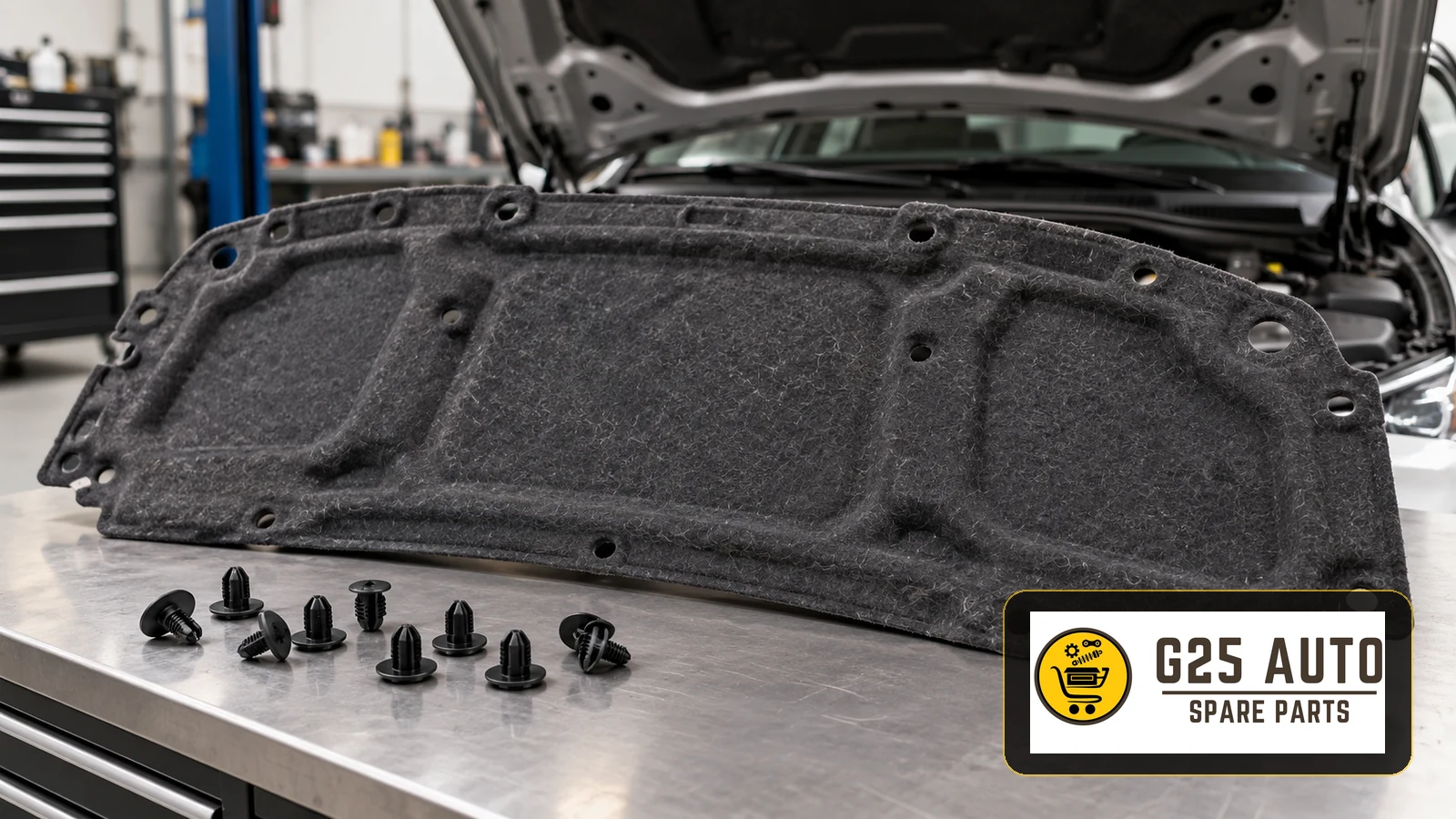
The bonnet insulation liner helps manage heat and noise around the underside of the bonnet. Its retaining clips hold the liner against the inner panel. The liner and its fasteners therefore need to be checked together when material begins to sag, tear or detach. This guide covers their roles, signs of damage, replacement selection and the checks to make before installation.
The Role and Importance of Bonnet Insulation
The bonnet insulation liner is an easily overlooked vehicle component. It sits between the engine compartment and the bonnet panel, with its particular functions depending on the vehicle design.
Functions to consider include:
- Heat insulation: the liner forms part of the vehicle’s heat management arrangement beneath the bonnet.
- Sound insulation: it helps absorb engine noise; the effect depends on the installation.
- Paint protection: heat protection of the bonnet panel may be part of its intended role.
- Winter conditions: any contribution to heat retention depends on the vehicle and liner design.
- Fire resistance: verify any material or fire resistance claim in the product documentation rather than assuming it applies to every liner.
The Function and Construction of Retaining Clips
Even a sound liner needs the correct fasteners to remain in place. Retaining clips attach it to the bonnet inner panel and support it during vibration and changes in temperature.
Clip characteristics to check include:
- Material suitability: confirm that the specified clip is intended for this location and operating environment.
- Installation method: check how the particular clip is fitted; do not assume every type can be pushed in by hand.
- Secure retention: the clip must hold the liner at its intended mounting point.
- Removal: establish the correct release method before attempting to remove the liner.
Signs of Damage and Wear
Several observations can indicate a problem with the liner or its clips. They call for inspection rather than establishing a diagnosis on their own.
Signs Visible on the Insulation Liner
- Tears or wear on the liner surface.
- Sagging material or a partially detached liner.
- More engine noise reaching the cabin than usual.
- Unusual heat at the bonnet outer surface.
- Material breaking up or shedding.
- Water absorption, increased weight or distortion.
- A burning smell or scorch marks on the liner.
Problems Visible at the Clips
- Broken or cracked retaining clips.
- Loose clip mounting points.
- Missing clips.
- The liner separating at individual attachment points.
- The liner moving when the bonnet is opened or closed.
How to Assess the Problem
The observations above can point to damage, but an inspection is needed to establish its extent:
- Open the bonnet and visually inspect the insulation liner.
- Check each clip individually for damage and retention.
- Assess whether the liner is attached securely without pulling on fragile material.
- Check the condition and integrity of the liner material.
- Look for scorching or heat damage, particularly in areas near the engine.
- Obtain a professional assessment when the cause or extent of damage is uncertain.
Choosing Original or Aftermarket Parts
Replacement bonnet liners and clips may be offered as original parts or aftermarket alternatives. Assess the documented application and product details for either option.
Original Parts
For a part offered as original equipment, establish its identity and the vehicle application through the relevant parts information.
Points to assess:
- The shape and dimensions specified for the vehicle.
- The applicable warranty terms.
- The documented quality requirements.
- The matching retaining clip arrangement.
Other purchasing considerations:
- The quoted cost.
- The confirmed supply time.
- The available suppliers.
Aftermarket Parts
Aftermarket alternatives come from independent manufacturers. Their description alone does not establish equivalence to an original part.
Points to compare:
- The actual quoted price.
- The supplier network available for the application.
- The documented product quality.
- The confirmed delivery arrangements.
Other considerations:
- Product standards and evidence can differ between manufacturers.
- Vehicle compatibility needs to be verified.
- Durability claims should be supported for the specific product.
Checking Compatibility When Selecting Parts
The central selection task is to confirm that the replacement liner and clips match the vehicle. An incorrect choice can create unnecessary expense and installation problems.
Information Needed for Verification
| Information | Why It Matters | Where to Check |
|---|---|---|
| Vehicle make and model | Establishes the basic application | Vehicle documents |
| Production year and month | Versions within a model can differ | Vehicle records and identification information |
| Vehicle identification number (VIN) | Identifies the vehicle for a catalogue check | Vehicle identification and registration documents |
| Engine type and code | Helps distinguish the relevant engine version | Engine identification and vehicle records |
| Original part reference | Supports comparison with the specified replacement | Existing part markings and service information |
Why the VIN and Engine Code Matter
Vehicles sharing a make and model name can use different parts according to production date, engine version or equipment. Check for:
- Changes to the clip system between production versions.
- Differences in the liner specified for different engine variants.
- Equipment dependent material or design differences.
- Design changes associated with a facelift.
Give the supplier the VIN and engine identification before ordering, and ask for confirmation of the relevant application. A similar appearance is insufficient evidence of compatibility.
Original and Aftermarket Parts Compared
| Criterion | Original Part | Aftermarket Part |
|---|---|---|
| Compatibility | Confirm the reference and vehicle application | Confirm the documented application and matching details |
| Quality control | Check the applicable manufacturer documentation | Check evidence for the particular product |
| Cost | Obtain a current quotation | Compare a current quotation for the correct application |
| Supply time | Confirm with the supplier | Confirm with the supplier |
| Warranty | Read the applicable terms | Read the applicable supplier or manufacturer terms |
| Choice | Check the references offered for the vehicle | Compare the documented options available |
Checks Before Purchasing
Use the following checks before ordering a bonnet liner and its retaining clips.
Vehicle Information Checklist
- Record the vehicle make and model.
- Establish the production year and month.
- Have the VIN available.
- Identify the engine type and code.
- Check any original part reference on the existing component.
- Identify the relevant facelift version.
Parts Selection Checklist
- Assess the supplier’s reliability.
- Confirm the vehicle application in the product information.
- Check whether retaining clips are included.
- Read the return and exchange conditions.
- Check the warranty period and scope.
- Consider available product experience without treating it as fitment evidence.
- Ask whether professional installation is needed.
Pre-installation Checklist
- Prepare the tools specified for installation.
- Obtain the appropriate clip removal tool where required.
- Prepare suitable materials for cleaning the bonnet inner surface.
- Read the installation instructions.
- Provide sufficient working space and lighting.
Choosing a Reliable Supplier
A reliable supplier should make it possible to check the product and purchasing conditions before an order is placed.
Look for:
- Clear product descriptions and technical details.
- Explicit vehicle application information.
- Accessible customer support.
- A clear return and exchange policy.
- Documented warranty terms.
- Secure payment arrangements.
Installation and Maintenance Tips
Once the correct part has been selected, follow the instructions applicable to the vehicle and the fasteners supplied.
Installation Considerations
- Avoid damaging the bonnet inner surface when removing the old liner.
- Check that old fasteners have been removed as required for the replacement.
- Clean and dry the mounting surface using the appropriate method.
- Check the attachment points before positioning the replacement liner.
- Fit the clips using their specified method without forcing them.
- Check that the liner is secured at all intended attachment points.
Care and Durability
- Avoid soaking the liner when cleaning the engine compartment.
- Inspect its condition periodically.
- Keep harsh chemicals away from the liner.
- Have abnormal engine compartment heat investigated.
Frequently Asked Questions
Can the Vehicle Be Used Without the Bonnet Liner?
The implications depend on the vehicle design. Removing the liner may affect its noise or heat management arrangements. Check the vehicle requirements rather than assuming that operation without it is appropriate.
How Often Should the Liner Be Replaced?
Assess its condition and the relevant vehicle guidance. Replace damaged material or defective fasteners as required; a universal service life cannot be assigned from appearance alone.
Can Only the Clips Be Replaced?
Separate replacement may be possible if the liner and its mounting points remain sound. Confirm that the replacement clip type matches the application.
Can an Aftermarket Liner Be Better Than an Original Part?
Compare the documented properties of the actual products. A premium description alone does not establish better insulation or material performance.
Are Special Tools Needed to Fit the Liner?
The tools depend on the retaining system. Check the required removal and installation methods, and seek professional assistance if the fasteners cannot be handled correctly.
What If a Liner Cannot Be Found for the Vehicle?
Ask a supplier to check the VIN and original part reference. Do not assume a universal liner can be cut to provide a suitable replacement.
Is Burning or Melting of the Liner Normal?
Burning or melting needs prompt investigation. Have the cause of abnormal heat assessed instead of replacing the damaged liner without addressing the underlying problem.
Conclusions and Recommendations
The bonnet insulation liner and its retaining clips work together. Inspecting both helps identify whether the problem involves damaged material, missing fasteners or defective attachment points.
Confirm compatibility using vehicle identification, engine information and production details. Compare original and aftermarket options through their documented application and properties rather than general claims about quality or value.
Read the product description and purchasing terms carefully. Ask the supplier to resolve uncertainties about the application, included clips and warranty before ordering.
Allow time for installation and follow the relevant instructions. Professional assistance is appropriate where the correct removal or attachment method is uncertain.
Make inspection of the liner part of vehicle condition checks. Early attention to loose clips or deteriorating material can prevent the problem from being overlooked.