
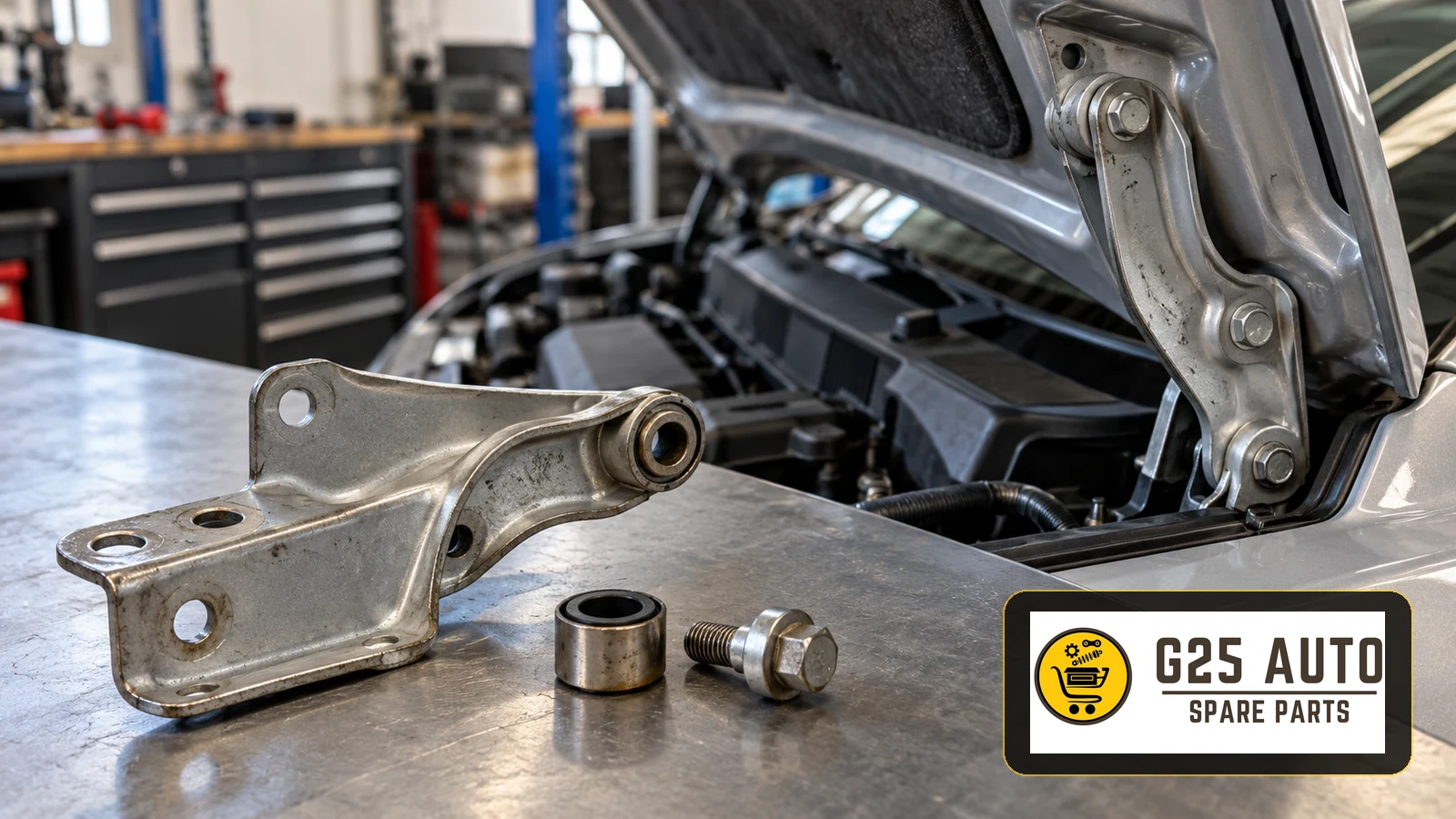
Bonnet hinges, bushes and adjustment bolts help the bonnet open and close correctly. Problems with these components can cause poor seating, squeaks and potentially unsafe operation. When choosing replacement parts, check the applicable OEM or part references against the vehicle identification number, relevant engine code and production date.
Functions of the Bonnet Hinge System
The bonnet hinge system performs several functions despite its apparently simple construction. It guides the bonnet as it opens and closes and contributes to its correct positioning when closed.
The hinges carry the bonnet’s weight and transfer the load to the body. That weight needs suitable support during movement and repair. Bushes at applicable pivot points help control friction and movement. Adjustment bolts or the relevant mounting arrangement allow the bonnet position relative to the body to be set so that the surrounding gaps are appropriate.
Fault Symptoms: When Might There Be a Problem?
Several symptoms can indicate a problem in the bonnet hinge system. None provides a definite diagnosis on its own; a professional inspection is recommended.
Visual and Audible Signs
Squeaking, cracking or rubbing noises when opening or closing the bonnet may indicate wear at a hinge pivot or bush. If one side sits higher or lower than the other, the hinge position or adjustment may have changed.
Uneven gaps between the bonnet and the wings or headlamp units are another possible sign. A larger gap on one side when the bonnet is closed warrants an inspection of the alignment and associated components.
Operating Problems
A bonnet that binds, needs unusual force or falls unexpectedly presents a serious safety concern. Damaged or worn hinges may be involved, but the cause requires inspection. A bonnet that does not close fully or engage the latch correctly can also have an alignment problem.
Bonnet vibration, particularly at higher road speeds, may accompany loose hinges or worn pivot components. These symptoms should be investigated rather than attributed to a particular part without checking.
Professional Inspection for a Reliable Diagnosis
The symptoms above suggest that something may be wrong, but a qualified technician should carry out a detailed inspection to establish the cause. The assessment includes the following checks.
The hinges are examined for cracks, fractures, wear and corrosion. Any bushes are inspected for deterioration or damage; their construction and serviceability depend on the particular hinge design.
The bonnet’s opening and closing movement is checked for abnormalities. Adjustment bolts and mounting fasteners are inspected for damage and correct security. Bonnet alignment is assessed using the appropriate equipment and vehicle procedure.
Comparing Hinges, Bushes and Adjustment Bolts
| Component | Main Function | Material Type | Causes of Deterioration | Replacement Timing |
|---|---|---|---|---|
| Bonnet hinge | Supports the bonnet and guides opening movement | Depends on the vehicle design | Mechanical fatigue, corrosion or impact damage | According to condition and repair assessment |
| Hinge bush | Controls friction and movement at applicable pivots | Depends on the hinge construction | Ageing, environmental exposure and wear | According to condition; no universal interval |
| Adjustment bolt | Helps set bonnet position where this arrangement is used | Check the specified fastener | Corrosion or damage from incorrect tightening | When damaged, missing or required by the repair procedure |
Why OEM and Part Reference Verification Matters
Identifying the correct part reference is an essential step when choosing a bonnet hinge or related component. An incorrect part can cause installation difficulties and compromise safe operation.
Verification Using the VIN
The vehicle identification number, or VIN, identifies the vehicle and supports application checking. Vehicles with the same model name and year can still use different hinge arrangements depending on the applicable specification.
A VIN-based parts enquiry can help identify the relevant manufacturer references. An OEM reference is useful for comparison, but a reference alone should not be treated as an unconditional guarantee that a particular offered product fits.
Engine Code and Production Date
Where the parts catalogue distinguishes applications by engine type, the engine code helps identify the correct version. Check the actual application information rather than assuming hinge strength or fitment from the engine’s size or weight.
The production date also matters because a manufacturer may change a design during a model year. Similar-looking vehicles built at different dates may therefore require different parts.
Choosing Genuine or Aftermarket Parts
Replacement choices commonly include genuine parts and alternatives from independent manufacturers. Both categories require careful application and product checks.
Characteristics of Genuine Parts
Genuine parts are supplied through the vehicle manufacturer’s parts system. Select the correct reference and revision for the vehicle so that the mounting arrangement and component specification correspond to the intended application.
Check the actual warranty terms and supply information. Part origin alone does not establish service life, availability or the terms offered for a particular purchase.
Assessing Aftermarket Parts
Aftermarket parts are made by independent manufacturers as alternatives to the original component. Assess the documented product specification and application information rather than assuming equivalent standards from the category name.
Compare the actual offers, including the stated design, availability and warranty. Claims that an alternative improves on the original design need supporting product evidence.
The manufacturer’s reliability also matters. An unsuitable or poorly made component can lead to early problems and safety concerns. Verify the supplier and the proposed part before ordering.
Checklist Before Parts Selection and Replacement
- Have the vehicle identification number ready.
- Identify the relevant engine code and production date.
- Record the OEM or part reference on the existing component.
- Inspect both hinges before deciding which components need replacement.
- Inspect the bushes or pivot components at the same time.
- Assess adjustment bolts for corrosion or damage.
- Check the reliability of the parts supplier.
- Check whether special installation tools or supports are required.
- Read the warranty terms and retain the documentation.
- Include the required alignment checks after installation.
Installation Process and Points Requiring Care
Bonnet hinge replacement calls for suitable expertise and the correct tools. Incorrect installation or inadequate support can allow the bonnet to fall or leave it incorrectly retained.
Why Professional Installation Matters
The bonnet’s weight must be securely supported while the hinge is being replaced. The existing position can be marked as a reference for installation, followed by adjustment according to the vehicle procedure. Appropriate assistance and support equipment may be needed.
After installation, the bonnet alignment must be checked and adjusted as required. Check the surrounding gaps and correct operation of the latch mechanism before considering the repair complete.
Maintenance and Care
Appropriate maintenance helps keep the hinge system operating correctly. Follow the vehicle instructions for lubrication, including whether lubrication is required and which product is suitable. Excess lubricant can collect dirt, so avoid applying more than the procedure calls for.
Inspect bushes and pivot components for damage or deterioration during the relevant maintenance checks. Investigate cracking, stiffness or abnormal movement and replace components where the assessment requires it. There is no single inspection or replacement interval suitable for every design.
Close the bonnet in the manner specified for the vehicle. Avoid uncontrolled handling that puts unnecessary shock loads on the hinges or surrounding components.
Frequently Asked Questions
How Often Should Hinge Bushes Be Replaced?
There is no universal replacement age. Serviceability and deterioration depend on the design and operating conditions. Squeaking or stiffness calls for an inspection to establish whether replacement is necessary.
Can a Hinge on Only One Side Be Replaced?
A single hinge may be replaceable, but inspect both sides and follow the repair requirements. Do not assume that replacing both is always necessary; base the decision on condition and alignment.
Why Is Bonnet Alignment Important?
Correct alignment supports the intended fit of the bonnet and proper latch operation. It also helps maintain consistent surrounding gaps and the vehicle’s appearance. Do not assume alignment alone resolves every water-entry or aerodynamic concern.
Are Aftermarket Hinges as Safe as Genuine Ones?
Assess the particular product’s documented suitability and quality information. A reliable manufacturer and relevant certification can support the assessment, but an aftermarket label alone does not demonstrate equivalent performance.
Does a Hinge Fault Affect Driving Safety?
Yes. A serious hinge or retention problem can compromise bonnet security. Have the fault inspected and safe operation restored before using the vehicle. A hinge fault alone does not establish an airbag sensor fault.
Conclusion
Bonnet hinges, bushes and adjustment bolts have an important role in safe, functional bonnet movement and positioning. Recognising problems early and choosing suitable replacement parts helps restore the intended operation.
Use the VIN, relevant engine code and production date to support parts verification. Check OEM references and choose a reliable supplier. Give documented quality and application suitability priority when comparing genuine and aftermarket products.
Arrange competent installation and appropriate ongoing care. A small hinge problem can develop into a more serious retention or repair concern if left unresolved. Regular checks in line with the vehicle’s requirements help identify deterioration before it progresses.