
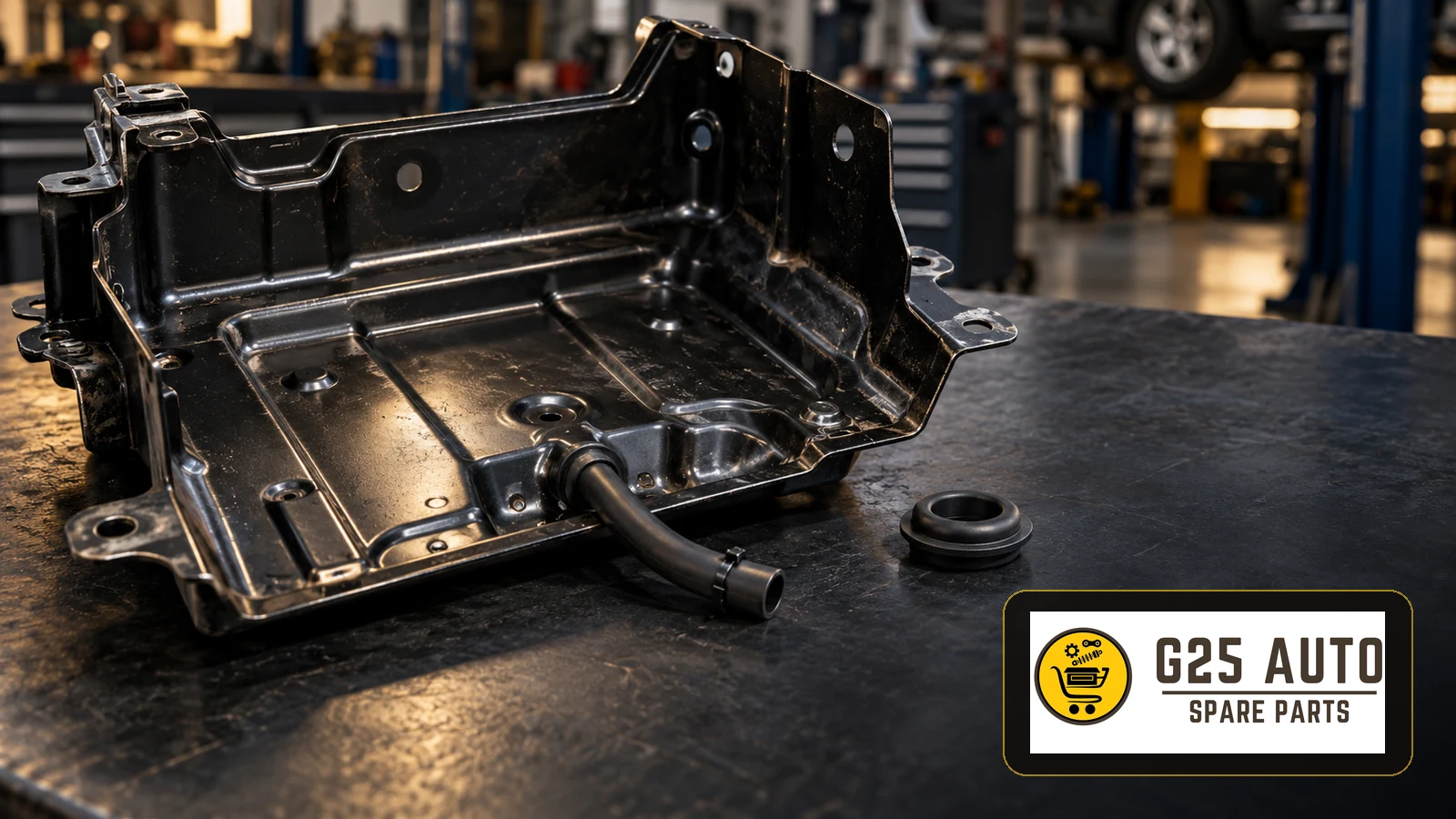
To select a battery tray drain plug or outlet fitting, first identify the component in the vehicle parts catalogue and confirm its function: a tray drain carries liquid away, a body blanking plug closes an opening, and a battery vent connection releases gases from the battery. These parts are not interchangeable. For workshops and parts distributors across Europe and the Balkans, the safest starting point is the vehicle identification, the installed battery details and a clear photograph of the original installation.
Identify the drain before ordering a plug
Battery tray drainage
The tray supports the battery. Depending on the vehicle design, the surrounding installation may include a drainage opening, outlet, hose or retaining fitting. Trace the route using the workshop information: do not assume that an opening should be sealed simply because a plug fits it. Equally, do not remove a body closure because it resembles a drain. The catalogue illustration and service procedure should establish what belongs there.
Battery ventilation
A battery vent connection belongs to the battery casing and, where specified, connects to a hose routed outside the vehicle. It is separate from the tray drain. ACDelco explains that batteries using a single external vent tube may require the opposite vent port to be plugged; configurations can differ. Follow the battery and vehicle instructions, and never block all required vent outlets. Cell filler caps and internal pressure valves are another category and must not be treated as tray repair parts.
Inspect the cause of moisture and corrosion
Record where moisture appears before cleaning the area. Inspect the tray, outlet, hose connections and surrounding bodywork for debris, damage, loose fittings and corrosion. Look for a displaced drain tube or a route that no longer matches the service information. A wet tray alone does not identify a failed plug, and starting problems do not prove a drainage fault.
VARTA recommends checking the battery compartment and brackets for corrosion and damage, and investigating possible acid leakage. Do not assume that liquid near a battery is harmless rainwater. A damaged or leaking battery needs assessment by a trained technician; replacing a drain fitting does not resolve the underlying battery fault.
Routing matters as much as the fitting itself. An FCA service bulletin for specific North American vehicles treats the tray drain pipe, battery vent pipe and vent cap as separate components in a corrosion repair. That example supports checking the complete route; its parts and repair procedure must not be applied to European vehicles without vehicle-specific confirmation.
Build a clear parts enquiry
Use the VIN and applicable production information to locate the correct vehicle catalogue entry. Record the battery manufacturer and model separately, because a replacement battery may have a different vent arrangement from the original. Ask the supplier to identify whether the required item is a blanking plug, drain outlet, grommet, hose or complete assembly.
Photographs should show both the installed position and the removed component when safe access is available. Compare the attachment method, sealing profile, mating surface and hose connection against documented specifications. Colour and visual similarity are insufficient evidence of compatibility. Dimensions can support identification when taken from the actual part or an authoritative drawing; they should never be guessed from a product photograph.
For an alternative replacement, request a documented application reference and suitable material information for its location. Do not assume that every rubber plug has the required chemical resistance or that every plastic outlet uses the same retention system. Confirm whether seals and clips are included, and obtain installation instructions before approving a substitute.
Plan replacement around the vehicle procedure
Determine whether battery removal is required for access. Follow the manufacturer’s electrical isolation and battery handling instructions, including any vehicle-specific shutdown and reconnection steps. Use appropriate eye and hand protection and keep ignition sources away. Do not open a sealed battery to investigate a tray drain.
Once access is safe, inspect the mounting opening and surrounding tray. A new fitting will not correct a cracked seat or a badly corroded support. Clean or repair the area using the specified method. Fit the confirmed replacement with the required seals and retainers; use only the lubricant, sealant or tightening instruction specified for that installation.
Restore the original drain and vent routing without kinks, pinching or unsupported sections. Confirm that the battery, covers and nearby wiring do not obstruct the fittings. Verify drainage using the prescribed service method rather than pouring water over electrical components. Record the inspection and check the area at the vehicle’s specified service intervals, with further investigation if moisture or corrosion returns.
Workshop and procurement checklist
- Confirm the vehicle identity and relevant catalogue illustration.
- Separate tray drainage, body closures and battery ventilation.
- Record the installed battery identification and vent layout.
- Inspect the complete route and the source of any liquid.
- Match the fitting, seal, retention and mating surface.
- Obtain application evidence and replacement instructions.
- Check the tray condition before installing the new part.
- Document final routing, secure attachment and service checks.
Frequently asked questions
Does every battery tray have a removable drain plug?
No universal arrangement should be assumed. Confirm the installed design in the vehicle parts catalogue and workshop information before ordering or removing anything.
Can a universal body plug replace a drain outlet?
Only if its documented application and function match the original installation. Sealing a required outlet can defeat the intended drainage route.
Will a new plug stop battery acid leakage?
A tray fitting cannot repair a leaking battery or a ventilation fault. The technician must identify and address the source of the liquid as well as any damaged drainage components.
Should both battery vent ports be plugged?
No. Required gas outlets must remain functional. Follow the instructions for the actual battery and vehicle hose configuration rather than using the tray drain as a guide.
Technical references
VARTA battery replacement guidance; ACDelco battery vent plug guidance; FCA battery drain and vent routing bulletin, specific North American applications.