
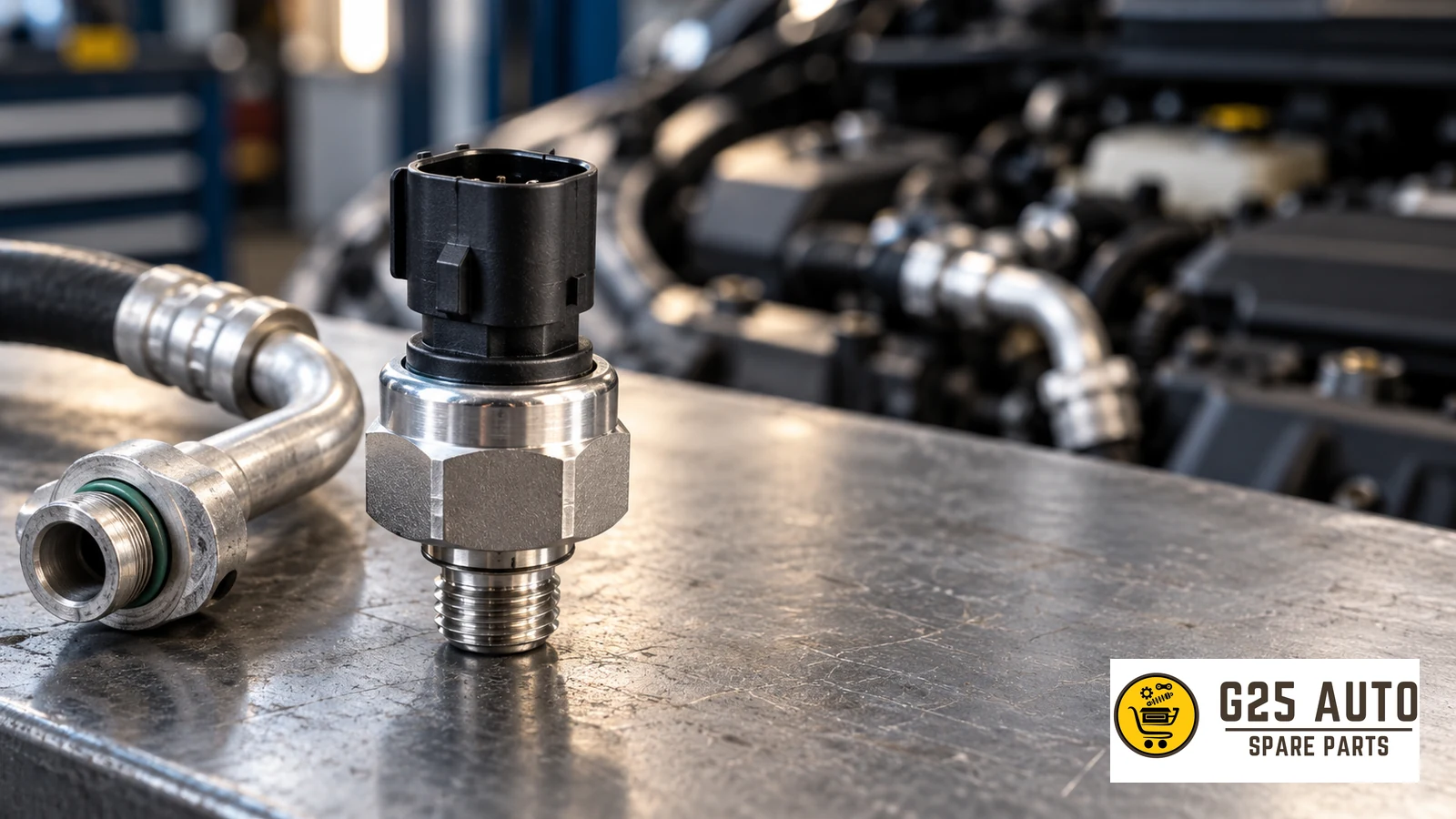
An air conditioning pressure sensor measures refrigerant pressure in a vehicle’s climate control system, helping it operate safely and efficiently. When abnormal pressure is detected, the control system can disable the compressor to help prevent damage. A faulty pressure sensor may stop the air conditioning from operating or cause intermittent operation.
How Does an Air Conditioning Pressure Sensor Work?
Pressure sensing allows the air conditioning system to monitor refrigerant conditions. Depending on the vehicle, the system may use pressure sensors or switches on the high-pressure or low-pressure side; the number and arrangement vary. Electronic sensors convert pressure changes into electrical signals using a sensing element whose design depends on the application.
The sensor sends its readings to the vehicle’s electronic control system. The controller uses this information to help determine when to enable or disable the compressor. If pressure moves outside the specified operating range, the system can stop compressor operation.
Functions of the Air Conditioning Pressure Sensor
- Monitoring system pressure: Provides information about refrigerant pressure during operation.
- High-pressure protection: Helps the control system stop the compressor when pressure becomes excessive.
- Low-pressure monitoring: Helps protect the system when a leak or insufficient charge causes low pressure, depending on the system design.
- Compressor control: Supports compressor operation under suitable conditions.
- Efficiency: Contributes to efficient air conditioning operation.
- System protection: Helps reduce the risk of damage to components.
Fault Symptoms and Observable Problems
Problems involving the pressure sensor can produce several noticeable symptoms. Recognising them can help identify a problem early, although these signs can also have other causes:
Air Conditioning Symptoms
- The compressor does not engage.
- The air conditioning switches on and off intermittently.
- There is no response when the air conditioning button is pressed.
- Cooling performance drops noticeably.
- Unusual noises occur during air conditioning operation.
- The vents do not deliver the expected cold air.
Dashboard Indicators and Warnings
- An air conditioning fault indicator illuminates, where fitted.
- The check engine light comes on.
- Air conditioning fault codes are stored in the vehicle’s control system.
- Climate control warning messages appear on the infotainment display, where supported.
Engine and General Symptoms
- Air conditioning operation changes with engine speed.
- Engine performance changes abnormally when the air conditioning is switched on.
- Unusual heat is noticed under the bonnet.
Diagnosis and Professional Inspection
Confirming a pressure sensor fault requires suitable professional equipment and expertise. After symptoms have been identified, the following checks help distinguish sensor faults from other system problems:
Professional Diagnostic Steps
Electronic scanning: A workshop or air conditioning specialist reads the vehicle’s fault codes using suitable diagnostic equipment. Codes P0530 to P0533 can indicate faults involving the refrigerant pressure sensor circuit; they do not by themselves prove that the sensor is defective.
Pressure measurement: Suitable manifold gauges are used to measure actual system pressure, which is compared with the sensor readings under the specified test conditions.
Electrical testing: The sensor connections, wiring continuity and voltages are checked with a multimeter against the vehicle’s specifications.
Visual inspection: The sensor and surrounding connections are examined for corrosion, moisture and physical damage.
Comparative analysis: Where another pressure sensor is fitted, its readings may provide additional diagnostic context, allowing for its location and operating conditions.
Choosing Original or Aftermarket Parts
When a pressure sensor needs replacement, original and aftermarket parts are possible options. Both have advantages and points that require checking.
Characteristics of Original Parts
Original parts are supplied to the vehicle manufacturer’s specification for the relevant application. The correct part reference still needs to be verified, and warranty coverage depends on the applicable terms. Purchase costs may be higher, while lead times vary with the supplier and part.
Characteristics of Aftermarket Parts
A suitable quality aftermarket sensor should meet the technical requirements of its intended application. It may offer a lower purchase cost or an alternative supply route, but neither availability nor equivalence should be assumed. Choosing a reputable manufacturer and checking the documented specification are essential.
Part Selection Comparison
| Feature | Original Part | Quality Aftermarket Part |
|---|---|---|
| Fitment | Verify the correct application and reference | Verify the cross-reference and application |
| Quality standards | Vehicle manufacturer specification | Check documented standards and any relevant certification |
| Lead time | Depends on the part and supplier | Depends on the part and supplier |
| Purchase cost | May be higher | May offer a cost advantage |
| Warranty coverage | Subject to manufacturer terms | Subject to manufacturer or supplier terms |
| Supply channels | Authorised supply channels | Aftermarket supply networks |
OEM References and the Importance of Verification
Identifying the correct component is the most important step when selecting a pressure sensor. Different versions of the same vehicle make and model can use different sensors.
What Are OEM and Part References?
An OEM reference identifies a part within the original equipment manufacturer’s numbering system. It helps establish the intended application when checked against the relevant catalogue information. Different production years of the same model can have different sensor references.
Information Needed for Verification
- Vehicle identification number (VIN): The vehicle’s unique identifier, usually 17 characters, supports application checks through the relevant catalogue.
- Engine code: Identifies the engine variant; its location depends on the vehicle and documentation.
- Production date: Check the actual build date using reliable vehicle or manufacturer records.
- Equipment specification: Features such as manual or automatic climate control may affect the sensor required.
- Existing part reference: Record the code on the sensor being replaced and check it against current application data.
Risks of Choosing the Wrong Part
An incompatible pressure sensor may prevent air conditioning operation, produce incorrect readings or interfere with system protection, potentially causing damage. Part selection therefore requires technical verification and, where necessary, specialist support.
Pre-Replacement Checklist
Before replacing a pressure sensor, the following checks can help avoid unnecessary expense:
- ☐ Check the air conditioning fuses and relays.
- ☐ Inspect electrical connections for corrosion or looseness.
- ☐ Have the refrigerant charge assessed using suitable equipment.
- ☐ Read fault codes with a suitable professional diagnostic tool.
- ☐ Check that the sensor connector is clean and undamaged.
- ☐ Verify the operation of other air conditioning components.
- ☐ Prepare the vehicle’s VIN and engine code.
- ☐ Record the OEM reference on the existing sensor.
- ☐ Establish whether refrigerant recovery and recharging will be required.
- ☐ Consult an authorised workshop or qualified air conditioning technician.
Maintenance and Service Life Tips
Regular maintenance supports reliable air conditioning operation and can help protect the pressure sensor and its connections:
- Operate the air conditioning periodically in winter where conditions and the vehicle’s instructions allow.
- Replace climate control filters at the specified intervals.
- Have the air conditioning system inspected according to the vehicle’s maintenance guidance and condition.
- Do not ignore signs of refrigerant leakage.
- Keep under-bonnet electrical connections clean and dry.
- Avoid splashing water or detergent onto the sensor area.
- Protect sensitive components appropriately when the engine compartment needs cleaning.
Reliable Spare Parts Sourcing
Working with a reliable supplier matters when selecting components such as air conditioning pressure sensors. Comparing original and quality aftermarket options can support an informed purchasing decision.
For G25Auto B2B purchasing in Europe and the Balkans, use the relevant part references and vehicle application information when assessing supply options. Confirm technical suitability before ordering rather than relying on a general product description.
Frequently Asked Questions
How long does an air conditioning pressure sensor last?
Service life depends on operating conditions. Moisture, corrosion and electrical faults can cause premature failure, so a fixed lifespan should not be assumed.
Does a pressure sensor fault make the vehicle unsafe to drive?
A fault may primarily affect climate control, but loss of air conditioning can reduce comfort and impair visibility when windows mist up. Assess any effect on visibility and investigate associated warnings rather than assuming the fault is harmless.
Must refrigerant be removed before replacing the sensor?
This depends on the sensor location and system design. Some applications allow replacement without opening the refrigerant circuit, while others require refrigerant recovery. A qualified technician should establish and follow the correct procedure.
Can a pressure sensor be cleaned, or must it be replaced?
The sensor is an electronic component, and cleaning generally does not repair an internal fault. A confirmed defective sensor needs replacement, although cleaning or repairing a contaminated connector may resolve a connection problem.
If one of two pressure sensors fails, should both be replaced?
Replacement of both is not automatically necessary. Where two sensors are fitted, their similar age and operating conditions may justify checking both, but replacement should follow diagnosis and the applicable service guidance.
Why is compatibility checking so important?
The wrong sensor can create electrical incompatibility, produce incorrect pressure readings and potentially damage the air conditioning system. VIN and OEM reference checks support identification, but the application and technical specification must also be verified.
Conclusion
The air conditioning pressure sensor is an important monitoring and control component in modern vehicle climate systems. Its pressure readings support comfort and system protection. Recognising symptoms early and obtaining an accurate diagnosis can help prevent more extensive and costly problems.
Original and aftermarket replacement parts each have potential advantages. Part quality and verified suitability for the vehicle are the priorities, making OEM reference checks, VIN-based application checks and specialist advice important.
Accurate diagnosis of electronic components such as pressure sensors requires professional equipment and expertise. After identifying symptoms, arrange a detailed inspection by an authorised workshop or qualified air conditioning technician to avoid unnecessary work and expense.
Regular maintenance and appropriate operation support the service life of the air conditioning system and its pressure sensor. Periodic operation in winter where appropriate, timely filter servicing and inspections in line with the vehicle’s guidance all contribute to reliable performance.