
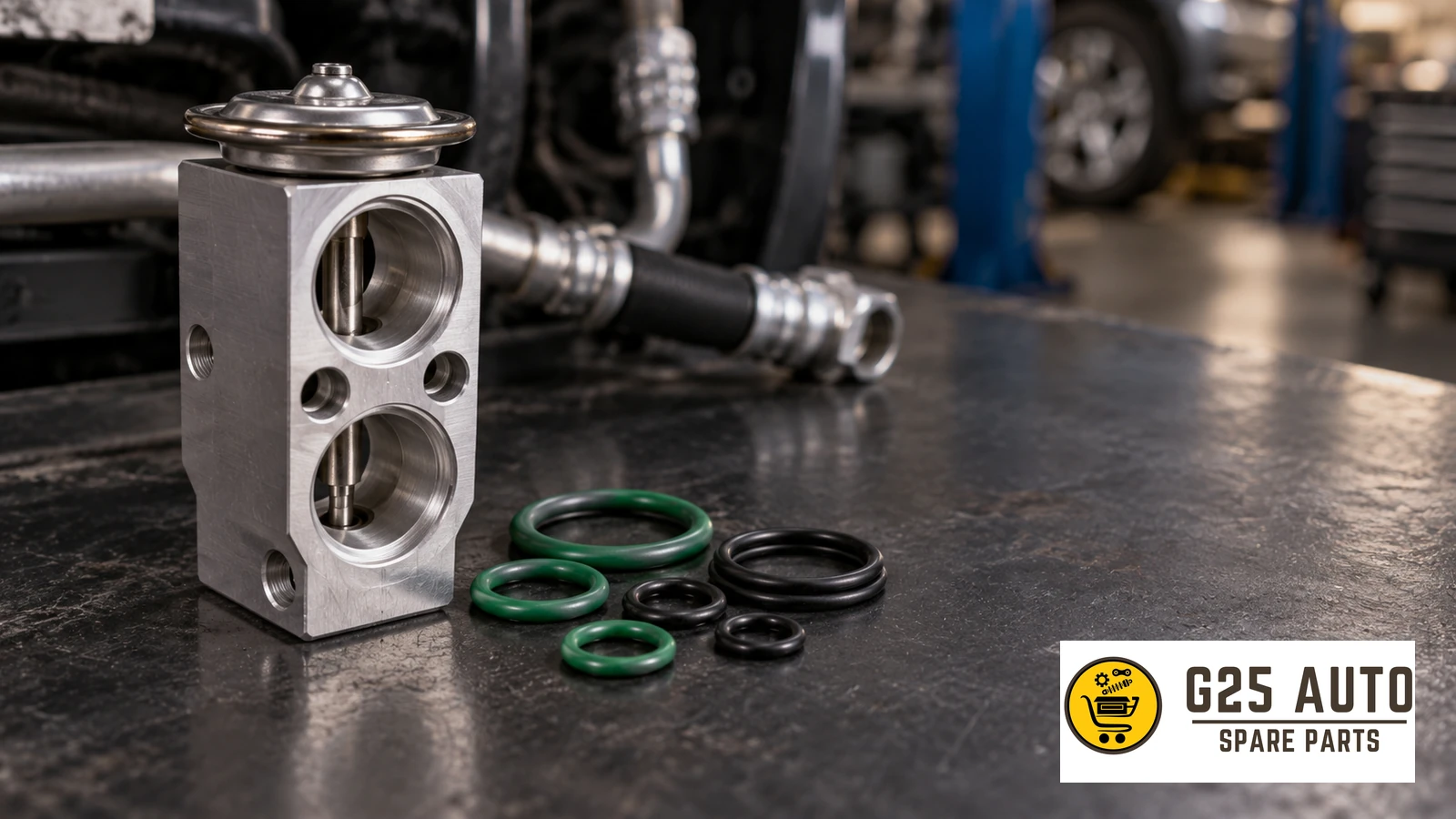
Air-conditioning expansion valves and O-ring seals are critical components of a vehicle’s climate-control system. The expansion valve regulates refrigerant flow and pressure, while O-rings maintain sealed connections and help prevent refrigerant leaks. These components need to work together correctly for effective air-conditioning performance.
What Is an Air-Conditioning Expansion Valve and How Does It Work?
The expansion valve is a regulating component that allows high-pressure liquid refrigerant to expand to a lower pressure. The refrigerant then evaporates in the evaporator, absorbing heat and producing the cooling effect.
Vehicle air-conditioning systems may use the following refrigerant-metering arrangements:
- Thermostatic expansion valve (TXV): Automatically adjusts refrigerant flow in response to conditions at the evaporator outlet.
- Orifice tube: Produces a pressure drop through a fixed opening rather than using an adjustable valve.
The Importance of O-Ring Seals in Air Conditioning
O-rings are rubber or elastomer sealing elements used at many air-conditioning connections. They perform an important role at expansion-valve connections, compressor ports, and condenser and evaporator connections.
Air-conditioning O-rings require materials specified for the particular refrigerant and lubricant. Material compatibility and temperature resistance must be checked against the component specification; a generic rubber type alone does not establish suitability for every system.
Symptoms of Expansion-Valve and O-Ring Faults
Problems with an expansion valve or O-ring seals may produce several symptoms:
Common Fault Symptoms
- Insufficient cooling from the air conditioning.
- Intermittent or inconsistent cooling.
- Ice forming on the evaporator.
- An oily smell associated with leakage under the bonnet.
- The air-conditioning compressor repeatedly cycling on and off.
- Visible oil traces or staining around pipe connections.
- Unusual sounds, such as hissing or rumbling, while the air conditioning operates.
- An air-conditioning pressure warning, where the vehicle provides one.
Important: Professional Inspection Is Needed for Diagnosis
These symptoms may suggest an expansion-valve or O-ring problem. A specialist air-conditioning workshop can select appropriate checks to establish the cause:
- Leak testing with an electronic detector.
- Measuring system pressure on the high- and low-pressure sides.
- Visual leak inspection using compatible UV dye where permitted by the system procedure.
- A vacuum holding check as part of the specified service procedure; this alone does not establish leak-free operation.
- Thermal imaging to support assessment of evaporator performance where appropriate.
Without suitable diagnostic checks, conclusions remain uncertain and can lead to unnecessary component replacement.
Original and Aftermarket Parts Compared
| Feature | Original Part | Quality Aftermarket Part |
|---|---|---|
| Manufacturer warranty | Check the vehicle manufacturer’s applicable terms | Check the component manufacturer’s applicable terms |
| Fitment | Specified for particular vehicle applications | Verify the application and reference against the required specification |
| Quality standards | Vehicle manufacturer’s requirements | Check the individual manufacturer’s specifications and documented approvals |
| Lead time | Confirm for the required reference | Confirm for the required reference |
| Brand choice | Vehicle manufacturer’s parts channel | Alternative manufacturers, depending on the application |
| Cost | Assess the quotation for the specific part | Compare quotations for parts meeting the required specification |
Checklist for Selecting the Correct Part
Before ordering an expansion valve or O-ring seal, gather the following information:
Part Selection Checklist
- Vehicle make and model, for example Volkswagen Golf.
- Production year and month, checked against vehicle records or the parts catalogue.
- Engine type and code, available from vehicle documentation or engine identification.
- Vehicle identification number (VIN).
- Climate-control system type: manual air conditioning or automatic climate control.
- Refrigerant type, such as R134a or R1234yf, as specified for the vehicle.
- The existing component’s OEM reference, where identifiable.
- Engine capacity and fuel type, such as petrol or diesel.
Why Is This Information Essential?
Even within the same model, different production years, engine options or equipment packages can use different air-conditioning systems. Manual and automatic climate-control versions may use different expansion valves. A VIN helps identify the vehicle configuration, but the resulting part selection still needs to be checked against the applicable catalogue and component details.
OEM references identify specific manufacturer parts. They help locate original replacements and aftermarket cross-references, although a cross-reference should be checked for the exact application.
Installation and Maintenance Recommendations
Points to Consider When Replacing an Expansion Valve
- Recover the refrigerant with professional equipment before opening the system; do not release it into the environment.
- Evacuate the system at the stage specified in the manufacturer’s replacement and charging procedure.
- Replace the affected O-rings and lightly lubricate them with the specified compatible oil where instructed.
- Tighten connections to the manufacturer’s torque specification; overtightening can damage the seals.
- Check for leaks after the system has been recharged.
Professional Advice on Replacing O-Rings
- Renew the relevant O-ring when a connection is opened, following the service instructions.
- Use the specified air-conditioning oil for seal lubrication where required by the fitting procedure.
- Do not mix O-rings of different diameters or cross-sections.
- Keep seal grooves free from burrs, scratches and contamination.
- Protect stored O-rings from sunlight and excessive heat, which can cause deterioration.
Frequently Asked Questions
How Long Does an Expansion Valve Last?
Expansion-valve service life varies with system condition and use. Contamination, moisture and neglected maintenance can shorten its life, so a fixed replacement age should not be assumed.
Why Do O-Ring Seals Harden and Crack?
Material ageing, temperature changes and unsuitable refrigerant or lubricant can cause O-rings to lose elasticity. Extended periods without air-conditioning use may also be relevant when assessing the system’s condition.
Can Replacing Only an O-Ring Solve the Problem?
If the fault is confined to a leaking O-ring, replacing it may be sufficient. However, prolonged operation with refrigerant loss may also have affected the compressor or expansion valve. A wider system inspection is therefore advisable.
Can an Aftermarket O-Ring Damage the System?
An aftermarket O-ring must meet the required material, diameter and cross-section specifications. Compatibility with the system’s refrigerant and lubricant is essential. Suitability should be established from the product specification rather than assumed from its appearance or aftermarket status.
Does Every Refrigerant Leak Come from an O-Ring?
No. Leaks can also occur at compressor seals, corroded condenser or evaporator tubing, connection flanges and air-conditioning hoses. Professional leak testing is needed to locate the source.
Parts Sourcing and Reliable Purchasing
When sourcing critical components such as expansion valves and O-ring seals, work with a reliable supplier able to identify the required application. Have the vehicle details listed above ready before starting the search.
For G25Auto B2B enquiries serving Europe and the Balkans, provide the vehicle information and available OEM references so the proposed part and its application can be checked before ordering.
Preventive Maintenance Advice
The following measures can help maintain expansion valves, O-ring seals and the wider air-conditioning system:
- Operate the air conditioning during colder months in line with the vehicle manufacturer’s guidance to support lubricant circulation.
- Arrange professional air-conditioning servicing at the recommended intervals.
- Replace cabin filters according to the vehicle’s maintenance schedule and operating conditions.
- Keep the condenser area clean using an appropriate method.
- Have an unexpected loss of system pressure investigated promptly.
- Use only the refrigerant type specified by the vehicle manufacturer.
- Have lubricant requirements checked during professional air-conditioning service.
Conclusion
Expansion valves and O-ring seals are important to reliable vehicle air-conditioning operation. Faults can reduce system efficiency and affect cabin comfort; their effect on fuel consumption depends on the fault and operating conditions.
Use the VIN, engine code, production date and available OEM references when selecting replacement parts. General model compatibility information may be insufficient and can lead to an incorrect order.
The choice between original and aftermarket parts depends on the required specification, budget and availability. Assess aftermarket products against the relevant requirements, choose a reliable supplier and clarify the applicable return or exchange terms.
Replacing an expansion valve or O-ring requires professional knowledge and equipment. Refrigerant recovery and charging need appropriate handling and environmental care. Parts may be sourced separately, but installation should be entrusted to a qualified workshop, with any applicable warranty requirements checked.
Regular maintenance and appropriate use help preserve air-conditioning performance, cabin comfort and the condition of the vehicle.