
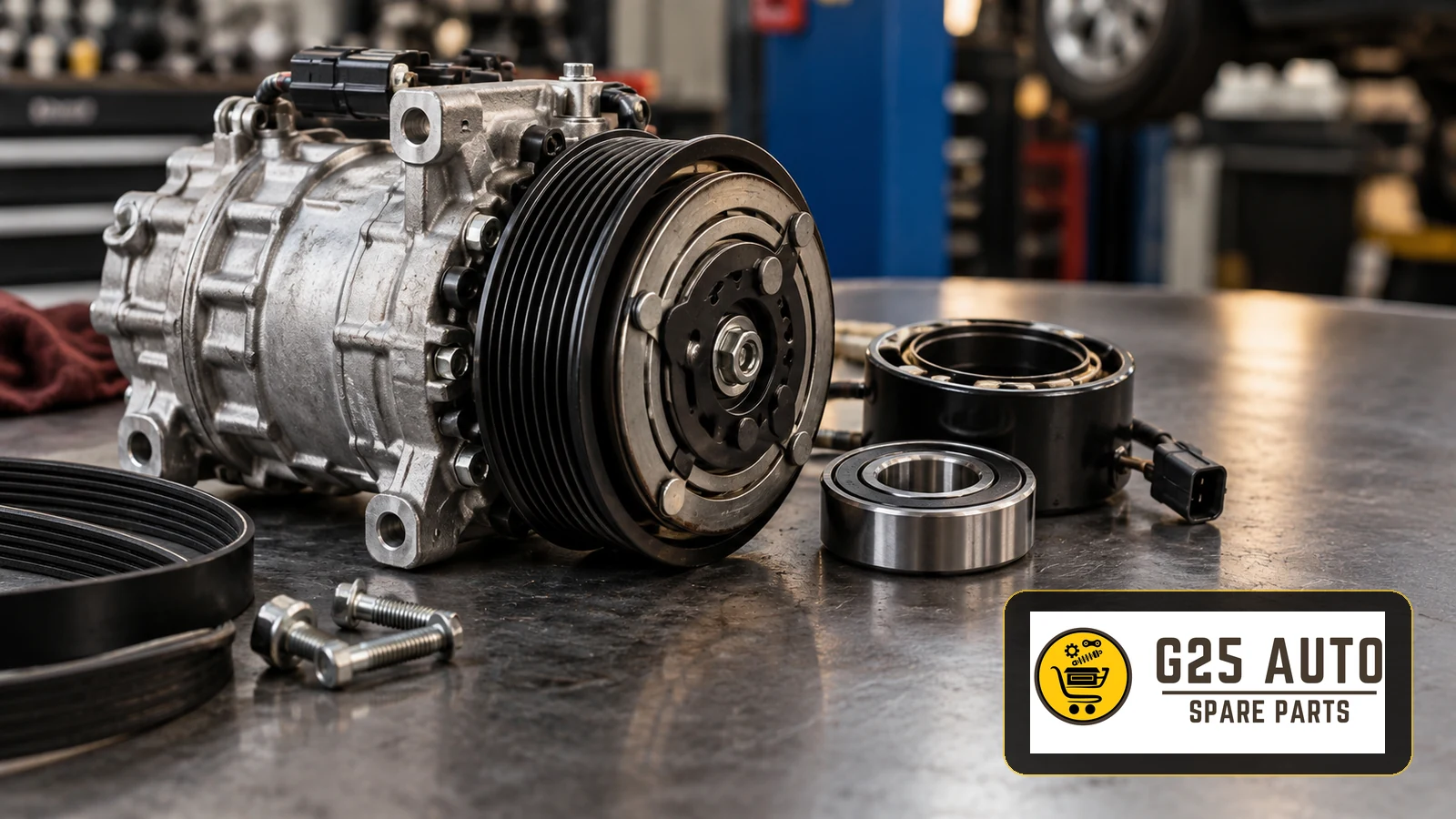
The air-conditioning compressor clutch and pulley are important components in vehicles equipped with this type of compressor drive. The compressor clutch is an electromagnetic mechanism that transfers engine power to the compressor; the pulley is the rotating component that takes drive from the belt and passes it to the clutch. A fault in these parts can prevent cooling or cause unusual noises.
What Are the Air-Conditioning Compressor Clutch and Pulley?
On a clutch-equipped automotive air-conditioning compressor, the clutch and pulley are two separate components that work together. The engine belt turns the pulley continuously, while the electromagnetic clutch engages when required to drive the compressor.
The Pulley’s Function and Construction
The compressor pulley consists of an outer body and bearing and is driven by a serpentine belt or V-belt. It rotates while the engine is running, but its rotation alone does not drive the compressor on this design. The bearing inside the pulley allows smooth rotation and is designed to withstand wear.
How the Clutch Works
When cooling is requested and system controls permit operation, current flows through the electromagnetic clutch coil, producing a magnetic field. This attracts the clutch plate towards the pulley and drives the compressor shaft. When the power supply is interrupted, the magnetic field disappears and the clutch releases.
Fault Symptoms and Warning Signs
Identifying compressor clutch and pulley problems early can help prevent further damage. However, symptoms do not necessarily establish that either component has failed; professional diagnosis is required.
Observable Symptoms
- Unusual noises: Squealing, squeaking or rattling from the compressor area
- No cooling: The system does not cool despite being switched on
- Intermittent operation: Cooling switches on and off unexpectedly
- Belt wear: Rapid serpentine belt wear or a burning smell
- Electrical problems: Repeatedly blown fuses or other electrical faults
- Vibration: Unusual engine vibration when the air conditioning engages
Professional Checks Are Needed for a Reliable Diagnosis
These symptoms can have several causes. Refrigerant pressure tests, electrical measurements, clutch air-gap checks and bearing inspection may be needed to identify the fault. A single symptom is not conclusive evidence of a failed component and should be assessed by a qualified technician.
Comparing Genuine and Aftermarket Parts
Genuine and aftermarket options may be available when replacing the compressor clutch and pulley. Each has potential advantages and points that require attention.
| Feature | Genuine Part | Quality Aftermarket Part |
|---|---|---|
| Compatibility | Confirm the exact application and reference | Verify the part reference and application coverage |
| Quality standards | Specified by the vehicle manufacturer | Depend on the product and manufacturer; review supporting documentation |
| Supply lead time | Check with the supplier | Check with the supplier |
| Cost | Depends on the specific part and supplier | May offer a lower-cost alternative; compare the actual quotation |
| Warranty | Check the applicable terms | Varies by brand and supplier |
| Range of options | Application-specific range | May include several alternatives; verify suitability |
What to Check When Choosing an Aftermarket Part
Review the manufacturer’s documented certifications, references and warranty terms carefully. Established aftermarket manufacturers may offer suitable alternatives, but product-specific evidence should support quality claims. For European and Balkan B2B orders through G25Auto, confirm the part specification and supplier terms before ordering.
Why OEM References and Vehicle Details Matter
Identifying the correct part reference is a critical step when selecting a compressor clutch or pulley. An incorrect choice can cause fitting problems, premature failure and additional costs.
OEM and Part References
Vehicle manufacturers use OEM (Original Equipment Manufacturer) references to identify parts. These references help establish the intended model, engine application and production period when checked against the relevant catalogue. Even within one make and model, different engine options can use different clutch and pulley designs.
Verification Using the Vehicle Identification Number
The vehicle identification number (VIN) identifies the vehicle. Using it with the manufacturer’s parts catalogue or vehicle records can help check production details, engine type and original equipment. VIN-based verification before ordering reduces the risk of compatibility errors, but fitment still requires confirmation against the relevant part data.
Engine Code and Production Date
The same vehicle model may have several engine options, each potentially using a different compressor system. The engine code may be found on the engine or in vehicle documentation. The production date also matters because manufacturers can introduce design changes during a model’s production life.
Installation and Replacement Checklist
The following points need attention when replacing a compressor clutch or pulley:
Checks Before Installation
- ✓ Confirm the correct part reference.
- ✓ If the refrigerant circuit must be opened, have the refrigerant recovered using professional equipment.
- ✓ Check electrical connections.
- ✓ Inspect the compressor and belt pulleys.
- ✓ Assess the condition of the bearing.
- ✓ Prepare the tools needed to measure the clutch air gap.
Points to Check During Installation
- ✓ Set the clutch air gap to the specification for the particular compressor.
- ✓ Tighten fasteners to the specified torque values.
- ✓ Connect and insulate the wiring correctly.
- ✓ Check belt tension.
- ✓ Check pulley alignment.
- ✓ Confirm the integrity of any refrigerant connections disturbed during the work.
Checks After Installation
- ✓ Where refrigerant servicing is required, recharge to the specified quantity and check operating pressures after the appropriate circuit preparation.
- ✓ If the circuit was opened, ensure the prescribed evacuation and leak checks are completed before recharging.
- ✓ Test electromagnetic clutch operation.
- ✓ Listen for unusual noises.
- ✓ Assess cooling performance.
- ✓ Perform a final belt condition check.
Common Causes of Failure and Prevention
Factors That Can Cause Premature Wear
Several common problems can contribute to compressor clutch and pulley failure. Incorrect belt tension can put excessive loads on the pulley and its bearing. A low refrigerant charge can affect compressor operating conditions; investigate the underlying problem rather than assuming it is the direct cause of clutch overheating.
Voltage fluctuations can interfere with electromagnetic clutch operation. Corroded or loose wiring connections can cause similar problems. Insufficient compressor lubrication can increase internal friction and accelerate wear.
Preventive Maintenance Recommendations
Regular maintenance can help extend clutch and pulley service life. Arrange professional air-conditioning inspections in line with the vehicle’s service requirements. Check belt condition and tension during servicing, and assess refrigerant pressures when required by the diagnostic or maintenance procedure.
Keep the compressor area free of excessive dirt and inspect visible wiring for damage. Periodic air-conditioning operation during colder months may help maintain system operation where permitted by the vehicle’s controls and operating instructions.
Frequently Asked Questions
When Should the Compressor Clutch Be Replaced?
Unusual noises, lack of cooling or intermittent operation can prompt a clutch inspection. Replacement should follow professional diagnosis. In some cases, the problem may be limited to a bearing or electrical connection.
Should the Pulley and Clutch Be Replaced Together?
They do not always need replacing together. If the pulley bearing is sound and its outer surface is undamaged, replacing only the clutch may be possible, depending on the design and service procedure. On an older or high-mileage vehicle, combined replacement may be economical where the labour overlaps; assess component condition and actual costs.
Why Is the Clutch Air Gap Important?
The air gap is important for electromagnetic engagement. An excessive gap can prevent engagement, while an insufficient gap can cause continuous rubbing and premature wear. Set it to the compressor manufacturer’s specification.
Can an Aftermarket Clutch Be as Durable as a Genuine Part?
A suitable aftermarket clutch may offer comparable service performance, but durability depends on the particular product and application. Assess documented quality information and warranty terms rather than assuming equivalence. Review manufacturer references and relevant user experience where available.
Does the Refrigerant Need Recharging After Clutch Replacement?
Clutch replacement itself may not require opening the refrigerant circuit. If the compressor or circuit has been opened, or a leak is present, refrigerant servicing may be necessary. Follow the applicable leak-testing and charging procedure; do not assume that every clutch repair requires a refrigerant top-up.
Conclusions and Recommendations
The compressor clutch and pulley play important roles in vehicles that use this drive arrangement. Correct operation supports effective cabin cooling. Recognising fault symptoms early can help prevent further damage and repair costs.
When selecting parts, use OEM references, VIN-based catalogue checks and engine details to verify compatibility. Neither genuine nor aftermarket parts are automatically the better choice in every case; product quality and correct installation matter. Choose a reliable supplier and check the documentation and warranty terms for the specific product.
Professional installation and correct adjustment support service life. Clutch air gap, electrical connections and belt tension should not be overlooked. Regular maintenance and inspections help keep the system operating correctly.
An informed approach to compressor clutch and pulley repairs supports cooling performance and long-term cost control. Investigating symptoms, choosing suitable quality parts and obtaining professional support are central to a successful repair.