
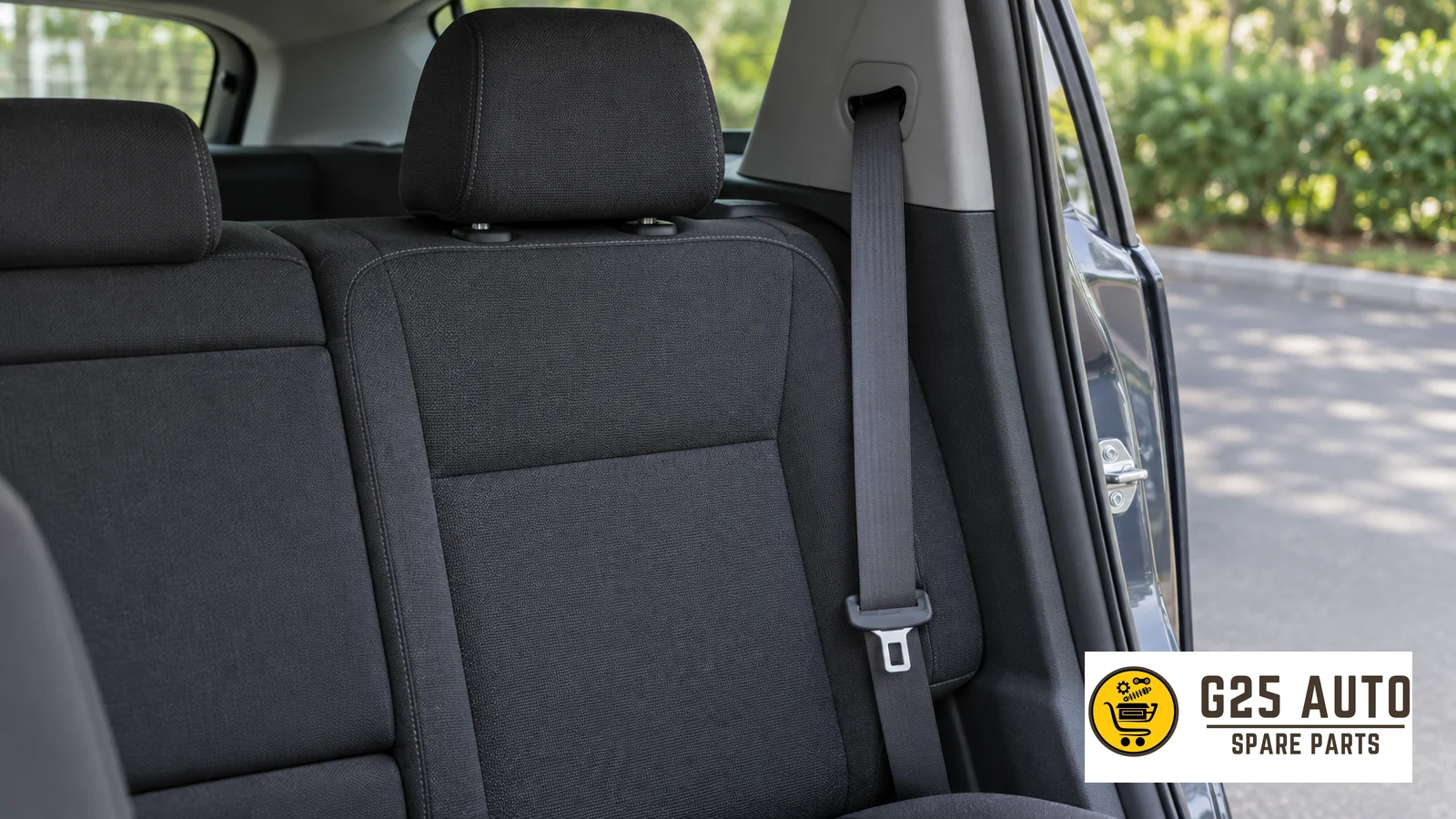
Short answer: When you return a rear seat backrest to the upright position after folding it to expand cargo space, verify that the lock has engaged according to the method in your vehicle manual. On some models, a red indicator shows the backrest is not yet locked. Do not allow a passenger to use that seating position until the backrest, headrest, and seat belt checks are complete.
Learn which section moves before expanding the cargo area
The rear seat may fold as a single unit or in sections to access the cargo area. How the sections are divided varies from vehicle to vehicle. In the example from the Volvo XC60 owner’s manual, the left outer section is separate, while the center and right sections move together. If a passenger will remain in the rear row, determine in advance which section will stay in place. Information showing which seating positions move with a particular folding lever may be found immediately next to that lever. If the marking is unclear, consult the appropriate manual diagram.
Consider both positions of the seat before bringing cargo to the vehicle. Sufficient space is needed while transporting cargo. When the cargo is unloaded, the seat’s movement path must be cleared again and the backrest must be locked. A small bag left behind a large box or an item forgotten on the floor can cause you to overlook the return movement. Knowing in advance which parts to check makes this brief task systematic.
Clear space before folding
Park the vehicle safely. Remove items from the sections to be folded and check the condition of the seat belts. The XC60 manual requires that belt buckles not be fastened before this operation and that sufficient clearance be left for seat movement. If you need to adjust a front seat, follow the sequence in the manual. If the seat backrest, headrest, or belt is caught on a front seat or other item, clear the obstruction before proceeding.
During folding, verify that no one enters the movement path in front of or behind the seat. If the vehicle has multiple release levers, identify the lever to be used from the relevant diagram in the manual. After operating the release lever, guide the backrest in a controlled manner in the direction shown by the manual. If the expected section does not open when you move the lever, verify you have selected the correct control before forcing another part.
Check three separate points when returning to upright position
| Check point | What is verified? |
|---|---|
| Backrest and latch | Movement path must be clear, backrest upright, and locking check in manual completed. |
| Headrest | If position changed during folding, headrest must be brought to use position and secured per manual. |
| Seat belt | Belt must not be trapped behind backrest; buckle and webbing must be accessible to passenger. |
Clear the backrest movement path
After the last item unloaded from the cargo area, look at the floor and the edges of the folded section. A belt webbing, cargo cover, or small item may have remained in the movement path. If the seat stops earlier than normal, rather than applying force, fold it back down in a controlled manner and inspect the gap between. The vehicle’s door and cargo openings provide different viewing angles. You can check an area you cannot see from one side from the other side.
Read the lock indicator correctly
In the Volvo XC60 example, a red indicator next to the lock signals that the backrest is released. If this indicator remains visible after the backrest is brought to the upright position, the manual states the backrest is not locked. Your vehicle may not have the same color, window, or location. Apply the check described in the manual for each section you move. Locking one section does not mean an adjacent independent section is also secured.
Check headrest and belt access
After the backrest is secured, check the headrest. In some configurations, the headrest position changes with the folding operation and is checked separately on return. Bring it to the position the manual describes for travel. Then verify that the belt webbing and buckle at the seating position are visible, accessible, and not trapped between the backrest and upholstery. Only at the end of this step should you assess whether the relevant seating position is ready for a passenger.
If the locking indicator does not clear
Re-read the correct closing sequence explained in the manual. If there is a visible obstruction around the backrest, remove it first. If the backrest is upright but the lock verification in the manual does not occur, do not use the relevant seating position. Obtain service support before intervening with a tool such as a screwdriver on the latch. If there are multiple independent sections in the rear row, tell the service which side moved and at which stage the lock indicator did not change.
If another person traveling in the vehicle also frequently changes the cargo arrangement, do not simply show them the location of the lever. Find the lock indicator in the manual together and look at where the belt should remain after returning to the upright position. In situations where one person prepares the cargo and another prepares the passenger seating, make clear who will perform the final check. This way a step that could be skipped by relying on the backrest appearing upright becomes part of a joint check.
Transition from carrying cargo to carrying passengers
If cargo will partially remain in the vehicle, plan the new position of the cargo before the backrest returns to the upright position. Moving a box leaning against the moving part to the side makes it easier both to access the seat and to see the belt passage behind it. After the backrest is secured, arrange the cargo as described in the vehicle manual for cargo placement. Cargo placement and passenger seat locking are separate checks. At the end of the job, review again which section remains folded and which section has been prepared for a passenger.
Especially if you will unload cargo from the vehicle and pick up rear passengers again on the same day, turn this sequence into a brief habit. First clear the movement area, then lock the backrest, then assess the headrest and belt. Take one final look from the rear door before a passenger sits down if needed. The backrest indicator seen from the cargo area and the belt path seen from the door may not be in view at the same time.
If you are doing this for the first time, keep the manual open before folding. When you find the headrest or backrest indicator specified by the manual on the vehicle, note from which angle it is easily seen. If you later have to perform the same operation in the dark, you can stop in a lighted area and check the indicator up close rather than looking at the backrest posture from a distance. As the driver, perform the final check before passengers settle in and fasten their seat belts.
Frequently asked questions
The backrest appears upright. Is the lock check still necessary?
Yes. Appearing upright from the outside and the latch engaging are separate conditions. Perform the locking check shown in the manual for that section.
Does every vehicle have a red indicator?
The indicator is vehicle-specific. Before looking for the red indicator from the Volvo XC60 example on your own vehicle, read the owner’s manual appropriate for the model and model year.
What should I do if the belt of the section I folded is trapped in between?
Before using the relevant seating position, move the backrest again in a controlled manner using the release step in the manual. Bring the belt to an accessible position, then repeat the lock and headrest check.
Source: Volvo XC60 2026 owner’s manual, folding the rear outboard seats section.