
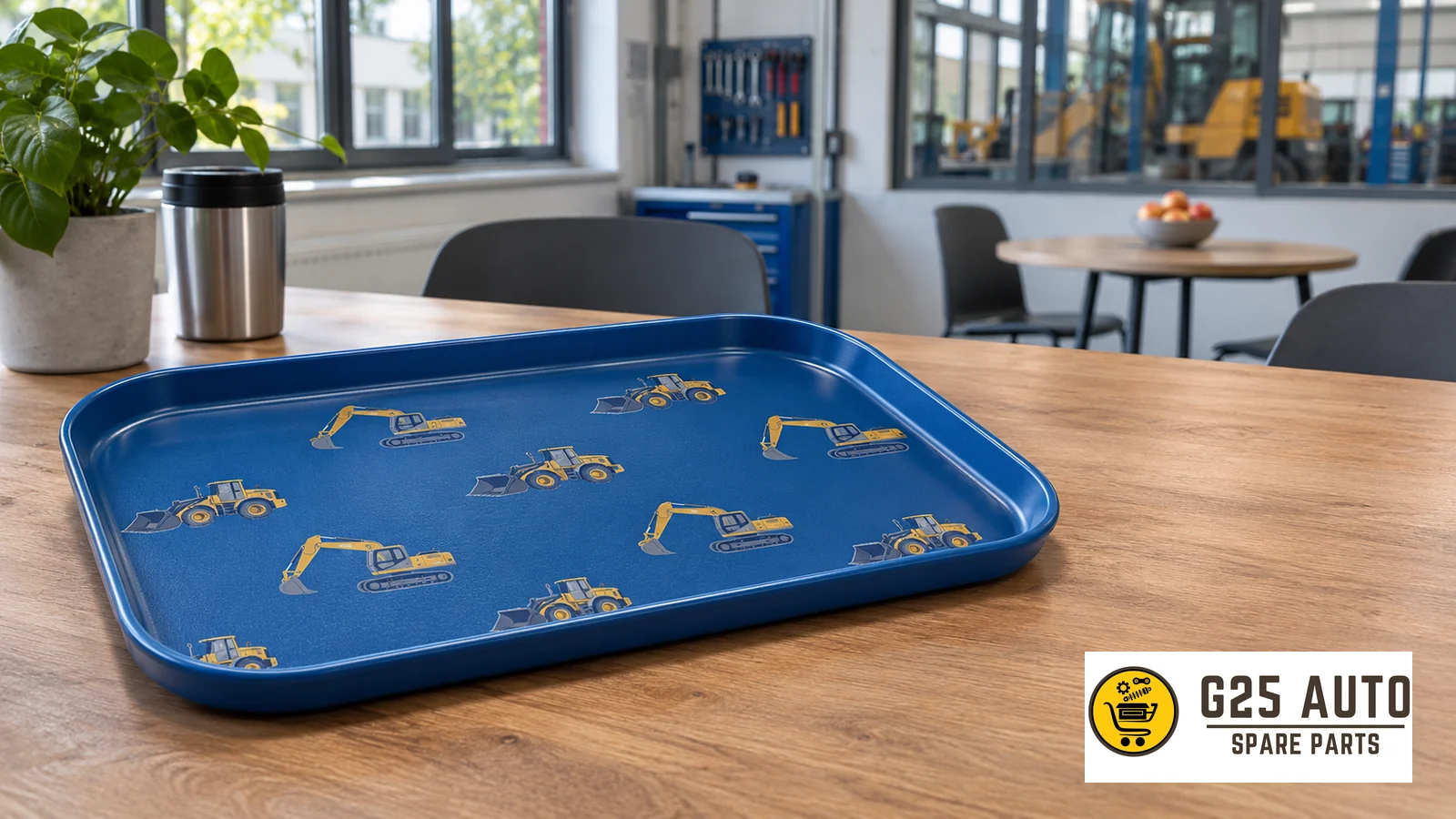
The example offered as Now And Then Construction Equipment Tray (product code 113996) in the Volvo Group official store includes construction equipment patterns, blue color, and Birch Veneer material description. This example demonstrates the importance of asking the seller which outer edge the dimension statement defines, which surface the pattern is located on, and what the single-pack scope includes when purchasing a single tray for office or workshop break area.
Determining Which Boundary the Dimension Statement Defines
When purchasing a single tray, it is necessary to learn which physical point the dimension statement references. You can ask whether the given dimension defines the outer edge or the inner usable area. For example, a tray’s “width” statement may include edge protrusions or may only define the flat floor portion.
It is recommended to ask the seller which points the dimension statement covers. The question “Does the specified width refer to the outermost edges, or the inner usable area?” reduces dimension ambiguity. For rectangular trays, checking whether corner protrusions are included in the dimension, and for round trays, whether edge thickness is included, is useful for placement planning.
Before purchase, requesting a simple drawing or photograph showing dimension reference points from the seller may be recommended. This document provides concrete comparison for checking the received product later. Recording in writing which boundary the dimension statement defines can be used in communication with customer service in case of post-delivery mismatch.
Questioning Pattern Position and Surface Coverage
In the Volvo Group example, construction equipment patterns are described, but the detail of which surface of the tray the pattern is located on and in how much area may differ for each seller. Information about whether the pattern covers the entire top surface, is only in a small central area, or is designed as an edge strip is important.
It is recommended to direct the question “Where on the tray are the construction equipment patterns located and what percentage of the surface area do they cover?” to the seller. Learn from the relevant offer whether the pattern is described as only a detail or as a visual spread across the entire base.
Obtaining information about pattern quality and application method is also useful. The question “Is the pattern printed, coated, or applied by another method?” helps understand how the pattern sits on the surface. Having the seller share a close-up photograph showing pattern detail clarifies the buyer’s expectations.
Evaluating Birch Veneer Statement with Layer Structure
In the Volvo Group example, Birch Veneer is described in the material field. However, the birch veneer expression does not mean that all layers are solid birch wood. Do not determine the material of other layers by looking only at the veneer expression.
It is recommended to ask the seller “Which layer does the birch veneer expression define and what is the carrier material?” If there is no statement about the lower layer, do not add your own assumption to the material record. This information is necessary to understand the product’s weight, texture, and overall structure.
Requesting information about the number of layers and the thickness of each layer is also useful. The question “How many layers does the tray consist of and what is the material of each layer?” reveals structural detail. Having the seller provide a cross-section diagram or written explanation showing the layer structure enables the buyer to obtain more concrete information about the product.
Learning Which Tone the Color Definition Covers
In the Volvo Group example, blue color is described. However, the “blue” definition may include a very wide range of tones. Different tones such as light blue, dark blue, turquoise, or navy can be expressed with the same general color name.
It is recommended to direct the question “Which tone range does the blue color description cover?” or “Can you share the color code or reference number?” to the seller. If a color code is provided in the offer, record which reference system the code belongs to; do not consider the mere presence of a code as a guarantee of tone matching.
It should be considered that colors in screen displays may differ from the actual product tone. Requesting photographs taken in different lighting conditions or a color card sample from the seller clarifies tone expectations. Asking whether color differences are included in return or exchange conditions is also recommended.
Concretely Determining Single-Pack Scope
When purchasing a single tray, it is necessary to determine whether the package content includes only one tray or additional parts. Request the package scope from the relevant statement without making accessory assumptions.
It is recommended to ask the seller “Does the single-pack scope include only the tray, or are there other materials?” Do not count undescribed additional parts as being within scope; you can use the answer in the delivery record.
Recording package contents in list form in writing is useful for post-delivery inspection. The question “Can you document the package contents with a photograph or list?” ensures the seller shares clear information. Photographing the package’s external appearance and internal contents at delivery time provides evidence in case of possible problems.
Comparing Statements Among Different Offers
If you plan to compare multiple offers when searching for a single tray for office or workshop, first determine your record headings. It should be considered that not every seller provides dimension, material, and package scope statements with the same standard.
Directing the questions “Which points are referenced in your dimension statement?” and “Which layers does your material description cover?” to the seller makes fair comparison of offers easier. One seller may provide outermost edge dimensions, while another specifies inner area dimensions. This difference may create the impression that products are not the same size.
For comparison, it is recommended to request the same information set from all sellers. Standardizing headings such as dimension reference points, layer structure, color code, and package contents makes side-by-side evaluation of offers easier. Storing information provided by each seller together with date and communication record is useful in case of possible post-purchase mismatches.
Pre-Purchase Verification Questions Table
| Verification Question | Seller Answer (Blank Space) | Record Date |
|---|---|---|
| Which boundaries does the dimension statement define? (Outermost edge / inner usable area) | ||
| On which surface and in how much area is the pattern located? | ||
| Which layer does the birch veneer define? What is the carrier material? | ||
| What is the tone code or reference of the blue color definition? | ||
| Does the single-pack scope include only the tray, or is there additional material? | ||
| What is the number of layers and the thickness of each layer? | ||
| Is the color tone’s appearance in different lighting conditions documented? | ||
| Can a drawing showing dimension reference points be shared? |
Written Record and Documentation Recommendations
It is recommended to record all communication with the seller in writing when purchasing a single tray. Email, messaging applications, or seller platform chat records provide concrete documentation. Immediately noting information obtained in telephone conversations and sending written confirmation to the seller reduces potential future mismatches.
Before purchase, it is recommended to request a document or screenshot containing the product description from the seller. Storing a printout of the page containing dimension, material, color, and package scope information creates a reference for post-delivery inspection. Keeping order number, date, and seller contact information in the same file provides organization.
At delivery time, it is recommended to record the package’s external appearance, opening moment, and the product’s initial dimensions with photographs or short video. These records constitute concrete evidence that can be submitted to customer service in case of damage, missing parts, or statement mismatch. Including a simple ruler or measuring tape in the photograph supports dimension claims visually.
Frequently Asked Questions
1. Does the dimension statement’s “width” expression always define the outermost edge?
No, not every seller uses the same reference. Some sellers may specify the outermost edge distance, others the inner usable area or flat base width. It is recommended to ask the seller about dimension reference points and receive a written answer. Requesting a drawing or photograph showing which physical points the dimension definition covers reduces ambiguity.
2. Does the birch veneer description mean the entire tray is made of solid birch wood?
Do not draw conclusions about the structure of all layers from only the Birch Veneer expression. It is recommended to ask the seller whether all layers are solid wood, what the carrier material is, and the number of layers. Requesting written information or a cross-section diagram explaining layer structure clarifies material expectations.
3. Does the single-pack scope include only the tray, or can there be additional accessories?
Package contents vary by seller. Do not assume that any additional part visible in the listing images is also included in the order. It is recommended to ask the seller about package scope in list form and receive a written answer. Checking and photographing package contents at delivery time prevents suspicion of missing parts.
4. Which tone range does the blue color description cover, can different tones arrive?
The “blue” definition may include a wide range of tones. Different tones such as light blue, dark blue, turquoise, or navy can be expressed with the same general color name. It is recommended to ask the seller for the color code (such as RAL, Pantone, RGB) or photographs taken in different lighting conditions. It is useful to consider that colors in screen displays may differ from the actual product tone and to learn whether color differences are included in the return scope.
Source and Review Information: The Now And Then Construction Equipment Tray (product code 113996) information shown as an example in this content was reviewed and verified by web tool on November 6, 2026 at the Volvo Group official store address (https://shop.volvogroup.com/en/product/in-focus-collections-now-then/now-and-then-construction-equipment-tray–113996). Blue color, birch veneer material, and construction equipment pattern descriptions apply only to this source example. It is recommended that these features not be generalized to other products or other seller offers. For each offer, it is necessary to ask the seller for their own dimension, material, color, and package scope statement.
Cover Image Note: The cover image is a representative scene prepared with artificial intelligence; it is not a one-to-one photograph of the source product. It should be considered that images of other seller offers may differ.