
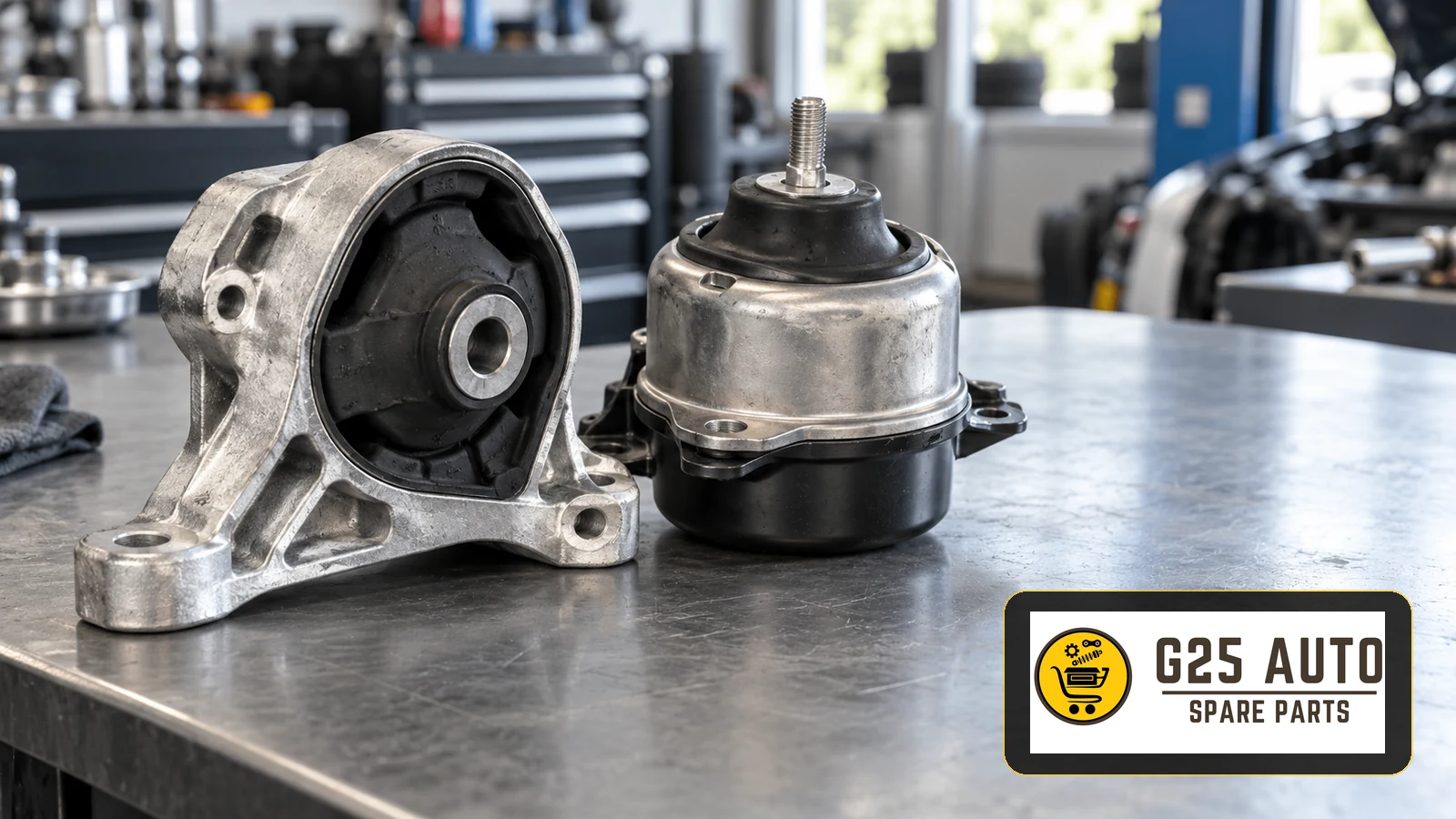
The Turkish terms “motor kulağı” and “motor takozu” are often confused, but this article uses both names for the same component: the engine mount. These supports connect the engine to the vehicle structure and absorb engine vibration. They contribute to driving comfort while helping to limit movement that could damage the engine or surrounding structure.
What Is an Engine Mount and What Does It Do?
An engine mount supports the engine on the vehicle structure and isolates vibration. Rubber-and-metal construction is common, although the design and number of mounts depend on the vehicle. The mounting arrangement supports the engine from different directions.
Their main functions are:
- Carrying engine weight and securing it to the vehicle structure
- Absorbing engine vibration to reduce its transmission into the cabin
- Limiting excessive engine movement during changes in acceleration and braking
- Cushioning shocks associated with uneven road surfaces
- Providing isolation between engine and structure to reduce transmitted stresses
Engine Mount Types and Construction
Engine mounts are produced in different designs:
Conventional Rubber Engine Mounts
Traditional designs use rubber bonded into a metal assembly. This is a widely used construction; the appropriate design depends on the application.
Hydraulic Engine Mounts
These mounts contain fluid and are designed to damp vibration over their intended operating range. They may be used where the vehicle’s mounting system calls for this type of vibration control.
Active Engine Mounts
Electronically controlled mounts can adjust their response according to engine operation and driving conditions. Their use depends on the vehicle specification.
Symptoms of Engine Mount Faults
Worn or damaged engine mounts can cause several symptoms. Recognising a change helps a workshop investigate before further damage develops:
Vibration and Shaking
More vibration than usual at the steering wheel or in the cabin while stationary can be a symptom. It may become more noticeable with the air conditioning operating or while an automatic vehicle is held in Drive with the brake applied.
Unusual Noises
A knock or thud from the engine area when the accelerator is pressed or released can be associated with mount movement. Similar noises may occur over speed humps. Noise alone does not confirm the cause.
Engine Movement
Excessive engine movement observed during an appropriate workshop check may indicate a mounting problem. Noticeable movement during changes between acceleration and braking warrants investigation.
Gear Selection Problems
Stiff or difficult gear changes, particularly with a manual transmission, may accompany worn mounts. A professional diagnosis is needed to distinguish this from other causes.
How Is a Mount Fault Diagnosed?
A definite diagnosis requires professional inspection. The following points describe the inspection process; running-engine checks should be performed by trained personnel using the vehicle’s safe procedure:
Engine Mount Inspection Checklist
- Observe the engine’s resting position with the bonnet open and the engine stopped
- Have a technician carry out any controlled engine-speed check required by the vehicle procedure
- Assess how far and in which direction the engine moves during that check
- Inspect the mounts for cracks, separation and tears
- Check the condition of the rubber, including signs of hardening
- Look for corrosion or looseness at metal attachment points
- Arrange a detailed inspection on a suitable workshop lift
Each mount needs individual inspection with suitable access. One mount may be damaged, while another vehicle may require work on several mounts. The findings determine the replacement scope.
Comparing Original and Aftermarket Engine Mounts
| Feature | Original Part | Aftermarket Part |
|---|---|---|
| Cost | Confirm the current quotation | Compare the actual quotation |
| Quality assurance | Check the specified part and supporting documentation | Assess the manufacturer and supporting documentation |
| Availability | Confirm the current supply position | Confirm the current supply position |
| Compatibility | Verify the exact vehicle application | Verify the exact application and reference |
| Service life | Depends on the part and operating conditions | Depends on the part and operating conditions |
Key Points for Choosing the Correct Part
The central requirement is a mount matched to the vehicle. Even within one model, engine variants, production changes and vehicle identification details can lead to different mounting requirements.
Why OE References and Part Numbers Matter
An OE part reference helps identify the required component in the relevant catalogue. When ordering an engine mount, gather the following information:
- Vehicle identification number (VIN): Use the vehicle identity to check the applicable catalogue listing
- Engine code: Confirm the installed engine variant
- Production date: Parts may change within a model year
- Existing part reference: A readable number on the old mount can assist comparison, subject to catalogue verification
Ordering without this information increases the risk of receiving the wrong part. Make, model and year alone may be insufficient, particularly when ordering online.
Why Check the VIN?
A model can use different mounts following a production change within the same year. Different petrol and diesel engine options can also require different mounts. A VIN-based catalogue check helps resolve these distinctions.
The Engine Mount Replacement Process
Replacing an engine mount requires experience and suitable equipment. The engine must be safely supported as specified before a load-bearing mount is removed.
Replacement Steps: General Overview
Depending on the vehicle procedure, workshop replacement may involve:
- Raising the vehicle safely and removing the undertray where access requires it
- Supporting the engine with the specified support equipment
- Releasing the damaged mount’s fasteners in the prescribed sequence
- Removing the old mount and positioning the replacement
- Tightening the fasteners to the vehicle’s specified procedure with the appropriate tools
- Removing the support as directed and checking that the mounts are correctly seated
The time required depends on the vehicle and access. Some mounts are readily accessible; others require removal of surrounding components. A universal labour time cannot be assumed.
What to Check When Choosing an Aftermarket Mount
Quality and compatibility should guide aftermarket selection. Available products differ, so assess the actual part rather than relying on the aftermarket label alone.
Assessing Aftermarket Manufacturers
A manufacturer’s reputation can inform selection, but does not by itself establish that a particular mount matches an original part. Claims about equivalent quality, OE supply or common factory production require evidence for the product concerned.
Points to assess include:
- Documented compliance with the standards claimed for the product
- Rubber compound suitable for the intended application and exposure
- Accurate metal housing dimensions
- Stiffness characteristics appropriate to the application
- A design that matches the required mounting arrangement
Engine Mount Life and Maintenance
Mount life varies with use and condition; a universal mileage life should not be assumed. Factors that can contribute to deterioration include:
- Aggressive acceleration and braking
- Repeated operation on poor road surfaces
- Engine oil leaks that can damage susceptible rubber
- Excessive loading
- Large temperature changes
Looking After Engine Mounts
The following measures support routine care:
- Keep up with scheduled vehicle servicing
- Have engine oil and other fluid leaks addressed promptly
- Use smooth driving inputs where possible
- Include visual mount checks in appropriate inspections
- Have abnormal vibration or noise investigated promptly
Frequently Asked Questions About Engine Mounts
Do the Two Turkish Names Mean Different Parts?
In the terminology used here, “motor kulağı” and “motor takozu” are alternative names for the engine mount: the support connecting the engine to the vehicle structure.
When Should an Engine Mount Be Replaced?
Excessive vibration, unusual noises, engine movement or visible cracking, tearing or separation call for inspection. Replacement should follow a professional diagnosis.
Can Just One Engine Mount Be Replaced?
A single damaged mount may be replaced where appropriate. The remaining mounts should be assessed, and any decision to replace several should follow their condition and the vehicle requirements.
Can a Vehicle Be Driven with a Failed Mount?
A failed mount can create comfort and safety risks and may allow damage to other components. Symptoms alone cannot establish that driving is safe; obtain a professional assessment before continuing to use the vehicle.
Can I Replace an Engine Mount Myself?
This work is unsuitable for someone without the necessary experience and equipment. Supporting the engine safely is essential, and incorrect installation can cause serious injury.
Why Supplier Selection Matters
Supplier checks matter when purchasing engine mounts. Ask a prospective supplier about:
- Vehicle compatibility checks using the VIN
- Documented original and aftermarket options
- Detailed product information and specifications
- Return and warranty terms
- Technical customer support
Conclusion
The two source terms describe engine mounts, which contribute to comfort and controlled engine support. Identifying and replacing a faulty mount helps protect the mounting system and surrounding components.
Selection should use the VIN, engine code and applicable part references. Whether choosing an original or aftermarket mount, assess the documented application and product quality; price alone cannot establish equivalent performance.
Have vibration, noise or other changes checked promptly by a professional workshop. Mounts affect engine support as well as comfort and should receive appropriate attention.
Correct selection, a suitable part and professional installation are the basis for reliable mount operation. They do not establish a guaranteed service life.