
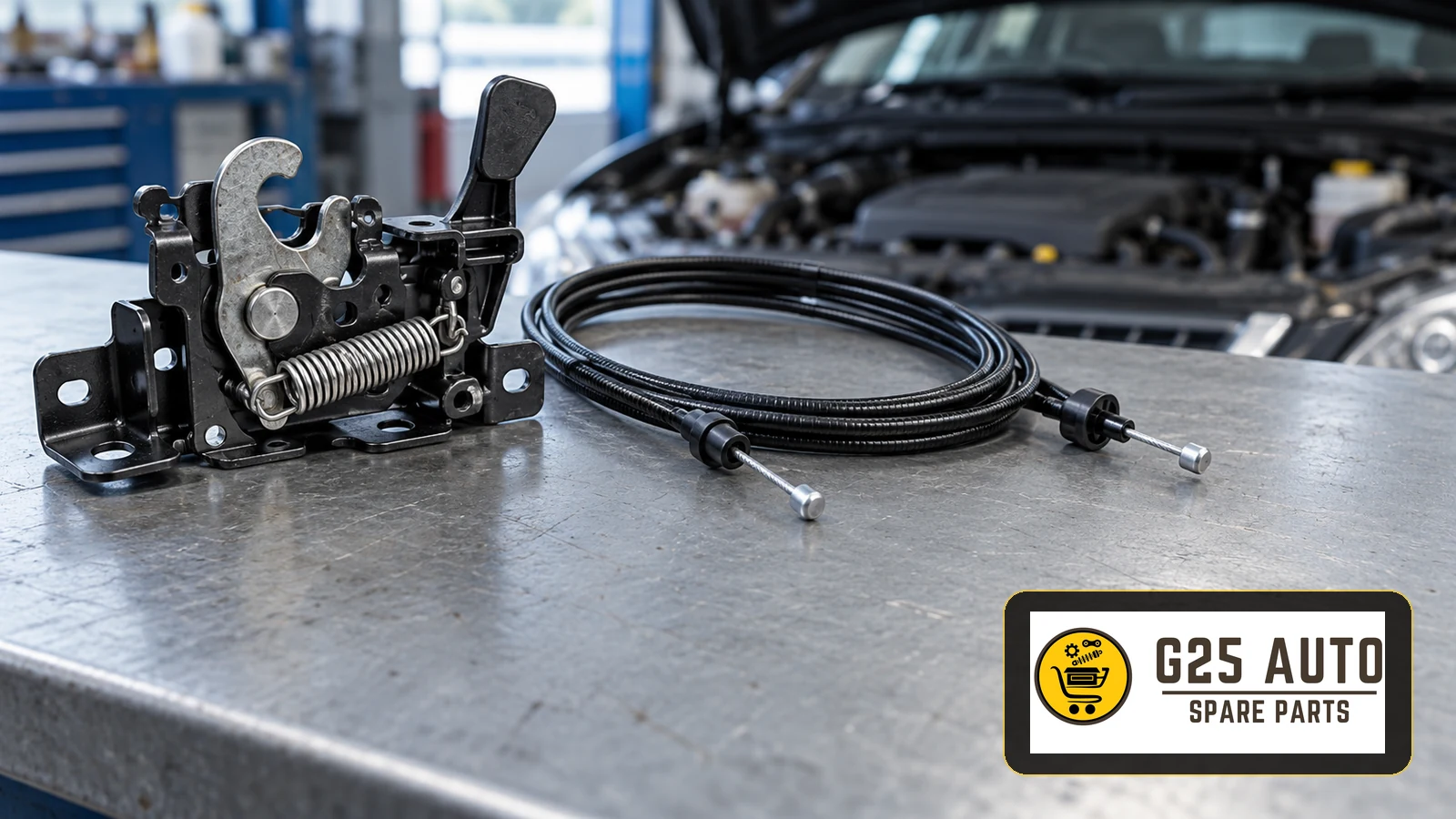
When a bonnet latch or release cable fails, the bonnet may refuse to open or close. Before replacing either part, check the relevant original part reference, vehicle identification number and engine variant against the supplier’s application information. The choice between an original and an aftermarket part should also take account of your budget, vehicle use and the condition of the car.
What Are the Bonnet Latch and Release Cable?
The bonnet latch is the mechanical component that holds the bonnet securely closed. It helps prevent the bonnet from opening in the airflow while the vehicle is moving. The release cable connects the handle inside the cabin to the latch. Together, these components allow controlled opening and closing of the bonnet.
Although the system appears simple, it is exposed to mechanical loads during use. The latch encounters different weather conditions, while the cable experiences repeated pulling movements. Wear and faults can therefore develop in either component over time.
Symptoms of Bonnet Latch and Release Cable Faults
A problem with the latch or cable can produce several symptoms. Recognising these signs can help you arrange an inspection before the fault becomes more serious:
Common Symptoms
- The bonnet does not open when the release handle is pulled.
- The handle feels loose or moves without resistance.
- The bonnet does not close fully or remains loose.
- Unusual noises occur when the bonnet opens.
- Rust or corrosion is visible on the latch.
- The release cable appears broken or worn.
- The bonnet vibrates slightly while driving.
- The latch mechanism is difficult to operate.
Checks Needed for a Diagnosis
If you notice these symptoms, a professional inspection is needed to identify the cause. Depending on the vehicle and the fault, a workshop may carry out the following checks using the applicable repair procedure:
- Inspect the latch mechanism, removing it where the procedure requires this.
- Examine the cable along its accessible length for damage.
- Check the function of the latch spring.
- Assess wear at the mounting points.
- Check that the secondary safety catch operates.
- Check bonnet alignment and mounting fit.
A diagnosis helps establish which component needs replacement. Sometimes the cable alone is responsible; in other cases, both the latch and cable may need attention.
Choosing Original or Aftermarket Replacement Parts
When replacing a bonnet latch or release cable, you may be offered original vehicle-brand parts or aftermarket alternatives. Each option needs to be assessed for the specific application.
Original Parts
Original parts are supplied through the vehicle manufacturer’s parts range. Check the precise part reference and any applicable replacement reference before ordering. Fitment, warranty terms and price should be confirmed for the actual item rather than assumed from its original-part designation.
Aftermarket Parts
Aftermarket parts are alternatives supplied by independent manufacturers. Their application coverage, specifications and supporting documentation vary. Compare the actual product information and supplier terms; an aftermarket label alone does not establish equivalent performance or a price advantage.
Comparison Table
| Feature | Original Part | Aftermarket Part |
|---|---|---|
| Price | Confirm the current quotation. | Compare the current quotation. |
| Fitment assurance | Verify the exact application and reference. | Verify the manufacturer’s application data. |
| Warranty period | Check the supplier’s written terms. | Check the manufacturer’s and supplier’s terms. |
| Availability | Confirm availability before ordering. | Confirm availability before ordering. |
| Quality information | Review the information for the specified part. | Review the individual manufacturer’s documentation. |
| Choice | Depends on the vehicle application. | Depends on available application coverage. |
Critical Checks for Selecting the Right Part
There are several points to check before purchasing a bonnet latch or cable. Selecting an unsuitable component can waste money and create a safety problem.
The Importance of the Original Part Reference
An original part reference helps identify the required component and its listed vehicle applications. Check the reference on the existing part where available and confirm it against the relevant parts information. A reference is useful for narrowing the choice, but the replacement application still needs verification.
Checking the Vehicle Identification Number
The vehicle identification number, or VIN, identifies the vehicle. Cars with the same model name may use different bonnet latches according to production year, engine variant or equipment. Give the supplier the VIN and ask for an application check.
Engine Variant and Production Date
The engine variant and production date can also matter when identifying a replacement. Model-year changes or a facelift may involve changes to the bonnet or latch arrangement. Check these details against the vehicle’s identification information and the parts listing.
Replacement Part Selection Checklist
- Confirm the vehicle make, model and year.
- Have the VIN available.
- Check the original reference on the existing component.
- Identify the engine variant and production date.
- Ask the supplier for written fitment confirmation.
- Check the warranty period and conditions.
- Ask about the returns and exchange policy.
- Check whether additional mounting parts, such as bolts or nuts, are required.
- Assess the need for professional installation.
- Compare alternatives in terms of documented suitability, quality and price.
Installation and Maintenance Advice
Correct installation of the bonnet latch and release cable is essential for safe operation. Incorrect installation can leave the bonnet insecure and create a risk of it opening while the vehicle is moving.
Professional Installation
Although replacing a bonnet latch may look straightforward, correct adjustment requires experience. Matching the cable to the latch, setting it according to the vehicle procedure and checking the safety catch need careful attention. If you are unfamiliar with the work, use an authorised repairer or an experienced workshop.
Routine Maintenance
The following maintenance points should be considered in line with the vehicle manufacturer’s guidance:
- Clean and lubricate the latch only as specified for the vehicle; use the prescribed product and schedule.
- Inspect the routes and guides through which the cable moves.
- Use corrosion-protection products only where suitable and permitted by the vehicle procedure.
- Avoid excessive force when closing the bonnet.
- Remove accumulated dirt around the latch as appropriate.
Where Should Replacement Parts Be Purchased?
Obtain safety-related components such as bonnet latches and release cables from a reliable supplier. Ask for application information and relevant product documentation, together with written warranty and fitment terms where offered.
Frequently Asked Questions
When should a bonnet release cable be replaced?
Visible damage, corrosion, wear or difficult operation calls for inspection. If the handle movement suggests that the cable has broken, have the fault diagnosed promptly and replace the damaged component as required.
Can a faulty bonnet latch create a safety problem?
Yes. An insecure latch can allow the bonnet to open while driving, creating a serious accident risk. A suspected fault needs prompt attention, and secure closure must be confirmed before the vehicle is driven.
Can an aftermarket bonnet latch be a suitable choice?
It can be suitable when its application and product information meet the vehicle’s requirements. Assess the individual manufacturer and part documentation through a reliable supplier; do not assume that all aftermarket components match original-part standards.
How long does bonnet latch replacement take?
The time depends on access, the vehicle’s arrangement, the fault and the adjustments required. Ask the workshop for an estimate based on the actual vehicle rather than relying on a universal replacement time.
Which vehicles are more exposed to these problems?
Age, maintenance history and exposure to corrosion are relevant considerations when inspecting the mechanism. Pay attention to rust and wear, especially on vehicles used in corrosive environments such as coastal areas.
Conclusions and Recommendations
The bonnet latch and release cable are important safety components. Faults in this system need prompt investigation because they can affect the security of the bonnet.
Compatibility is central to selecting a replacement. Verify the original reference, VIN, engine variant and production date against the application data. Choose between original and aftermarket options on the basis of the vehicle’s condition, use, budget and the documented suitability of the actual part.
Use a reliable supplier and seek written fitment confirmation and professional installation support where appropriate. After installation, check opening, closing and secure retention according to the vehicle procedure before returning the vehicle to use.
Regular inspection, cleaning and any specified lubrication help keep the mechanism in working order. Follow the vehicle manufacturer’s maintenance guidance rather than assuming that every latch needs the same inspection or lubrication interval.
Even a small replacement component can be important to vehicle safety. If you notice a problem with the bonnet latch or release cable, arrange the necessary diagnosis and repair without delay.