
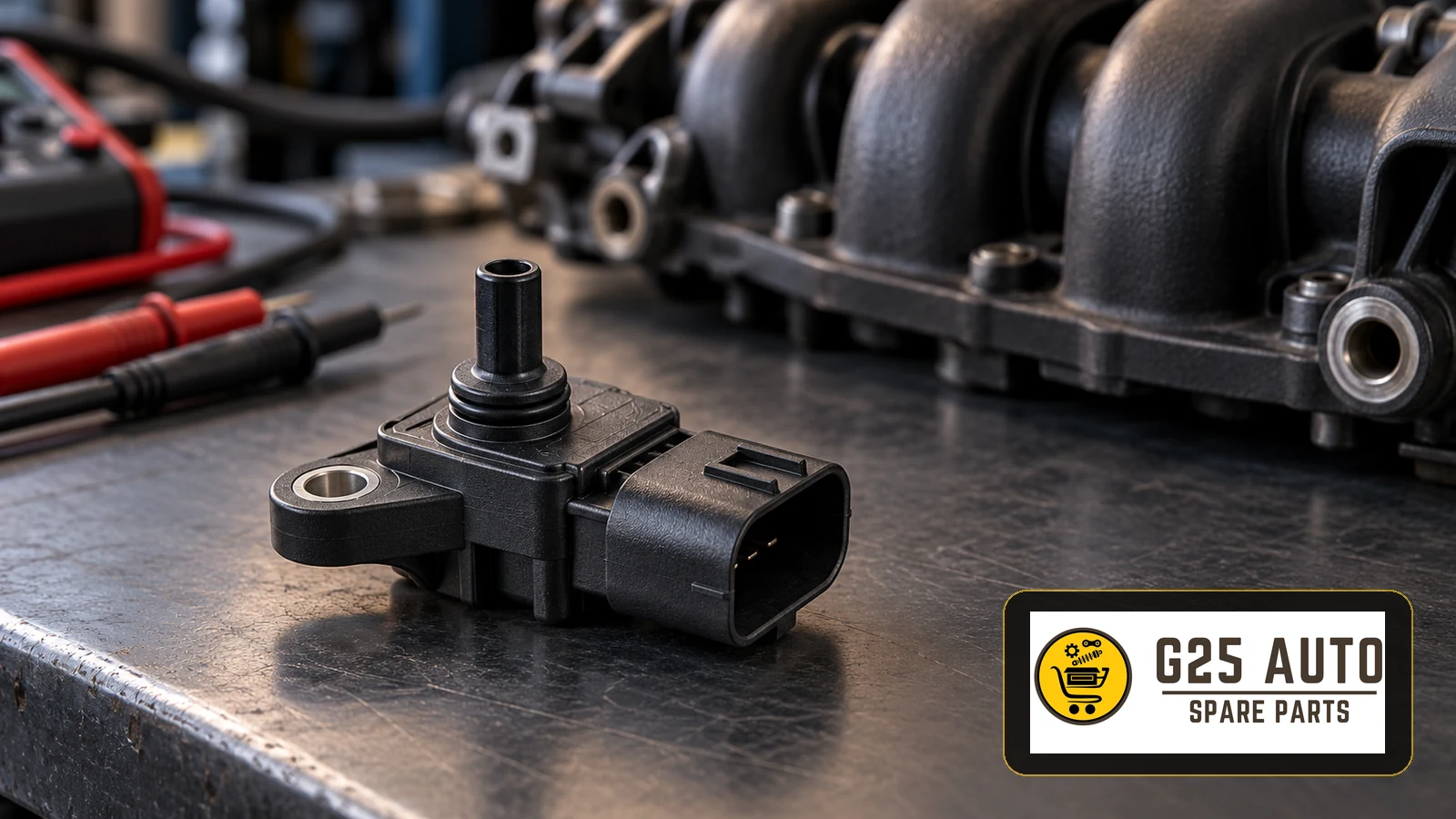
A MAP sensor (Manifold Absolute Pressure sensor) is an important component of an engine management system. It measures pressure in the intake manifold and sends data to the engine control unit (ECU), which uses it when calculating fuel injection. A faulty MAP signal can be associated with reduced performance, increased fuel consumption and, in some cases, difficulty starting or failure to start.
What Does a MAP Sensor Do and How Does It Work?
The MAP sensor measures intake manifold pressure and sends an electrical signal to the ECU. The ECU uses this information, together with other operating data, to calculate the fuel quantity required under the current engine conditions and control the injectors.
Main Functions of a MAP Sensor
- Load assessment: Helps determine the load on the engine.
- Fuel calculation: Contributes to calculating the required fuel quantity.
- Ignition timing: Can contribute to ignition timing control.
- Emissions control: Supports engine management functions that affect exhaust emissions.
- Turbo control: Can provide pressure information used in boost monitoring on turbocharged engines.
The Difference Between MAP and MAF Sensors
Some vehicles use a MAP sensor, others a MAF (Mass Air Flow) sensor, and some use both. Their measurements differ, so they should not be treated as interchangeable components:
| Feature | MAP Sensor | MAF Sensor |
|---|---|---|
| Measurement | Pressure | Mass of air flowing into the engine |
| Location | At, or connected to, the intake manifold, depending on design | In the intake air path, depending on design |
| Accuracy | Check the specified operating conditions; altitude alone does not establish superiority | Check the specified operating conditions; sea level alone does not establish superiority |
| Cost | Depends on the specific application and supplier | Depends on the specific application and supplier |
| Durability | Depends on design and operating conditions | Contamination and handling can affect operation; durability depends on design and conditions |
Symptoms Associated With MAP Sensor Faults
A failed or inaccurate MAP sensor may produce several symptoms. These symptoms can also arise from faults in other components, so none confirms a MAP sensor failure by itself:
Common Symptoms
- Engine warning lamp: A check engine light that remains on or appears intermittently.
- Loss of power: Reduced performance, particularly when pulling away or climbing a hill.
- Increased fuel consumption: More fuel used than expected under comparable driving conditions.
- Uneven idle: Unstable engine speed or vibration.
- Difficult starting: Starting problems, including in cold conditions.
- Black smoke: Exhaust smoke that is darker than usual.
- Hesitation: Delayed response or stumbling when the accelerator is pressed.
- Gearshift problems: Harsh shifts on some automatic vehicles, requiring investigation of the wider system.
Symptoms and Other Possible Causes
| Symptom | Possible MAP Connection | Other Possible Causes |
|---|---|---|
| Engine warning lamp | A MAP circuit or signal fault is one possibility | Oxygen sensor, catalytic converter or other sensors |
| Loss of power | Incorrect pressure data may affect engine control | Fuel pump, air filter or turbocharger faults |
| Increased fuel consumption | Incorrect pressure data may affect fuel calculation | Injector, thermostat or oxygen sensor faults |
| Uneven idle | An inaccurate MAP signal is one possible cause | Spark plugs, ignition coils or an intake air leak |
| Black smoke | A pressure signal fault may contribute to incorrect fuelling | Air filter, injectors or piston rings |
How Is a MAP Sensor Fault Diagnosed?
Symptoms indicate that investigation is needed, but diagnosis requires appropriate testing. Establishing the cause before replacing a component helps avoid unnecessary parts replacement and leaving the original fault unresolved.
Professional Diagnostic Methods
- OBD-II scan: Read and interpret fault codes with a suitable diagnostic tool; a code alone does not prove that the sensor needs replacement.
- Multimeter testing: Check the relevant supply and signal voltages under the conditions specified for the vehicle.
- Vacuum testing: Where the sensor design and service procedure permit, check its response using a hand vacuum pump.
- Oscilloscope analysis: Examine the sensor signal using the appropriate procedure.
- Live data: Monitor sensor readings while the engine operates and compare them with the applicable service information.
- Wiring and connector checks: Test continuity and insulation as specified for the circuit.
Diagnostic Checklist
MAP Sensor Inspection Steps
- Visual inspection: Examine the physical condition of the sensor and wiring.
- Connector inspection: Check that the connections are secure and clean.
- Vacuum hose: If fitted, inspect the hose leading to the sensor for cracks or blockage.
- Fault codes: Read the codes with a suitable OBD-II tool.
- Voltage measurement: Check the supply with the ignition on against the vehicle specification.
- Signal check: Measure or monitor the output under the specified engine conditions.
- Ground check: Verify the sensor ground connection.
- Vacuum test: Check the response with a hand pump only where the procedure permits.
- Comparison test: Where appropriate, compare with a known good sensor of the correct specification.
- Contamination check: Inspect the sensor port for carbon or dirt deposits.
MAP Sensor Replacement and Correct Part Selection
Once testing confirms that the MAP sensor needs replacement, selecting the correct part is essential. An incorrect sensor may fail to resolve the problem and can cause further operating issues.
Information Needed for Part Selection
- Original part number: Record the number on the existing sensor and check it against the applicable parts information.
- Vehicle identification number (VIN): Use the VIN to support catalogue identification; it does not replace checking the listed application.
- Engine code: Different engines within the same vehicle model may use different sensors.
- Production date: Changes during a model year may affect the required part.
- Equipment specification: Different equipment configurations may require different sensors.
Original and Aftermarket MAP Sensors
Replacement options may include original and aftermarket parts. Each should be assessed against the specific application, documented specification and purchase terms.
| Criterion | Original Part | Aftermarket Part |
|---|---|---|
| Compatibility | Verify the correct part number and application | Verify the documented application and specification |
| Cost | Check the current quotation | Check the current quotation |
| Availability | Confirm availability and delivery terms | Confirm availability and delivery terms |
| Warranty | Read the applicable warranty terms | Read the applicable supplier and manufacturer terms |
| Quality | Assess the documented specification | Assess the manufacturer and documented specification |
What to Check When Selecting an Aftermarket Part
- Manufacturer reputation: Consider a supplier with identifiable product information and references.
- Warranty terms: Review the actual coverage and conditions before purchase.
- Technical specification: Confirm that the specified characteristics meet the vehicle requirement.
- Application check: Check compatibility using the VIN, engine code and parts catalogue.
- Seller reliability: Obtain the part from a reliable, traceable source.
MAP Sensor Care and Service Life
A MAP sensor may not require routine servicing, but the condition of the intake system and electrical connections matters. The following checks support vehicle maintenance without guaranteeing a particular sensor lifespan:
- Air filter maintenance: Maintain the air filter according to the vehicle schedule.
- Engine maintenance: Follow the engine maintenance requirements and investigate excessive deposits where found.
- Wiring protection: Check that engine compartment wiring and connectors remain secure.
- Leak checks: Have intake leaks investigated as part of the relevant inspection.
- Fuel quality: Use fuel that meets the vehicle requirements.
Frequently Asked Questions
Can a MAP sensor fault prevent the vehicle from being driven?
The effect varies. A vehicle may continue running with reduced performance, may enter a restricted operating mode, or may fail to start or stall. Increased fuel consumption and other running problems are possible. Have the fault assessed instead of assuming that continued driving is suitable.
Can a MAP sensor be cleaned, or must it be replaced?
Some deposits may be removable if the vehicle or sensor procedure permits cleaning. Cleaning will not repair damaged electronics or an internal calibration fault. Obtain professional advice and check the permitted method before attempting it.
Is adaptation needed after replacing a MAP sensor?
The requirement depends on the vehicle. Some systems may accommodate the replacement during normal operation, while others require a diagnostic procedure. Follow the applicable service instructions for adaptation, fault code handling and the post-repair check.
How much can a MAP sensor fault affect fuel consumption?
The change depends on the fault and the engine management system. Incorrect pressure data can affect fuelling, but there is no reliable universal percentage increase. Diagnose the fault and assess consumption under comparable operating conditions.
Which vehicles use a MAP sensor?
MAP sensors are used in many turbocharged, diesel and speed-density petrol engine systems. They can also be present alongside a MAF sensor. Consult the vehicle service information or a qualified workshop to identify the arrangement fitted.
Conclusions and Recommendations
The MAP sensor supplies intake manifold pressure information to the ECU for engine management. A faulty signal can contribute to reduced performance, increased fuel consumption and other running problems.
When symptoms appear, obtain a proper diagnosis. Other faults can produce similar symptoms, and replacing a sensor solely on that basis may leave the problem unresolved. Scan data, electrical measurements and appropriate diagnostic equipment help establish the cause.
If replacement is necessary, verify the application using the VIN, engine code, production date and original part reference. Compare original and aftermarket options using documented compatibility, specifications and the actual purchase terms.
Follow the vehicle maintenance requirements for fuel, filtration and engine care, and investigate symptoms promptly. These steps support reliable operation without promising a particular sensor lifespan or repair outcome.
Important Reminder
Not every symptom indicates a faulty MAP sensor. Consult a qualified automotive electrical specialist or workshop for diagnosis. Verify the replacement using the vehicle and part identification details, choose a traceable supplier and read the warranty terms.