
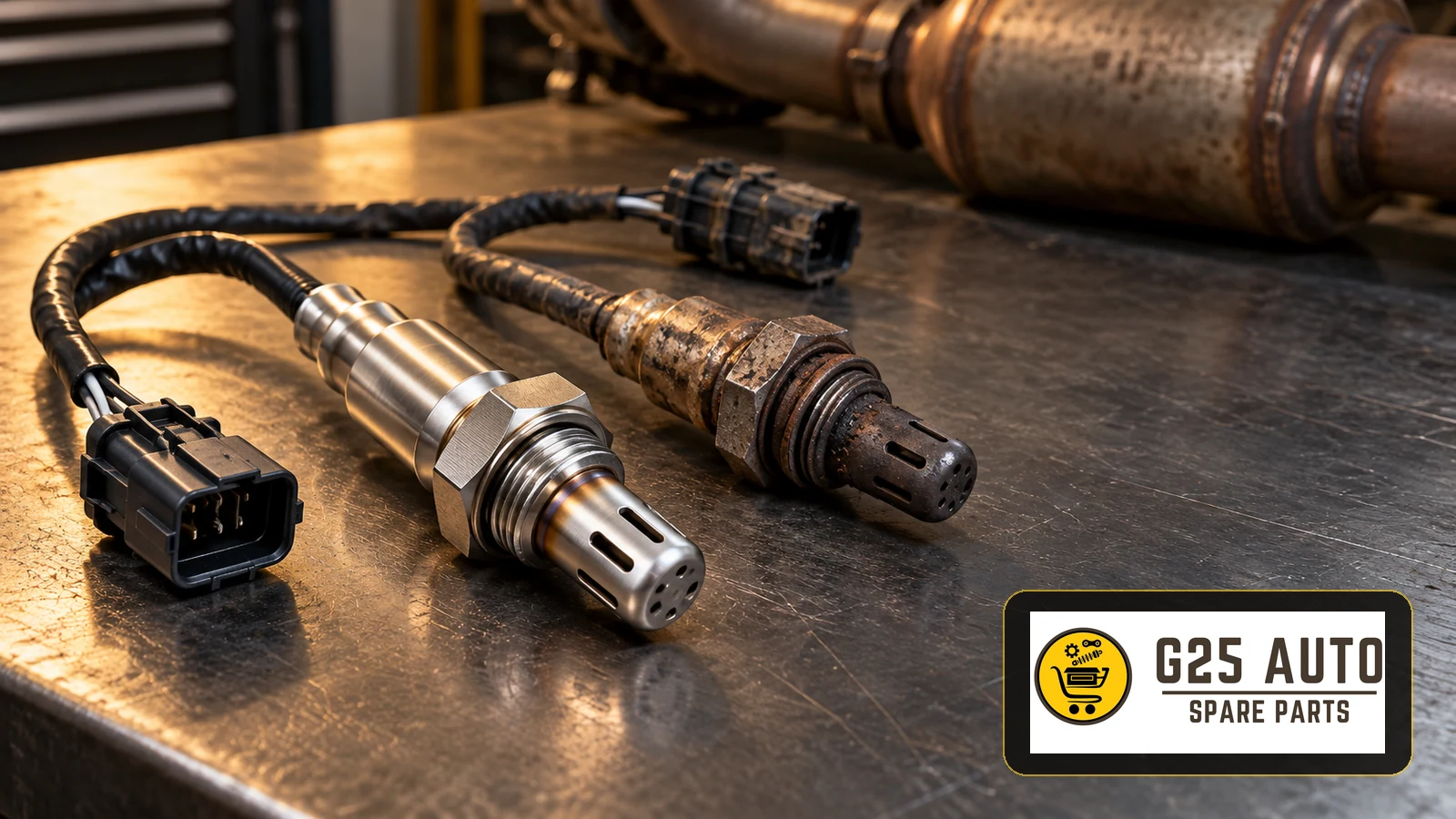
A lambda sensor, also called an oxygen sensor, sits in the exhaust system and provides the engine management system with information used to assess the air-fuel mixture. A faulty sensor can contribute to higher fuel consumption, reduced power and increased emissions. Diagnosis requires suitable professional equipment; choosing an original or aftermarket replacement requires checking the part reference, vehicle identification number and engine code.
What Is a Lambda Sensor and How Does It Work?
A lambda sensor measures oxygen in the exhaust gases and supplies feedback to the engine control unit (ECU). The ECU uses this information as part of its mixture control strategy, supporting fuel economy and emissions control.
Modern vehicles often have two or more oxygen sensors. The sensor before the catalytic converter, known as the upstream sensor, generally supports mixture control; the downstream sensor helps monitor catalytic converter performance. The exact roles depend on the engine management system.
How the Sensor Works
Lambda 1.0 represents the stoichiometric air-fuel mixture. The source describes this as approximately 14.7:1 for petrol, although the actual ratio depends on fuel composition. A rich mixture has a lambda value below 1, while a lean mixture has a value above 1. The ECU uses sensor feedback to adjust injection when operating in the relevant control mode.
Symptoms of a Lambda Sensor Fault
A faulty sensor can be associated with changes in vehicle behaviour. These symptoms do not establish a diagnosis, because other problems can produce similar effects:
- The check engine light may illuminate.
- Fuel consumption may increase noticeably.
- There may be an exhaust smell or black smoke.
- Engine performance may decline.
- The engine may idle unevenly.
- Throttle response may be delayed.
- The vehicle may fail an emissions test.
- Catalytic converter life may be affected indirectly by an unresolved mixture problem.
Symptoms Versus a Confirmed Diagnosis
The symptoms above indicate possible problems only. A professional assessment should include reading stored diagnostic trouble codes with an OBD-II scan tool. The source identifies these code groups as relevant to oxygen sensor, mixture or catalyst diagnosis; individual code definitions must be checked:
- P0130–P0167: various oxygen sensor circuit and heater-related faults.
- P0171–P0175: mixture-related codes, including lean and rich conditions.
- P0420–P0434: catalyst-related codes that may require oxygen sensor data during diagnosis.
After reading the codes, assess live sensor data and the relevant electrical signals using the vehicle-specific diagnostic procedure. An oscilloscope may help evaluate signal quality where appropriate. Neither a code nor an isolated signal reading proves that the sensor needs replacement.
Causes of Lambda Sensor Problems
Possible causes and contributing conditions include:
- Ageing under repeated heat and vibration.
- Unsuitable or contaminated fuel.
- Leaded fuel or unsuitable additives.
- Contamination associated with engine oil or coolant leakage.
- Prolonged rich or lean operation, requiring investigation of the underlying cause.
- Electrical connection problems.
- Mechanical damage from impact or road debris.
Original and Aftermarket Lambda Sensors Compared
| Feature | Original equipment replacement | Aftermarket replacement |
|---|---|---|
| Compatibility | Check the vehicle manufacturer’s application reference. | Verify the exact catalogue application and cross-reference. |
| Quality requirements | Check the specified part and supporting documentation. | Assess the manufacturer’s specifications and relevant documentation. |
| Cost | Obtain a current quotation. | Compare current quotations for verified applications. |
| Availability | Confirm with the supplier. | Confirm with the supplier; faster supply is not assured. |
| Warranty | Check the applicable manufacturer and seller terms. | Check the applicable manufacturer and seller terms. |
| Choice | Follow applicable references and supersessions. | Compare documented options for the exact application. |
What to Check When Choosing an Aftermarket Sensor
Price is one consideration, but quality evidence and application compatibility also require attention:
- Consider established manufacturers such as Bosch, Denso, NGK and Delphi, while checking the specific product application.
- Check relevant product and manufacturer documentation; a generic CE or ISO reference alone does not establish sensor compatibility or quality.
- Make sure the seller’s returns and warranty policies are clear.
- Treat unusually low prices as a reason to examine provenance and specifications carefully.
- Look for detailed technical information in the product description.
How Do You Identify the Correct Lambda Sensor?
The critical replacement step is identifying a sensor suitable for the exact vehicle and position. An incorrect choice can waste money and cause operating problems.
Why Original References and Part Numbers Matter
An original equipment reference or manufacturer part number helps identify the intended component. Check markings on the old sensor or its packaging where available. For an aftermarket part, verify the listed cross-references against the application catalogue; a matching number alone is not an unconditional fitment guarantee.
Verification Using the VIN
The vehicle identification number identifies the vehicle and is normally 17 characters on modern vehicles. A suitable VIN-based catalogue or vehicle record can help establish:
- The model year.
- The production date.
- The engine type.
- The equipment specification.
- Production details such as the manufacturing location, where available.
Vehicles with the same model name and year can use different sensors. A VIN-based application check helps resolve these differences and reduce ordering errors.
Checking the Engine Code
The engine code identifies the engine type. Different engines in the same vehicle model may require different sensors. Depending on the vehicle, the code may be available from:
- Vehicle registration records.
- A label or identification marking on the engine.
- The service documentation.
- An information label in the engine compartment.
Production Date Differences
Manufacturers can introduce technical changes within a model year. Vehicles built in different months may therefore use different sensor references. Check production month and year where the catalogue specifies a production split.
Lambda Sensor Replacement Checklist
Before replacing a sensor, work through the following checks:
- Have the diagnostic trouble codes been read with an OBD-II tool?
- Has professional diagnosis confirmed that the sensor itself is faulty?
- Has the vehicle’s VIN been recorded?
- Has the engine code been identified?
- Has the old sensor’s original reference or part number been recorded?
- Has the number of sensors fitted been established?
- Has the replacement position been identified: upstream/downstream and the relevant side or bank?
- Has the new part been cross-checked against the vehicle information?
- Are the required tools and equipment available?
- Have the electrical connections been inspected?
- Have the specified post-repair checks, code clearing and any appropriate road test been planned?
Maintenance and Sensor Service Life
Sensor life depends on the application and operating conditions; a universal replacement mileage cannot be assumed. The following maintenance points can help limit avoidable problems:
- Use fuel meeting the vehicle manufacturer’s requirements from a reliable source.
- Keep engine maintenance up to date.
- Replace air and fuel filters according to the applicable maintenance schedule.
- Investigate and repair engine oil leaks promptly.
- Maintain the ignition system, including plugs and coils.
- Consider the effect of repeated short journeys on engine operating conditions, following vehicle guidance.
- Use fuel additives only where suitable and permitted for the vehicle.
Frequently Asked Questions
How quickly can a lambda sensor fault develop?
A fault can appear suddenly or develop gradually. Small changes in response may be difficult to notice. Routine vehicle checks and emissions testing can help identify problems that require diagnosis.
If one sensor is faulty, must all of them be replaced?
A single confirmed fault does not automatically require replacing every sensor. On a high-mileage vehicle, assess the condition of the other sensors before considering additional replacement. Base the decision on diagnostic evidence, vehicle condition and cost.
Can an engine run without a working lambda sensor?
Some engines can continue operating using a fallback strategy, but behaviour depends on the system and fault. Fuel consumption, performance and emissions may be affected, and an unresolved mixture problem can damage the catalyst. Continued operation should follow professional assessment.
Are universal lambda sensors reliable?
A universal sensor requiring a wiring connection must be explicitly suitable for the application and installed according to its manufacturer’s instructions. Connection errors can cause problems. A correctly specified direct-fit sensor avoids the need for that wiring adaptation.
Can a lambda sensor be cleaned?
Improvised cleaning methods can damage the sensitive sensor, particularly when chemicals are used. Do not treat cleaning as a substitute for diagnosis. Follow manufacturer guidance and replace a sensor confirmed to be defective where required.
Can an aftermarket sensor affect warranty coverage?
Check the applicable vehicle, part and repair warranty terms before choosing a replacement. Coverage cannot be determined solely from whether a part is original or aftermarket. A vehicle outside its original warranty still requires a correctly specified part and suitable installation.
Conclusion
Oxygen sensors play an important role in modern emissions control and mixture management. A faulty sensor can contribute to increased fuel use and emissions; an unresolved mixture fault can also harm expensive components such as the catalytic converter.
Symptoms call for professional diagnosis because other faults can look similar. OBD-II information and appropriate sensor measurements form part of that investigation.
When replacement is necessary, verify the VIN, engine code, part reference and relevant production date. Incomplete identification can lead to an unsuitable order and wasted time.
Choosing original or aftermarket equipment requires checking the actual application, specifications, provenance and supplier terms. Neither label alone guarantees compatibility, quality or a particular saving.
Regular maintenance, suitable fuel and early investigation can reduce avoidable problems. Do not ignore a check engine light or postpone the relevant checks.
Understanding the sensor’s role, recognising possible symptoms and selecting the correct replacement supports sound maintenance decisions and helps avoid unnecessary expense.