
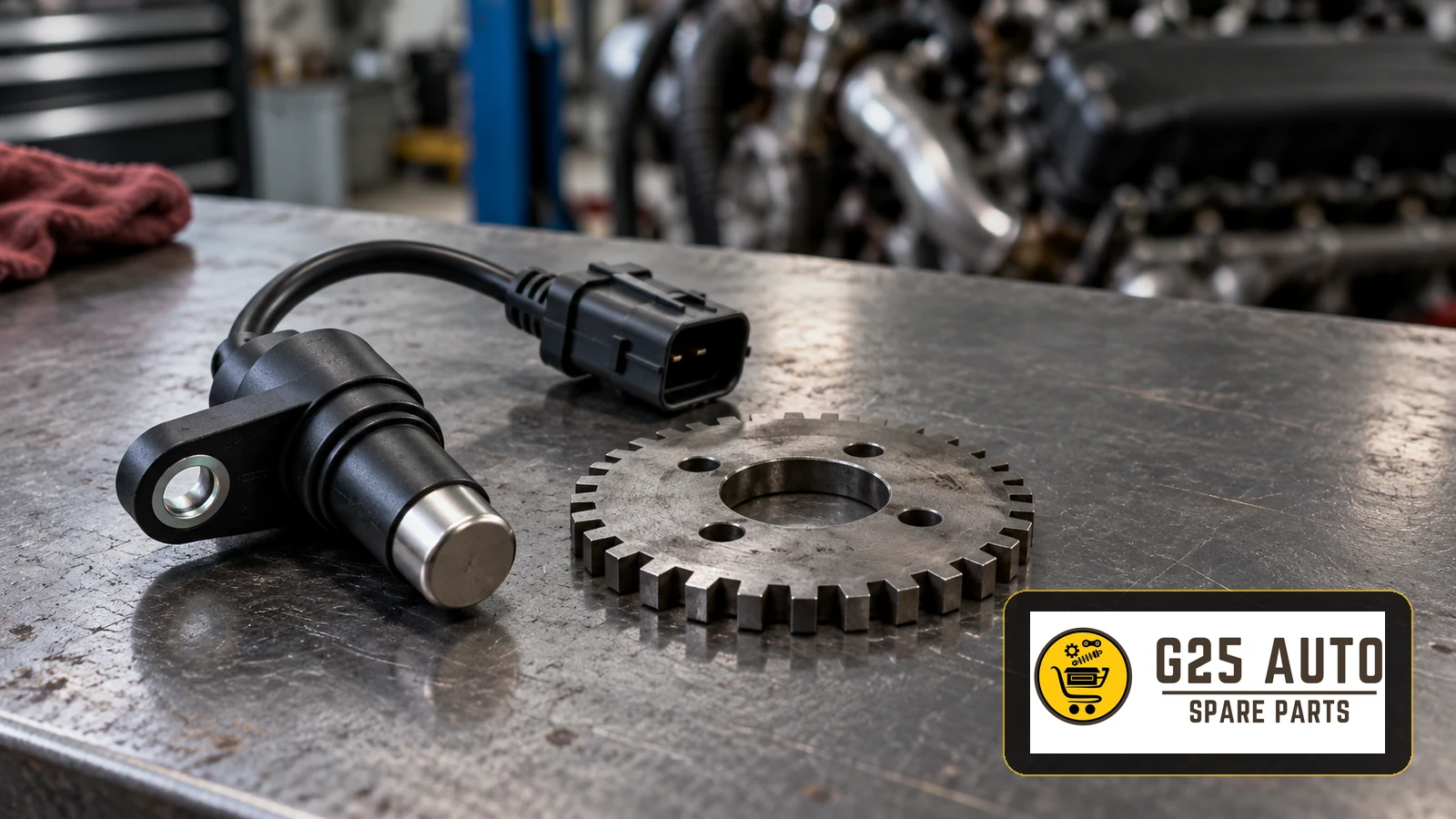
The crankshaft position sensor supplies the engine control unit with information about crankshaft speed and position. A faulty sensor can cause failure to start, sudden stalling or irregular running. Without a usable signal, the control unit may be unable to control injection and ignition timing correctly, depending on the engine’s control strategy.
What Is a Crankshaft Position Sensor and How Does It Work?
The crankshaft position sensor is an important electronic engine component. It continuously supplies the engine control unit (ECU) with crankshaft position and rotational speed information. The ECU uses this information to control fuel injection and, on applicable engines, spark ignition timing.
The sensor is positioned close to a target wheel, which may be near the crankshaft pulley or flywheel depending on the engine. As the target teeth pass the sensing element, changes in the magnetic field are converted into electrical signals for the ECU. The exact arrangement and sensor design are application specific.
Symptoms of a Faulty Crankshaft Position Sensor
A crankshaft position sensor fault can produce several symptoms. Recognising them can help identify a problem early and arrange diagnosis before it causes further disruption:
Engine Symptoms
- Difficult starting or failure to start
- Sudden engine stalling, sometimes when hot
- Uneven idle and vibration
- Reduced engine power and performance
- Hesitation or stumbling during acceleration
- Engine vibration at higher speeds
Instrument and Warning Signs
- An illuminated check engine light
- An erratic or inoperative rev counter
- Stored ECU fault codes, potentially including P0335, P0336, P0337 or P0338 where applicable
Fuel Consumption and Emission Problems
- Higher than usual fuel consumption
- Black exhaust smoke
- A smell of unburned fuel
Important: these symptoms, particularly fuel consumption and exhaust changes, can have many other causes. None proves that the sensor has failed. Diagnosis requires appropriate equipment and a qualified automotive electrical technician or workshop.
How Is a Crankshaft Position Sensor Fault Diagnosed?
Symptoms provide clues, but a reliable diagnosis requires professional checks. Diagnostic methods include:
Professional Diagnostic Methods
- Reading codes with an OBD-II scanner: retrieve and interpret stored ECU fault codes.
- Checking the signal with an oscilloscope: examine the electrical signal produced by the sensor.
- Testing with a multimeter: perform only the electrical checks specified for that sensor type; resistance and voltage tests are not interchangeable across designs.
- Visual inspection: check the sensor, wiring connections and connector for damage or corrosion.
- Monitoring live data: examine relevant sensor information using diagnostic equipment.
Basic visual checks and inspection of connections can be useful, but electronic testing and a definitive diagnosis require suitable equipment and knowledge.
Comparing Original and Aftermarket Crankshaft Position Sensors
When replacement is necessary, it helps to understand the original and aftermarket options. Both require attention to the application and the evidence supporting the particular product.
| Feature | Original Part | Aftermarket Part |
|---|---|---|
| Compatibility | Verify the correct vehicle manufacturer part reference and application. | Verify the manufacturer’s application listing and cross-reference. |
| Quality standards | Check the specification and provenance of the actual part. | Assess product documentation; a general quality certificate alone does not establish sensor suitability. |
| Price | Obtain a current quotation for the correct reference. | Compare current quotations for verified alternatives. |
| Supply time | Confirm availability and delivery with the supplier. | Confirm availability and delivery with the supplier. |
| Warranty | Check the applicable written terms. | Check the applicable manufacturer and seller terms. |
| Service life | Evaluate application-specific evidence rather than assuming a fixed lifespan. | Do not assume identical durability without supporting evidence. |
What to Check When Choosing an Aftermarket Part
If choosing an aftermarket crankshaft position sensor, establish product quality and suitability rather than relying on a broad description. Consider the following:
- Manufacturer reputation: choose a traceable manufacturer with relevant automotive experience and product documentation.
- Quality certificates: check the scope and validity of any certificates; they do not independently prove fitment or performance.
- OEM quality claims: verify the documented specification behind an equivalence claim rather than accepting the label alone.
- Material quality: confirm that the product is specified for the heat and vibration of its intended application.
- Electrical parameters: the sensor’s electrical characteristics must match the requirements of the application.
Checking Compatibility to Select the Correct Part
The most important selection step is confirming that the sensor suits the specific vehicle. An incompatible sensor can cause engine management faults; the consequences depend on the electrical mismatch and system design.
Information Needed for a Compatibility Check
- Vehicle make, model and model year
- Engine code, verified from vehicle records or engine identification
- Vehicle identification number (VIN)
- Production month and year
- The existing sensor’s part reference, where legible, checked against the vehicle catalogue
- Engine displacement and fuel type, such as petrol or diesel
- Equipment specification, where it affects sensor selection
Even within the same vehicle model, different production dates, engine codes or equipment specifications may require different sensors. Use the relevant identification information to verify the application before ordering.
Verification Using the OEM Part Reference
The reference marked or labelled on the existing sensor can help identify the replacement. Give it to the supplier and cross-check it against the vehicle details and current catalogue before choosing an original or aftermarket part. A marking alone should not be treated as a guarantee of compatibility.
Crankshaft Position Sensor Replacement and Installation Advice
Replacement requires care, and access and procedure vary between vehicles. The following outlines the general process rather than a vehicle-specific repair instruction:
Replacement Process
- Preparation: switch off the engine, allow it to cool and follow the vehicle’s electrical isolation procedure, including battery disconnection where specified.
- Sensor location: consult the service information because the mounting location varies by application.
- Electrical connection: release the connector carefully without damaging its pins or locking features.
- Removing the mounting fastener: use the specified tool and procedure; fastener size and arrangement depend on the vehicle.
- Installing the new sensor: position it carefully and tighten the mounting fastener to the specified torque; overtightening can damage the sensor.
- Testing: follow the prescribed post-replacement checks, address fault codes after confirming the repair, and carry out a road test only when safe.
When Is Professional Assistance Needed?
Although some owners have the skills to replace a sensor, seek professional assistance in the following circumstances:
- Access is difficult or other components must be removed.
- Your knowledge of the electrical system is limited.
- You cannot carry out the necessary fault-code and diagnostic checks.
- The engine still runs incorrectly after replacement.
- The application requires a timing-related check or relearn procedure.
Tips for Looking After a Crankshaft Position Sensor
A sensor may remain in service for a long time, but its life varies. The following maintenance checks can help address conditions around it without guaranteeing a longer sensor lifespan:
- Keep the surrounding engine area free of excessive oil and dirt accumulation.
- Inspect electrical connections as part of maintenance and address corrosion using an appropriate procedure.
- Check engine mounts when investigating excessive vibration.
- Use the specified engine oil and follow the vehicle’s oil service schedule as general engine maintenance; this is not a treatment for an electronic sensor fault.
- Keep the cooling system in proper working order and address abnormal engine temperatures.
Frequently Asked Questions
Can a Faulty Crankshaft Position Sensor Prevent the Engine from Starting?
Yes. If the ECU cannot obtain the required crankshaft signal, it may be unable to control injection and ignition and the engine may not start. An intermittent fault can instead cause difficult starting or running problems. Behaviour depends on the application.
How Long Does a Crankshaft Position Sensor Last?
There is no single reliable mileage lifespan for every sensor. Excessive heat, vibration, moisture and electrical faults can affect service life; assess the actual component and operating conditions.
Does a Sensor Fail Suddenly or Gradually?
Either is possible. Some failures cause a sudden loss of signal, while others appear intermittently or develop over time with worsening running problems.
Can the Sensor Be Cleaned, or Must It Be Replaced?
If debris or dirt has accumulated, cleaning may be appropriate where permitted by the service procedure. Cleaning cannot repair failed internal electronics. Determine the cause before deciding whether cleaning or replacement is needed.
Can an Aftermarket Sensor Damage the Vehicle?
An aftermarket sensor must meet the requirements of the application. An unsuitable or defective product can cause engine management problems, so verify compatibility, specifications and supplier traceability rather than assuming safety or quality from its label.
Is a Special Adjustment Needed After Sensor Replacement?
Post-replacement requirements vary. Some applications need diagnostic checks, fault-code handling or a sensor relearn procedure. Follow the service information rather than assuming automatic calibration or no further work.
Conclusion
The crankshaft position sensor plays an important role in modern engine management. Its signal supports engine operation, fuel control and emissions management, so suspected faults should be diagnosed and a confirmed failure addressed promptly.
Recognising symptoms can help identify a problem, but electronic testing requires professional equipment and knowledge. Basic visual checks may help; use qualified assistance for a definitive diagnosis.
Both original and aftermarket parts can be suitable options when the correct application and product specification are established. Check the part reference, VIN, engine code and production details before ordering.
If choosing an aftermarket part, assess the manufacturer’s documentation and the supplier’s traceability. General certificates or a wide product range alone do not establish the suitability of an individual sensor.
Careful selection and installation support correct engine operation. Take time to verify the necessary information and obtain professional assistance where needed.