
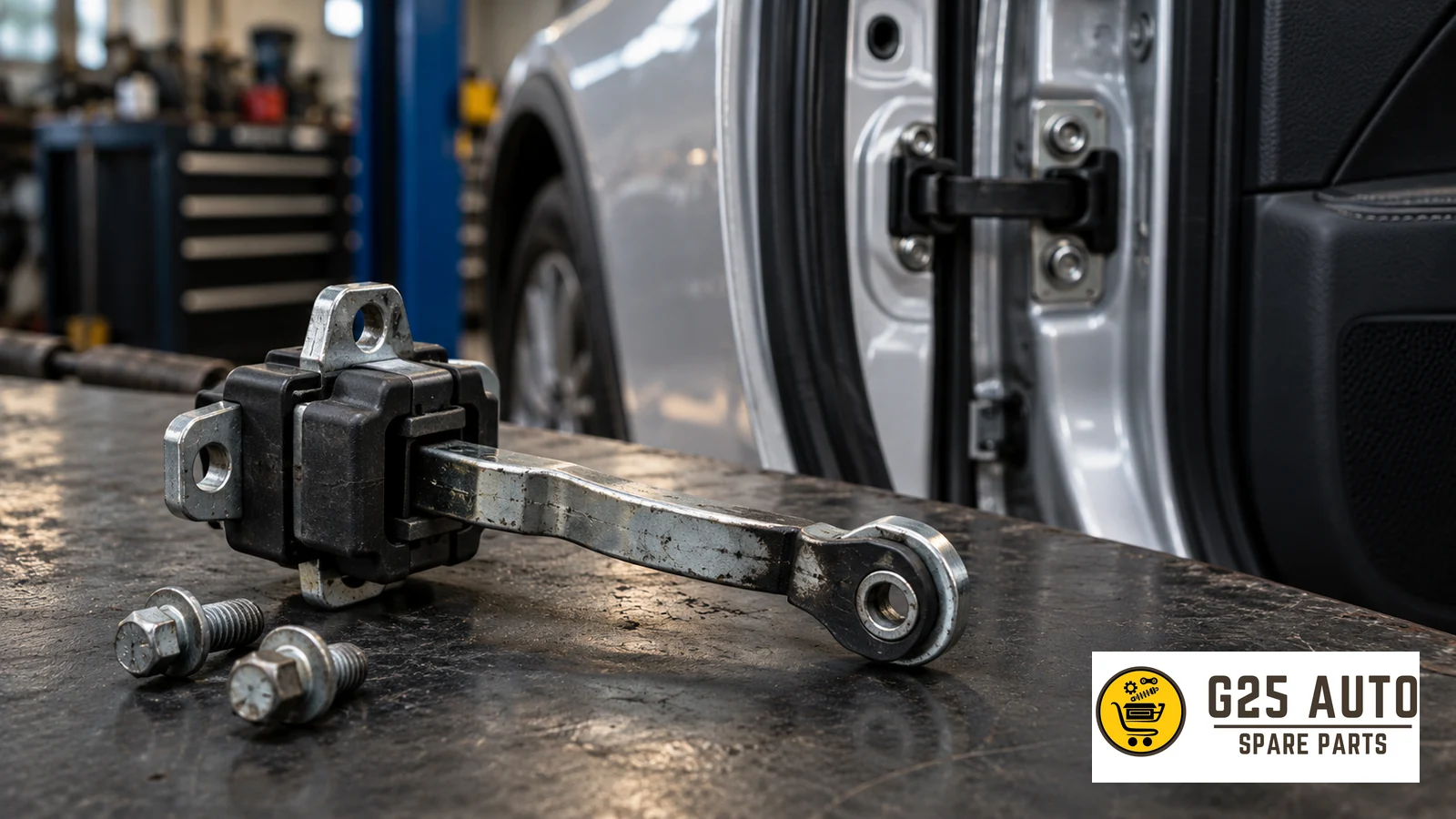
What Are Door Check Straps and Door Stops?
Door check straps and door stops help control the opening and closing of vehicle doors and contribute to safe operation. A check strap helps retain a door at defined opening positions, while a stop limits travel at the end of the opening range. Depending on the design, these functions may be combined in one assembly. They support correct door operation, user safety and service life.
Main Functions of Door Check Straps and Stops
Vehicle doors are among the components moved most often in everyday use. The check and stop mechanism plays an important role in keeping this movement controlled.
Functions of the Door Check Strap
A door check works alongside the hinges to help hold the door open. Its construction varies by vehicle; do not assume every design provides hydraulic or gas-assisted damping. Its main functions include:
- Helping resist unintended closing in wind or on a slope, within the mechanism’s limits.
- Retaining the door at defined positions, with the number of detents depending on the design.
- Helping control door movement.
- Helping limit excessive movement that can load the hinges and door frame.
- Making the door easier and safer to use.
Functions of the Door Stop
The stop defines the maximum opening travel and, depending on its construction, cushions the end of that travel. This is relevant when parking near another vehicle or a wall, although it does not guarantee clearance:
- Limiting excessive opening that could damage the hinges.
- Restricting uncontrolled outward travel in windy conditions, within its design limits.
- Helping reduce collision risk, while the user must still check surrounding clearance.
- Using cushioning elements to reduce impact noise where fitted.
- Maintaining the intended opening relationship between the door and body.
Door Check and Stop Fault Symptoms
Faults in these components can produce several symptoms. Recognising them early helps prevent further damage.
Symptoms to Watch For
| Symptom | Possible cause | Potential concern |
|---|---|---|
| The door will not stay open and closes by itself | Worn or broken check mechanism | Uncontrolled closing |
| Squeaking or rubbing during opening | Check or hinge friction; lubrication may need assessment | Requires inspection |
| The door opens too quickly and is difficult to control | Damaged stop mechanism | Uncontrolled movement |
| Metallic noise or clicking during opening | Wear at the check mechanism’s detents | Requires inspection |
| The open door shakes or moves loosely | Loose check mechanism or damaged mounting | Possible mounting damage |
| The door will not open fully or catches | Broken or displaced stop | Restricted travel |
| The door is difficult to close | Binding check mechanism or hinges | Requires inspection |
| Excessive force is needed to open the door | Seized check mechanism or hinges | Requires inspection |
The Difference Between Symptoms and a Confirmed Diagnosis
The conditions above are symptoms; a confirmed diagnosis requires professional inspection. A door that closes by itself may have a check mechanism fault, but hinge damage, alignment problems or body distortion may also contribute. Noise can range from a lubrication issue to damage requiring replacement.
A qualified workshop should inspect the vehicle and assess the hinges, check mechanism and stop individually. Visual inspection, movement checks and, where necessary, removal for closer examination may be required.
Choosing a Door Check Strap or Stop
Correct part selection matters for safety and durability. An unsuitable component can cause repeated faults, unsafe operation and additional expense.
Checklist for Correct Part Selection
- Vehicle identification number (VIN): Use the vehicle’s identification number as a key catalogue reference.
- OEM part reference: The reference on the existing part can help identify alternatives; confirm the application rather than assuming compatibility.
- Make and model: Different model years may use different components.
- Production date: Changes can occur within a model year, so month and year may matter.
- Engine variant: Include this information where the application catalogue requests it.
- Equipment level: Check whether trim or equipment differences affect the listed application.
- Door position: Specify left or right and front or rear.
- Body style: Saloon, hatchback and estate applications may differ.
Why Verification by OEM Reference Matters
An OEM (Original Equipment Manufacturer) part reference helps identify a component in the manufacturer’s parts system. Checking the reference on the existing part against the vehicle application helps locate an original replacement or a suitable aftermarket alternative and reduces selection errors.
A reference may appear on a label or as a marking on the check assembly or related component. Pass it to the workshop or parts supplier along with the vehicle details so the application can be verified.
Original and Aftermarket Door Checks and Stops Compared
When replacing a door check or stop, workshops often need to choose between original and aftermarket parts. Each option has points to assess.
Original and Aftermarket Part Comparison
| Feature | Original part | Quality aftermarket part |
|---|---|---|
| Compatibility | Confirm the correct manufacturer application | Verify the supplier’s application and cross-reference |
| Cost | Compare the quotation for the specified part | May offer a lower-cost alternative; compare the quotation |
| Availability | Supply for older models needs confirmation | Check available alternatives with the supplier |
| Quality standards | Assess the vehicle manufacturer’s specification | Specifications vary by brand and manufacturer |
| Warranty | Check the applicable written terms | Check the supplier’s written terms |
| Certification | Review documentation relevant to the component | Request relevant documentation; do not assume certification |
Advantages of Original Parts
An original part selected for the correct vehicle application provides a reference to the manufacturer’s specification and intended installation. Fitment still needs verification. For vehicles under warranty, review the applicable terms before deciding which component to use.
Advantages of Quality Aftermarket Parts
A suitable aftermarket component may offer a cost-effective alternative. Assess its specification and application instead of assuming it matches the original in every respect. Aftermarket options may be useful for older vehicles where original parts are difficult to obtain.
For European and Balkan B2B enquiries, provide G25Auto with the vehicle details and existing part reference so suitable options can be assessed.
Maintenance Recommendations for Door Checks and Stops
Routine inspection and appropriate maintenance can help reduce wear and identify developing faults.
Periodic Maintenance Checklist
- Clean hinge and check areas at intervals appropriate to the vehicle’s maintenance guidance and operating conditions.
- Lubricate moving parts only where specified, using a product approved for that mechanism and its materials.
- Check that the door’s holding positions operate correctly.
- Inspect stop cushions, where fitted, for cracking or wear.
- Watch for unusual noise or resistance when opening and closing the door.
- Have hinge fasteners checked against the prescribed tightening requirements.
- For winter protection, follow the manufacturer’s guidance on suitable products.
- Periodically inspect the alignment between the door frame and body.
Frequently Asked Questions
When should a door check strap be replaced?
Replacement may be needed if the mechanism no longer holds the door, has lost its detents or causes abnormal noise during movement. Confirm the cause first. Service life varies with use and operating conditions, so a fixed replacement age is not reliable.
Does a faulty door stop create a safety risk?
Yes. Uncontrolled door movement, particularly in wind or on slopes, can cause impacts with nearby vehicles and place excessive loads on hinges or mountings. Inspect a suspected fault promptly.
Can I fit a door check strap myself?
The work requires appropriate mechanical knowledge, and incorrect installation can create risks. Correct door support, the specified fastener torque and alignment all matter. Professional fitting is recommended.
Do all doors use the same check strap?
No. Front and rear mechanisms may differ, as may left and right versions. Specify the VIN and exact door position when requesting a replacement, then verify the catalogue application.
Does an aftermarket check strap have a shorter life than an original?
Durability depends on component quality, application and operating conditions. Do not assume identical service life from a cross-reference alone. Choose a reliable supplier and assess the available product documentation.
Must other parts be replaced with the check strap?
The check mechanism may be the only component requiring replacement, but mounting screws, bolts and hinge pins should also be inspected and renewed where necessary. If a hinge is damaged, replacing the check alone may not resolve the problem.
Conclusion and Recommendations
Door checks and stops are small components with an important role in safety and comfort. Faults can cause more than inconvenience: uncontrolled opening or closing can damage nearby vehicles, overload hinges and increase the risk of injury or other damage.
Recognising symptoms early and arranging timely inspection helps control repair costs and risks. Regularly check that doors move correctly, listen for abnormal noise and assess whether the holding positions work as intended.
When requesting replacement parts, provide the VIN, existing OEM reference and detailed vehicle information. Incorrect selection can lead to installation problems and repeated faults. Compare original and aftermarket options against the vehicle’s age, usage and budget while verifying suitability.
Carefully selected aftermarket parts from reliable suppliers may provide an economical alternative. European and Balkan trade buyers can ask G25Auto to assess the available options using the relevant vehicle and component details.
Professional diagnosis and fitting can help prevent avoidable work and expense. Intervention without the required door-system knowledge may create further damage or safety risks. Correct parts and qualified installation support reliable operation, with results depending on the vehicle’s condition and use.