
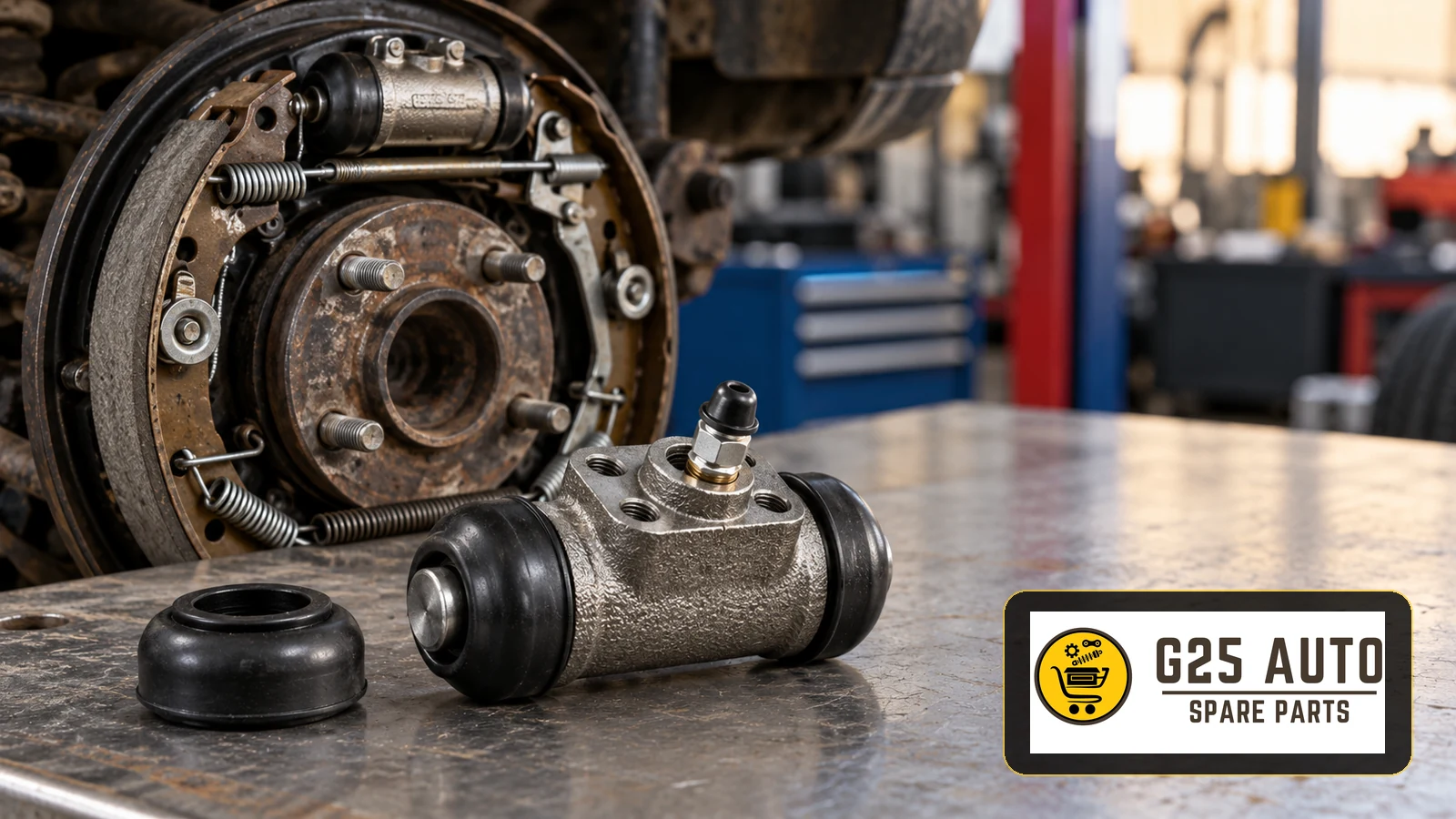
In drum brake systems, the wheel cylinder and its dust boots are critical components on the wheel side of the hydraulic braking system. The wheel cylinder converts pressure from the master cylinder into force that pushes the shoes against the drum to produce braking. Dust boots protect the exposed piston areas from contamination, helping the assembly remain serviceable. Both components directly affect braking performance, and their failure can create serious safety risks.
What Is a Wheel Cylinder and How Does It Work?
A wheel cylinder converts hydraulic brake fluid pressure into mechanical movement in a drum brake. Its body is commonly made from aluminium or cast iron. Internal components typically include pistons and seals; the precise arrangement depends on the design.
When the brake pedal is pressed, pressurised fluid from the master cylinder pushes the wheel cylinder pistons outwards. These act on the ends of the brake shoes, forcing them against the drum’s inner surface. The resulting friction slows the wheel. When the pedal is released and hydraulic pressure falls, the brake shoe return springs help retract the shoes and return the assembly towards its released position.
Why Dust Boots Matter and What They Protect
Dust boots are rubber protective components surrounding the exposed piston ends of the wheel cylinder. Although they look simple, they play an important role in protecting the assembly.
Their main functions are to:
- Protect exposed piston and sealing areas from dust, dirt, water and road salt.
- Help prevent damage to the hydraulic sealing components.
- Limit contamination that could affect the cylinder’s internal components.
- Help reduce corrosion and wear.
A torn or cracked boot can allow dirt and moisture to reach protected surfaces, potentially damaging seals and contributing to fluid leakage. Check the condition of the boots whenever the brakes are serviced.
Fault Symptoms: When Should You Pay Attention?
Several signs may indicate a problem with a wheel cylinder or its dust boots:
Signs of Hydraulic Leakage
- A wet or oily appearance inside the wheel rim.
- Traces of brake fluid around the drum.
- An unexplained drop in brake fluid level.
- Oil or fluid stains on the brake shoes.
Reduced Braking Performance
- A soft or spongy brake pedal.
- Increased stopping distance.
- Pulling to one side, potentially associated with a fault on one side.
- A brake pedal that travels progressively further down.
Visible and Physical Signs
- Cracked or torn dust boots.
- Boots that have hardened or lost elasticity.
- Corrosion or rust on the cylinder body.
- Scratches or wear on piston surfaces.
Important: These symptoms suggest a possible fault, but a professional inspection is needed to establish the cause. Braking systems are complex, and different faults can produce similar symptoms.
Checks Needed for a Reliable Diagnosis
Where a fault is suspected, a specialist should carry out the applicable checks:
- Remove the wheels and brake drums.
- Visually inspect the wheel cylinders.
- Check dust boot integrity and flexibility.
- Check piston movement using the prescribed service procedure.
- Test hydraulic system pressure where required.
- Assess brake fluid condition and contamination.
- Inspect the shoes for wear and fluid contamination.
These professional checks help establish which components require replacement rather than relying on symptoms alone.
Choosing Original or Aftermarket Parts
When a wheel cylinder or dust boot needs replacing, original and aftermarket parts may be available. Both options have points to consider.
Original Equipment Parts
Potential advantages:
- Specified for the vehicle manufacturer’s intended applications.
- Application information linked to the original part reference; correct selection still requires verification.
- Warranty terms that can be checked with the supplier.
- Established manufacturer reference information for sourcing replacements.
Points to consider:
- Pricing may be higher; compare the actual product quotation.
- Supply lead times vary by part and supplier.
- Check any installation conditions attached to the warranty.
Aftermarket Parts
Potential advantages:
- Alternative pricing options, depending on the product.
- A choice of manufacturers and product ranges.
- Additional sourcing options, subject to confirmed availability.
- Different material specifications, which require product-specific assessment.
Points to consider:
- Quality standards vary between manufacturers and suppliers.
- Check application details carefully before ordering.
- Warranty periods and conditions can differ.
| Feature | Original Part | Aftermarket Alternative |
|---|---|---|
| Application suitability | Verify the original reference against the vehicle | Verify the application and cross-reference information |
| Price | Compare the current quotation | Compare the current quotation |
| Warranty | Check the supplier’s written terms | Check the manufacturer’s and supplier’s written terms |
| Supply lead time | Confirm for the specific order | Confirm for the specific order |
| Quality requirements | Vehicle manufacturer’s specifications | Assess documented product specifications |
| Brand choice | Vehicle manufacturer’s parts range | Multiple manufacturers may offer alternatives |
Critical Checks When Selecting the Correct Part
Whichever option you choose, certain information is essential to identify the correct component:
Why OEM References and Part Numbers Matter
Original equipment references help identify parts and their intended applications. Use the relevant reference when ordering a wheel cylinder, and verify it against the vehicle and brake system specification rather than treating a number alone as proof of fitment.
Part references may be available from:
- Vehicle documentation or parts information, where provided.
- A label or casting mark on the existing component.
- An authorised workshop or parts supplier.
- Electronic catalogues using the vehicle’s VIN.
Verification Using the VIN
The vehicle identification number, or VIN, identifies the vehicle and supports catalogue checks of its build specification. This is particularly important when different equipment versions of the same model use different brake systems.
Engine Type and Production Date
Different engine versions of the same model can have different weight distributions or brake equipment. Petrol and diesel variants, for example, may require different components. Engine details must therefore be considered alongside the actual brake specification. Production date also matters because manufacturers can introduce changes during a model year.
What to Check When Buying Aftermarket Parts
Use the following checklist when assessing an aftermarket component:
Aftermarket Parts Checklist
- Has the supplier checked the application against the VIN and brake specification?
- Is relevant manufacturer quality documentation available, and does its scope relate to the product? A general certificate alone does not establish suitability.
- Are the brand and production details clearly identified on the part or packaging?
- Are warranty duration and conditions stated in writing?
- Is the component undamaged and in its original packaging?
- Are seals and dust boots included, or must they be ordered separately?
- Are installation instructions or technical information supplied?
- Are the B2B return and exchange terms clear?
- Is the supplier traceable, with references that can be checked?
Dust Boot Replacement and Maintenance
Rubber dust boots can harden, lose flexibility and crack with age. A separate boot replacement may cost less than replacing the complete cylinder, but only where the manufacturer’s procedure permits repair and the cylinder and seals remain serviceable. Boot condition alone cannot determine whether the complete assembly needs replacing.
When Should They Be Replaced?
- Inspect them whenever brake pads or shoes are replaced, as applicable to the brake assembly.
- Arrange prompt inspection and the required repair if cracks, tears or hardening are visible.
- Follow the manufacturer’s inspection and replacement requirements rather than a universal mileage interval.
- Consider more frequent condition checks in salty or dusty environments.
Features of a Suitable Dust Boot
A suitable dust boot should have:
- A rubber compound specified for the brake assembly and its operating temperatures.
- Appropriate flexibility and mechanical strength.
- Compatibility with the specified operating environment and brake fluid exposure.
- Suitable resistance to ageing and environmental exposure.
- The correct dimensions and profile for the intended fit.
Maintenance and Inspection Recommendations
The following maintenance steps help keep wheel cylinders and dust boots in serviceable condition:
- Regular visual inspection: Have the wheels removed and the brakes inspected at the manufacturer’s service intervals and whenever symptoms arise.
- Brake fluid replacement: Replace the fluid at the intervals specified for the vehicle.
- Corrosion prevention: After exposure to road salt, use the vehicle manufacturer’s cleaning guidance for wheels and brake areas; avoid contaminating friction surfaces.
- Professional servicing: Use experienced technicians for brake system work.
- Early action: Arrange inspection promptly when even a small leak or crack is noticed.
Choosing a Reliable Supplier
Supplier selection matters for safety-critical brake components. Assess parts matching, technical support and after-sales terms alongside the price offered.
For G25Auto B2B orders in Europe and the Balkans, verify the required wheel cylinder, dust boots and related drum brake components using documented application details. Confirm the specific product and commercial terms before ordering.
Frequently Asked Questions
How Long Does a Wheel Cylinder Last?
Service life depends on operating conditions, maintenance and component quality. Salty or dusty environments can accelerate deterioration. A universal mileage range cannot establish whether an individual cylinder remains serviceable.
I Have Found a Torn Dust Boot. Does It Need Immediate Attention?
Yes. Arrange prompt professional inspection and the required replacement. A torn boot can allow contamination to damage the cylinder and seals, potentially leading to a serious brake fault. Even a small tear should be assessed.
Is It Appropriate to Replace the Cylinder on Only One Side?
Inspect both sides and follow the vehicle manufacturer’s replacement requirements. The condition of the opposite cylinder and overall braking balance must be considered, particularly on older vehicles. Replacing both cylinders does not guarantee that future faults are eliminated.
Is an Aftermarket Dust Boot Inferior to an Original Part?
Performance depends on the actual product’s material specification, dimensions and suitability for the assembly. Assess documented quality and obtain parts from a traceable supplier. Neither a brand name nor a general certification claim proves equivalence or superiority.
Does a Brake Fluid Leak Always Come from the Wheel Cylinder?
No. Fluid can also leak from the master cylinder, hoses, ABS hydraulic unit or connections. A professional inspection is needed to locate the source. Visual symptoms alone can be misleading.
Can Drum Brakes Be Converted to Disc Brakes?
Some vehicles may permit a suitable engineered conversion, but this involves extensive changes and requires vehicle-specific assessment. Regular maintenance remains essential for the existing drum brake system. Drum brakes are still widely used, particularly on rear axles.
Conclusion
Wheel cylinders and dust boots look simple but perform critical functions in a drum brake system. Safe operation depends on their condition. Regular inspections, timely maintenance and appropriate parts selection support reliable braking.
When replacement is necessary, assess original and aftermarket options carefully. Use the VIN, engine details and production date to verify the application, cross-check the relevant original references and choose a traceable supplier.
The braking system directly affects safety. Choosing an unsuitable or poorly made component for a small initial saving can create larger safety and cost problems. Assess aftermarket alternatives on their documented suitability and quality rather than assuming comparable performance from price or category alone.
Leave brake servicing to qualified professionals. Incorrect installation or adjustment can cause serious safety problems regardless of component quality.