
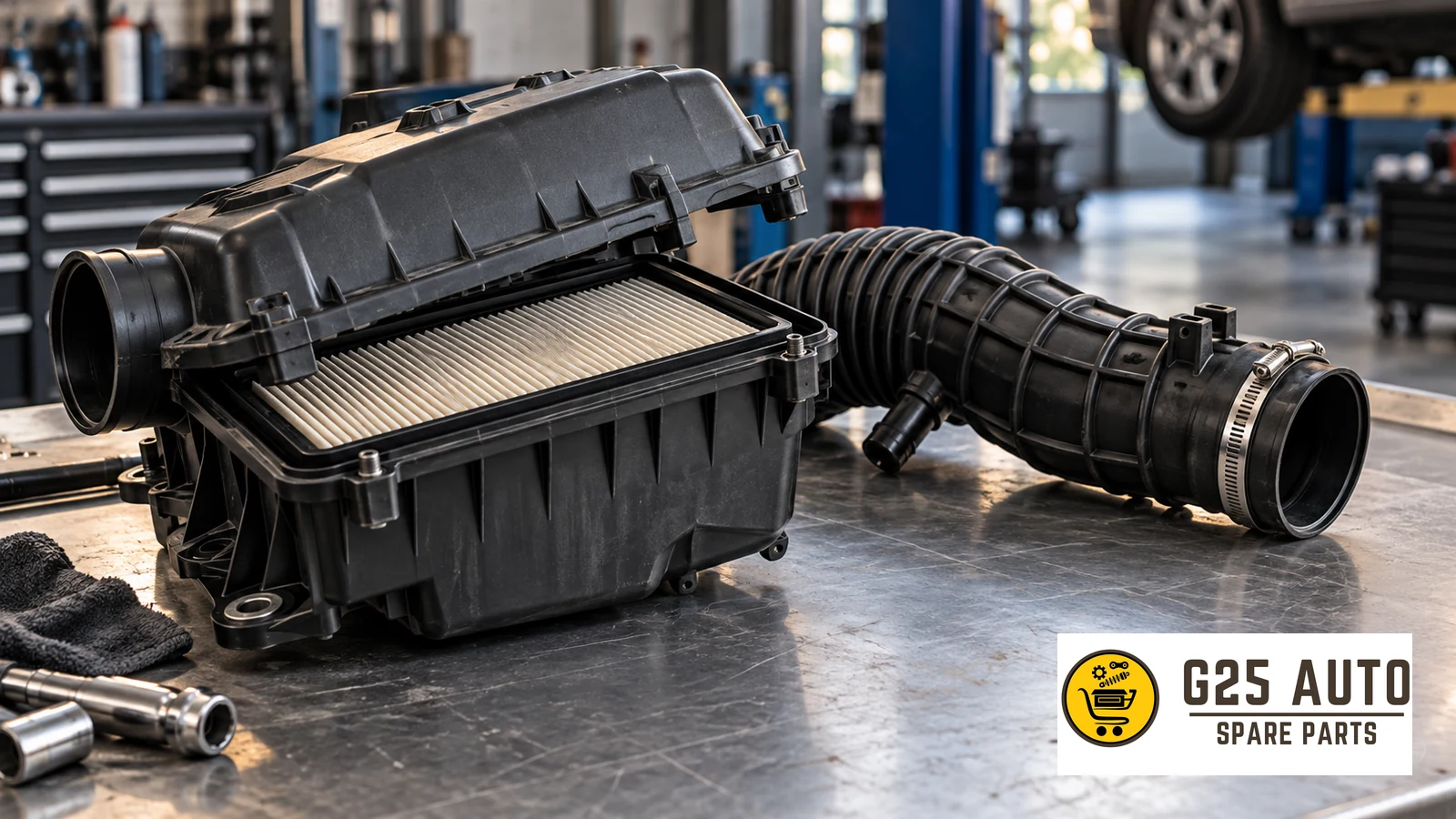
When an air filter housing or intake hose develops a fault, the most important steps are to diagnose the problem correctly and select a suitable replacement. Possible symptoms include reduced engine power, unusual noises and air leaks. Diagnosis and part selection should include checking OEM or part references, the VIN, engine type and production date.
Functions of the Air Filter Housing and Intake Hose
The air filter housing is an important part of the engine’s clean air supply. Combustion requires a substantial flow of air, and keeping that air clean helps protect the engine. The filter element inside the housing removes dust, dirt and particles from incoming air.
The intake hose connects the air filter housing to the engine’s intake system, carrying filtered air towards the intake manifold. It is generally made from flexible material that accommodates engine vibration and supports reliable operation. Both components can affect engine performance and fuel efficiency.
Possible Fault Symptoms
Problems with the air filter housing and intake hose may produce several symptoms. Recognising them can help prevent further damage:
- An unusual growling or whistling noise while the engine is running
- Less power than expected when pressing the accelerator
- Vibration or uneven running at low engine speeds
- Increased fuel consumption
- An illuminated check engine warning light
- An unusual air leak noise from the engine compartment
- Unstable engine idle speed
- Difficulty starting a cold engine
These symptoms do not necessarily indicate an intake system fault. Other faults can cause similar symptoms, so professional inspection is necessary.
Steps Towards a Reliable Diagnosis
Recognising symptoms and establishing the cause are different tasks. Diagnosis should include the following checks:
Visual Inspection
Open the bonnet and inspect the air filter housing and intake hose carefully. Look for cracks, holes, tears and loose connections on the hose. Check the housing for breaks, cracks and damage to the lid seal.
Air Leak Testing
A workshop can check for intake leaks using a test method appropriate to the vehicle. Check that clamps are secure and hose connections are sound.
Electronic Diagnosis
On modern vehicles, mass airflow and manifold pressure sensors provide information about the intake system. Their readings can be examined with an OBD diagnostic tool to identify abnormalities.
Critical Factors in Part Selection
Selecting the correct replacement air filter housing or intake hose is important. An unsuitable part can cause installation difficulties, air leaks and engine performance problems.
The Importance of OEM and Part References
Vehicle manufacturers assign references to their parts. An OEM (Original Equipment Manufacturer) part number helps identify a component and check its specifications, dimensions and application. Before ordering, check the reference on the existing part against the vehicle information and the proposed replacement.
Checking the VIN
Even within the same vehicle model, parts can differ according to production year, engine type or equipment level. The vehicle identification number (VIN) is a unique identifier used to look up the relevant vehicle specification. A parts supplier can use it to help identify the correct application.
Engine Type and Production Date
Engine capacity, fuel type and power output can affect part suitability. Manufacturers may also introduce revisions during a model year. The vehicle’s actual production date should therefore be checked.
Comparing Genuine and Aftermarket Parts
A common question when selecting a replacement is whether to choose a genuine or an aftermarket part. Both options have advantages and limitations.
Genuine Parts
Genuine parts are supplied under the vehicle manufacturer’s brand for specified applications. They may be preferred for vehicles still under warranty, although the correct reference and applicable warranty terms should still be checked. Their cost can be higher.
Aftermarket Parts
Aftermarket parts are alternatives intended for specified vehicle applications. A suitable, well-made aftermarket part may offer a cost advantage. Product quality varies, making a reliable supplier and verification of the specification important.
| Feature | Genuine Part | Quality Aftermarket Part |
|---|---|---|
| Application suitability | Check the manufacturer reference and vehicle details | Check the cross-reference, specification and vehicle details |
| Quality standard | Vehicle manufacturer specification | Depends on the manufacturer and product specification |
| Cost | Often higher | May be more economical |
| Warranty considerations | Check the applicable warranty terms | Check the applicable warranty terms |
| Availability | Confirm with the supplier | Confirm with the supplier |
| Brand choice | Vehicle manufacturer brand | Several brands may be available |
Checklist Before Replacing a Part
Before replacing an air filter housing or intake hose, work through the following checklist:
- Have you recorded the symptoms in detail?
- Have you inspected the system and identified damaged areas?
- Have you checked the existing part’s OEM or part reference?
- Have you recorded the vehicle identification number (VIN)?
- Have you confirmed the engine type and production date?
- Have you checked that the proposed replacement reference suits the vehicle?
- Have you checked related items such as clamps and seals?
- Do you have the tools and equipment needed for installation?
- Have you selected a reliable supplier?
- Have you checked the part warranty and return conditions?
Sourcing Parts Reliably
Once the correct part has been identified, source it from a reliable supplier. Consider the relevant product range and the supplier’s ability to provide clear product information and service.
For European and Balkan B2B enquiries to G25Auto, provide the vehicle details and relevant part references so that the requested application can be checked before ordering.
Checks After Installation
After fitting a new air filter housing or intake hose, carry out the following checks:
Leak Check
Check all connections, clamps and seals for a secure, leak-free installation. Listen for unusual noises while the engine is running.
Performance Assessment
Observe engine running quality, throttle response and smoothness. Confirm whether the original symptoms have been resolved.
Clearing Fault Codes
If the engine control unit has stored fault codes, they may need to be cleared after the repair and any required diagnostic checks.
Frequently Asked Questions
Can a damaged air filter housing affect engine life?
Yes. Damage or leaks that allow unfiltered air into the engine can contribute to internal wear and potentially serious damage over time.
Can a vehicle be driven with a cracked intake hose?
An air leak can affect engine performance and may expose other components to damage. Have the crack assessed and the damaged hose replaced promptly; the vehicle’s condition needs to be assessed individually.
Is an aftermarket intake hose as durable as a genuine one?
Durability depends on the manufacturer, material and product specification. A well-made aftermarket hose may be suitable, but equivalent durability should not be assumed without supporting product information.
Is the vehicle model alone enough when ordering?
No. Parts can vary within one model according to engine type, production year and equipment. Check the VIN and relevant OEM or part references.
Can I replace an air filter housing myself?
Some applications allow replacement with basic mechanical knowledge and hand tools. Professional support is recommended for the leak check after installation and any necessary electronic adjustments.
Is a warning light after replacement normal?
A warning light after installation should be checked rather than assumed to be normal. Use appropriate OBD diagnosis to investigate any remaining fault and follow the vehicle’s repair procedure.
Conclusion
The air filter housing and intake hose are key components of the engine’s air supply, and faults can affect engine performance. Recognising symptoms is useful, but professional inspection is needed to establish their cause. Before replacement, verify suitability using OEM or part references, the VIN, engine type and production date.
Choose between genuine and aftermarket parts according to the vehicle’s needs, budget and available product information. Either option requires a correct application check. Source suitable parts from reliable suppliers and complete all necessary installation checks.
A sound intake system helps protect engine life and performance. A small leak or damaged component can lead to more costly repairs over time. Regular inspection and timely repairs help limit that risk.