
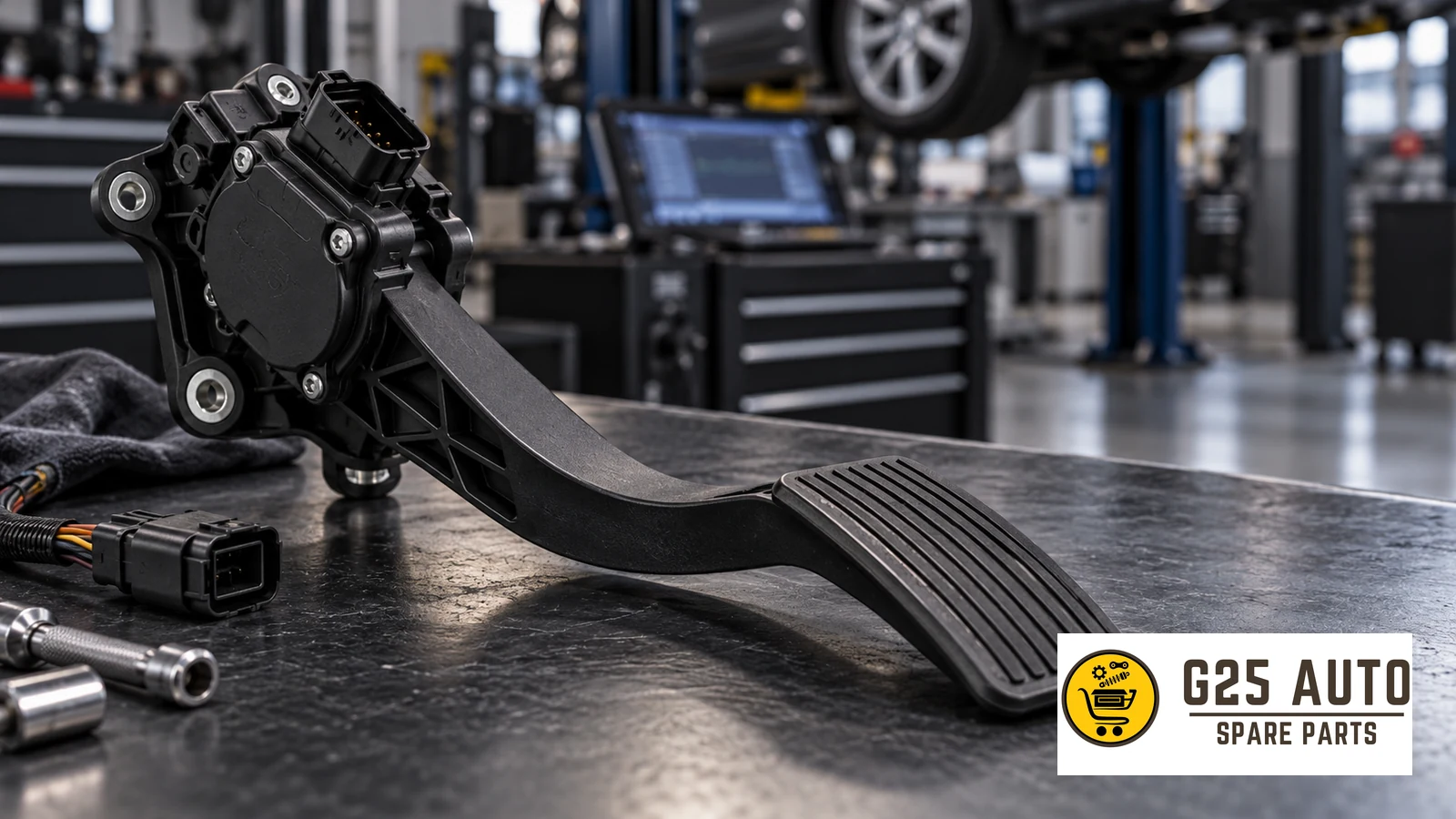
The accelerator pedal position sensor reports how far the pedal is pressed to the engine control unit. A fault can cause power loss, poor pedal response or limp mode. Correct sensor operation is essential to coordination with the electronic throttle system.
What Is an Accelerator Pedal Position Sensor and How Does It Work?
This electronic component converts pedal position into an electrical signal for the engine control unit (ECU). It forms part of the drive-by-wire technology that replaces a mechanical throttle cable.
Sensors commonly use potentiometer or Hall-effect technology. Many systems use two signal channels for safety checks; their response to a fault depends on the vehicle’s control strategy.
Basic Operating Principle
Pedal movement changes resistance or a magnetic field, producing a signal. The ECU interprets it to control throttle opening. This rapid process supports driveability, fuel management and emissions control.
Accelerator Pedal Position Sensor Fault Symptoms
Several symptoms can accompany a sensor fault. They do not confirm the diagnosis; professional testing is necessary.
Common Symptoms
- Engine warning light: Continuous or intermittent illumination.
- Delayed pedal response: Slow or abnormal response when pressing the pedal.
- Power loss: Sudden power reduction or poor acceleration.
- Fluctuating engine speed: Unstable revs at a steady pedal position.
- Limp mode: Operation with restricted engine power.
- Unexpected acceleration or deceleration: Speed changes without corresponding pedal input.
- Uneven idle: Unstable engine speed when stationary.
Fault Finding and Diagnosis
These symptoms warrant investigation, but diagnosis requires suitable equipment and expertise. Distinguish basic preliminary checks from professional electrical testing.
Preliminary Checks
- Check for floor mats or other obstructions beneath the pedal.
- Check that the pedal moves freely.
- Record dashboard warning lights.
- Note when the fault occurs, including engine temperature and driving conditions.
Professional Diagnostic Requirements
A qualified automotive electrical specialist or workshop should perform the relevant checks:
- Read fault codes with an OBD-II diagnostic tool.
- Measure sensor signals using an oscilloscope or suitable tester.
- Check reference voltage and ground connections.
- Inspect wiring and connectors for damage, corrosion and poor contact.
- Review ECU records and live data.
- Check related systems, including the throttle body and airflow meter where relevant.
Original and Aftermarket Sensor Comparison
Replacement may involve choosing between an original and an aftermarket part. Assess both options against the vehicle application and supplier documentation.
| Feature | Original Part | Quality Aftermarket Part |
|---|---|---|
| Compatibility | Verify the specified vehicle application | Verify the application and part cross-reference |
| Quality standard | Vehicle manufacturer’s specification | Depends on the manufacturer |
| Supply time | Confirm with the supplier | Confirm with the supplier |
| Warranty | Check the applicable terms | Check the supplier’s terms |
| Cost | Compare the current quotation | Compare the current quotation |
| Brand choice | Vehicle manufacturer’s parts range | Several manufacturers and quality levels |
Choosing the Right Option
Consider the following factors:
- Vehicle age and value.
- Budget and priorities.
- Expected remaining service life.
- Aftermarket manufacturer references and warranty terms.
- The installing workshop’s recommendations.
Why OEM References and Compatibility Checks Matter
Make and model alone are insufficient for selecting a pedal sensor. Different versions may be fitted within the same model range.
Essential Checks
- OEM part number: Record the existing reference and verify the replacement cross-reference.
- Vehicle identification number (VIN): Use it to check the vehicle application.
- Engine code: Sensor requirements may vary by engine.
- Production date: Revisions can change the required part.
- Equipment level: Different equipment packages may use different versions.
Share these details with the supplier to reduce ordering errors and delays.
Installation and Replacement
Replacement requires appropriate technical knowledge. Sensor location and service procedures vary by vehicle.
General Installation Steps
- Isolate electrical power where required by the vehicle procedure.
- Gain access to the pedal mechanism.
- Carefully disconnect the electrical connector.
- Remove the relevant screws or retainers.
- Install the replacement and reconnect it.
- Complete ECU adaptation or coding where required.
Important: Arrange professional testing after replacement. Some vehicles require a sensor learning or adaptation procedure.
Purchasing Checklist
Use this checklist before ordering an accelerator pedal position sensor:
- ☐ Prepare the vehicle’s VIN.
- ☐ Record the existing OEM part reference.
- ☐ Identify the engine code and production date.
- ☐ Check return and warranty terms.
- ☐ Compare product photographs with the existing part.
- ☐ Verify the connector type.
- ☐ Check whether mounting hardware is included.
- ☐ Check whether coding is required after installation.
- ☐ Obtain the installing workshop’s confirmation of the selection.
Supplier Selection for G25Auto B2B Enquiries
A reliable supplier helps identify the correct product. For European and Balkan B2B enquiries, provide the vehicle and part details needed to assess the application.
Confirm the required sensor or pedal assembly and the relevant order terms with your supplier.
Frequently Asked Questions
Can a pedal sensor fault prevent vehicle operation?
A fault may trigger limp mode with restricted power. Depending on the vehicle and fault, operation may be further restricted or prevented.
Can cleaning repair the sensor?
These sensors are generally sealed units rather than serviceable components. A confirmed internal fault normally requires replacement.
Is adaptation needed after replacement?
Some vehicles require ECU adaptation or coding using suitable diagnostic equipment. Check the specific service procedure and arrange professional assistance.
How long does the sensor last?
Service life varies. Moisture, temperature changes, mechanical stress and operating conditions can affect durability.
Can a fault affect fuel consumption?
A fault can disrupt engine management and performance. Any associated change in consumption requires diagnosis rather than assuming the sensor is responsible.
Conclusions and Recommendations
The pedal position sensor is important to controlled engine operation. Investigate fault symptoms promptly through professional diagnosis.
Choose an original or aftermarket replacement according to the application, vehicle condition and budget. Share the OEM reference, VIN and engine code with your supplier.
Supplier reliability matters alongside product quality. Check the assistance and after-sales terms available for the order.
Complete professional testing and any required ECU adaptation after installation to confirm correct operation.
Informed maintenance and parts purchasing decisions support vehicle safety and control long-term costs.