
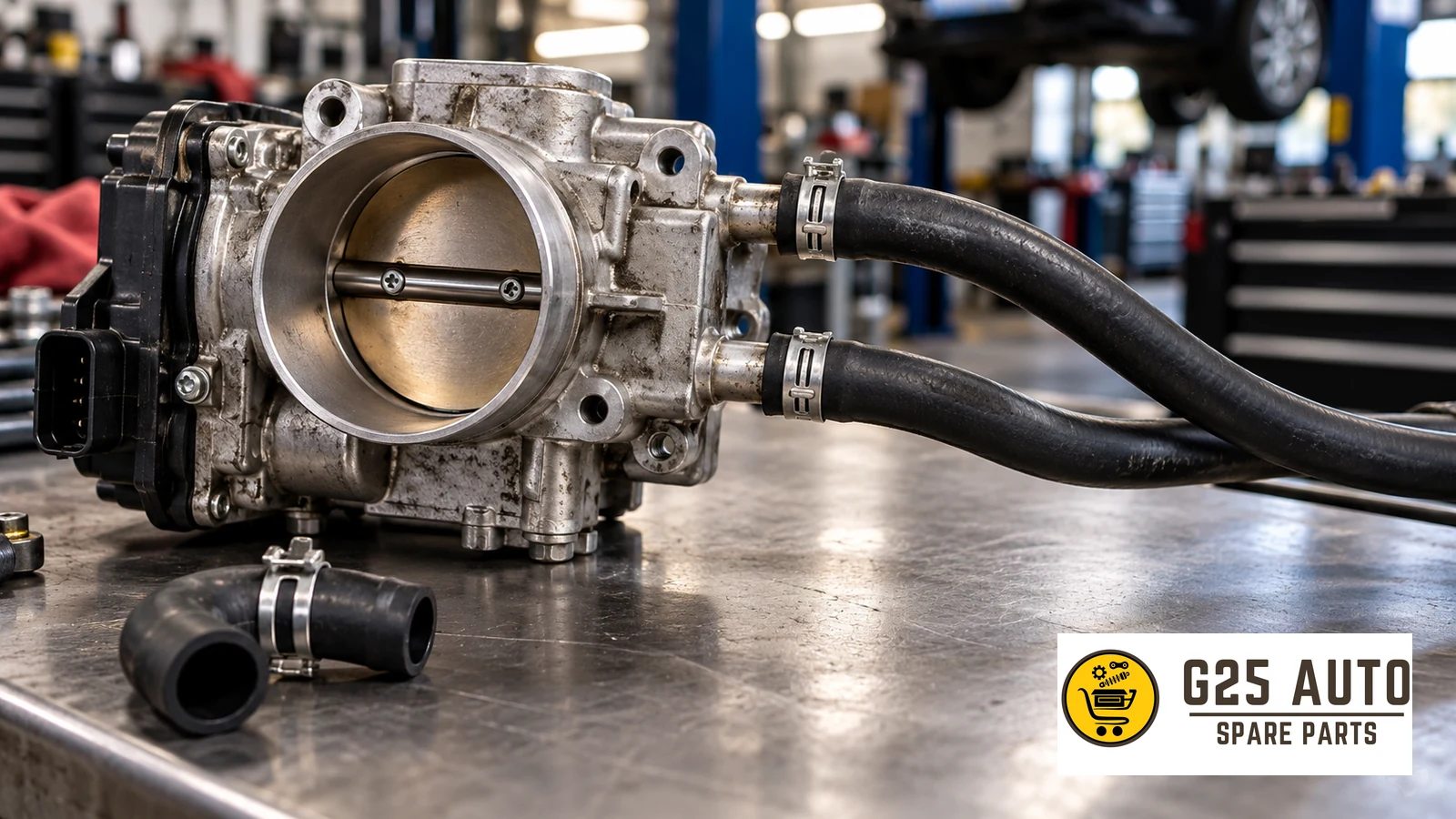
Throttle body coolant hoses and connections form part of the engine cooling circuit on vehicles equipped with a coolant-heated throttle body. They circulate coolant through the housing to help control its temperature and prevent icing, supporting stable operation in cold conditions.
What Is the Throttle Body Coolant System and How Does It Work?
Coolant from the engine passes through channels in the throttle body housing. The arrangement depends on the engine and throttle body design.
As the engine warms, the pump circulates coolant through the cooling circuit. Dedicated hoses carry it to the throttle body, providing heat to reduce icing and sticking in cold conditions.
Functions of Throttle Body Coolant Hoses
These hoses support several related functions:
- Temperature control: Help stabilise housing temperature.
- Icing prevention: Reduce cold-weather icing and sticking.
- Sensor operation: Support appropriate operating conditions around the housing.
- Fuel efficiency: Support consistent throttle operation; effects vary by application.
- Emissions: Support stable engine operation rather than guarantee emission reductions.
Fault Symptoms: What Should You Watch For?
Hose or connection problems may accompany these symptoms, which can also have other causes:
Engine Operation Problems
- Uneven idle after a cold start
- Shaking before warm-up
- Fluctuating engine speed
- Unusually slow warm-up
- Delayed throttle response
Visible and Physical Signs
- Coolant leaks in the engine bay
- Dampness around the throttle body
- Cracked, hardened or swollen hoses
- Corrosion at connections
- Falling expansion tank coolant level
Electronic Warnings
- Engine warning light
- Throttle position sensor faults requiring investigation
- Coolant temperature sensor faults
- Emissions warnings
How Is the Fault Diagnosed?
Professional inspection is needed to establish the cause. Workshop checks include:
1. Visual inspection: Examine hoses, connectors and clamps for cracks, swelling, hardening and leaks.
2. Pressure testing: Use suitable equipment and the vehicle’s specified procedure to locate leaks.
3. Electronic diagnosis: Read OBD-II fault codes and inspect sensor values.
4. Temperature checks: Use temperature measurements to assess coolant circulation.
5. Functional testing: Assess operation under cold and warm conditions.
Hose and Connection Types
The circuit can contain different components:
Hose Types
EPDM rubber hoses: Common flexible coolant hoses with suitable heat and chemical resistance when correctly specified.
Silicone hoses: Used in some demanding applications; suitability depends on the hose specification.
Reinforced hoses: Textile reinforcement helps withstand operating pressure.
Connection Components
- T-connectors: Branch coolant flow.
- Elbows: Change hose direction.
- Straight connectors: Join hose sections.
- Valves and regulators: Control flow where fitted.
- Clamps: Secure hoses to connections.
Genuine (OEM) and Aftermarket Parts Compared
| Feature | Genuine (OEM) part | Quality aftermarket part |
|---|---|---|
| Compatibility | Confirm vehicle application | Verify the matching specification |
| Availability | Confirm when ordering | Confirm when ordering |
| Cost | Compare current quotations | Compare current quotations |
| Warranty | Check applicable terms | Check manufacturer and vehicle terms |
| Quality control | Vehicle manufacturer’s requirements | Depends on manufacturer and specification |
| Service life | Depends on conditions | Depends on quality and conditions |
Both options require careful selection. Consider vehicle age, use, budget and documented quality rather than assuming guaranteed fit or equal durability.
Choosing the Correct Part: Why Reference Checks Matter
Incorrect hoses or connections waste workshop time and can put the engine at risk.
Information Needed for Part Verification
1. OEM/part reference: Check markings or technical documentation and verify the aftermarket cross-reference.
2. Vehicle identification number (VIN): Use vehicle identification to distinguish application variants.
3. Engine code: Different engines within one model may use different cooling components.
4. Production date: Production changes can affect the required part.
5. Equipment level: Equipment variations may affect component selection.
Incomplete information increases ordering errors. Provide these details when checking parts for European and Balkan B2B orders.
Pre-purchase Checklist
Before ordering a throttle body coolant hose or connector, check:
Preparation
- VIN available?
- Engine code checked?
- Production date known?
- Old part reference recorded?
- Faulty hose or connector identified?
Part Selection
- Application details match?
- Product photograph matches the old part?
- Hose diameter and length correct?
- Connection angles and types suitable?
- Clamps included or ordered separately?
Supplier and Product Checks
- Reliable brand and manufacturer?
- Warranty terms confirmed?
- Return and exchange terms checked?
- Delivery timing confirmed for the order?
- Clear product description?
Before Installation
- All required parts available?
- Replacement coolant available?
- Tools ready?
- Installation instructions reviewed?
- Professional assistance arranged if needed?
Installation and Maintenance Tips
Installation Precautions
Replacement requires technical knowledge; professional installation is recommended. Key precautions include:
- Work with the engine cold.
- Ensure cooling system pressure is safely relieved.
- Replace clamps as required by the procedure.
- Clean connection surfaces before fitting hoses.
- Avoid overtightening clamps.
- Bleed air following the vehicle procedure.
- Check for leaks after installation.
Regular Maintenance
Periodic inspection helps detect deterioration:
- Inspect visually at appropriate service intervals.
- Check coolant level regularly.
- Include hoses in scheduled servicing.
- Replace coolant according to manufacturer guidance.
- Investigate unusual smells or leaks promptly.
Frequently Asked Questions
How often should these hoses be replaced?
Life varies with specification and conditions. Replace cracked, hardened or leaking hoses; follow vehicle guidance and inspect regularly.
What happens if a hose splits?
Coolant loss and reduced system pressure can lead to overheating and engine damage. Stop operation and arrange repair.
Must all hoses be replaced together?
Not necessarily. Assess neighbouring hoses for similar deterioration and discuss replacement with the workshop to avoid repeated dismantling.
Are silicone hoses better than EPDM?
Neither material is universally better. Compare application requirements, temperature rating, durability and cost using the actual product specification.
Can water replace coolant?
Plain water is not a substitute for the specified coolant mixture, which provides frost, boiling and corrosion protection.
Can aftermarket hoses affect warranty cover?
Check applicable warranty terms and part requirements. Do not assume coverage from brand or compatibility claims alone.
Is special winter maintenance needed?
Check antifreeze concentration against vehicle guidance and local conditions. Inspect hose flexibility and replace cracked hoses.
Conclusions and Recommendations
Throttle body coolant hoses deserve attention where fitted. Timely inspection and replacement help preserve coolant circulation and reduce damage risks.
Use VIN, engine code, production date and part references to verify genuine or aftermarket replacements.
Investigate warning lights, coolant loss and irregular engine operation early, with professional diagnosis.
For G25Auto B2B enquiries, provide complete vehicle and part details so the required application can be checked.
Small hoses and connections matter alongside major components. Regular checks and suitable replacement parts support reliable vehicle operation.