
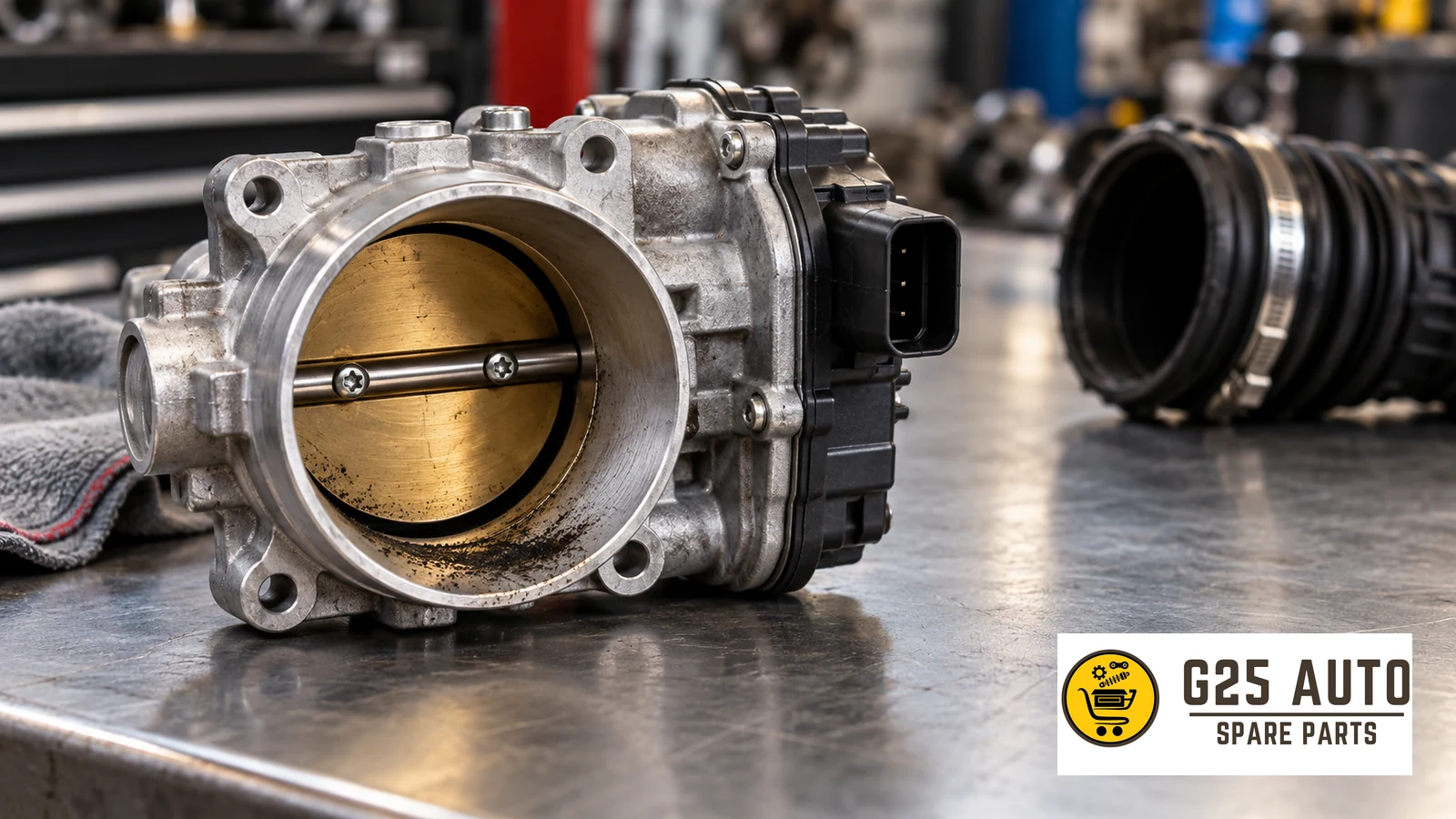
The throttle body regulates the air entering the engine and directly affects performance. Pressing the accelerator requests more airflow through its valve. Modern electronic throttles work with the engine control unit (ECU) to manage engine response and fuel use.
How Does a Throttle Body Work?
Located between the air filter and intake manifold, the throttle body controls intake airflow. Older vehicles may use a mechanical cable; modern designs commonly use electronic drive-by-wire control.
The accelerator position sensor sends signals to the ECU. Using engine speed, vehicle speed and coolant temperature, the ECU commands the throttle motor, enabling precise control and supporting fuel economy.
Throttle Body Fault Symptoms
Recognising these possible symptoms helps workshops investigate faults early:
Common Symptoms
- Unstable idle: Engine speed fluctuates at rest.
- Delayed response: Acceleration follows pedal input slowly.
- Engine warning light: The check-engine light illuminates.
- Sudden power loss: Power drops while driving.
- Uneven acceleration: Hesitation or jerking occurs.
- Increased fuel consumption: Fuel use rises under normal conditions.
- Rough running: The engine shakes or runs unevenly.
- Difficult starting: The engine struggles to start.
Symptoms Versus Confirmed Diagnosis
These signs do not confirm a throttle fault. Airflow sensors, oxygen sensors, ignition or fuel-system problems can cause similar symptoms. Diagnosis should include:
- Reading fault codes with an OBD diagnostic tool.
- Checking throttle position sensor readings.
- Testing for vacuum leaks.
- Inspecting the throttle body for carbon deposits.
- Reviewing live data to assess system behaviour.
Professional testing helps identify the underlying cause.
Throttle Body Maintenance and Cleaning
Carbon and dirt can impair operation. Appropriate maintenance and cleaning help preserve performance:
Cleaning Checklist
- Replace the air filter according to manufacturer guidance.
- Inspect and clean the throttle body when its condition and service instructions require it.
- Use a suitable throttle body cleaner.
- Perform ECU adaptation after cleaning where specified.
- Inspect intake hoses and replace damaged items.
- Check vacuum hoses for cracks and leaks.
- Inspect electrical connections and connectors.
Genuine and Aftermarket Throttle Bodies Compared
| Feature | Genuine Part | Aftermarket Part |
|---|---|---|
| Warranty | Check supplier terms | Check brand and supplier terms |
| Compatibility | Verify the exact application | Verify the exact application |
| Price | Request a current quotation | Compare equivalent specifications |
| Supply time | Confirm for the required reference | Confirm for the required reference |
| Quality standards | Check manufacturer specifications | Check documented brand specifications |
| Technical support | Check authorised-network support | Check supplier support |
Important Points When Selecting a Part
Choosing the wrong replacement can cause unnecessary expense and operating problems:
OEM and Part Number Verification
Manufacturer part references help identify the required version. Before ordering:
- Check the reference on the existing part.
- Share the vehicle identification number with your supplier.
- Identify the engine code from the engine or vehicle documentation.
- Establish the production month and year.
- Provide equipment-package details where relevant.
Different engines and production years may use different throttle bodies. Power output or emissions specifications can affect bore size and sensor configuration.
Checking Compatibility by VIN
The vehicle identification number helps suppliers look up production and equipment information. Using the VIN, they can:
- Check applicable part references.
- Identify production changes.
- Account for regional variations.
- Assess possible alternatives.
Why Engine Code and Production Date Matter
Production updates can change the required part within the same model year. The precise build date therefore matters.
The engine code distinguishes versions. Petrol or diesel, turbocharged or naturally aspirated engines and different capacities may require different throttle specifications.
Choosing Between Genuine and Aftermarket
The decision depends on budget, vehicle age, intended use and expectations:
When Might a Genuine Part Be Preferred?
- The vehicle is nearly new or under warranty.
- Long-term ownership is planned.
- Preserving vehicle value is a priority.
- An authorised-service history is being maintained.
When Might an Aftermarket Part Make Sense?
- The vehicle is older.
- The repair budget is limited.
- A reputable brand offers a verified application.
- The genuine reference has a confirmed long lead time.
Choose established suppliers and documented applications. An inexpensive part from an unknown source can create greater costs later.
Checks After Throttle Body Replacement
Follow the vehicle-specific procedure after installation:
- ECU adaptation: Carry out the specified adaptation procedure.
- Idle learning: Complete the manufacturer’s relearn sequence where required.
- Road test: Check response across appropriate engine speeds.
- Fault-code check: Check for remaining diagnostic faults.
Throttle Body Product Options
For European and Balkan B2B enquiries through G25Auto, compare the required references and vehicle applications. Provide complete vehicle details with the order rather than relying on model names alone.
Frequently Asked Questions
How Long Does a Throttle Body Last?
Service life varies with the vehicle, operating conditions and maintenance. Neglected maintenance or harsh conditions can shorten it; a universal mileage cannot establish replacement timing.
Can I Clean It Myself?
Cleaning requires suitable mechanical knowledge. Electronic assemblies need particular care and may require workshop adaptation afterwards. Incorrect handling can damage the unit.
Can a Fault Prevent Driving?
Some faults trigger reduced-power mode. Severe faults can prevent starting or cause stalling.
How Do Electronic and Mechanical Throttles Differ?
A mechanical throttle uses a pedal cable. Electronic systems use pedal sensors and an ECU-controlled motor, allowing finer control but adding complexity.
Which Fault Codes Are Relevant?
Throttle-position, accelerator-position and actuator-control faults may produce diagnostic codes. Interpret each code using vehicle-specific information; a code alone does not confirm a failed throttle body.
Conclusion
The throttle body affects response, performance and fuel economy. Recognise symptoms early, maintain the system and select the correct replacement when needed.
Before choosing genuine or aftermarket, share the VIN, engine code, original part reference and production date. Missing details increase ordering errors and delays.
Both options require application checks. Assess documented quality, supplier reliability and installation support; avoid uncertain parts from unknown sources.
The throttle body connects ECU commands with engine airflow. Giving it appropriate attention supports dependable vehicle operation.