
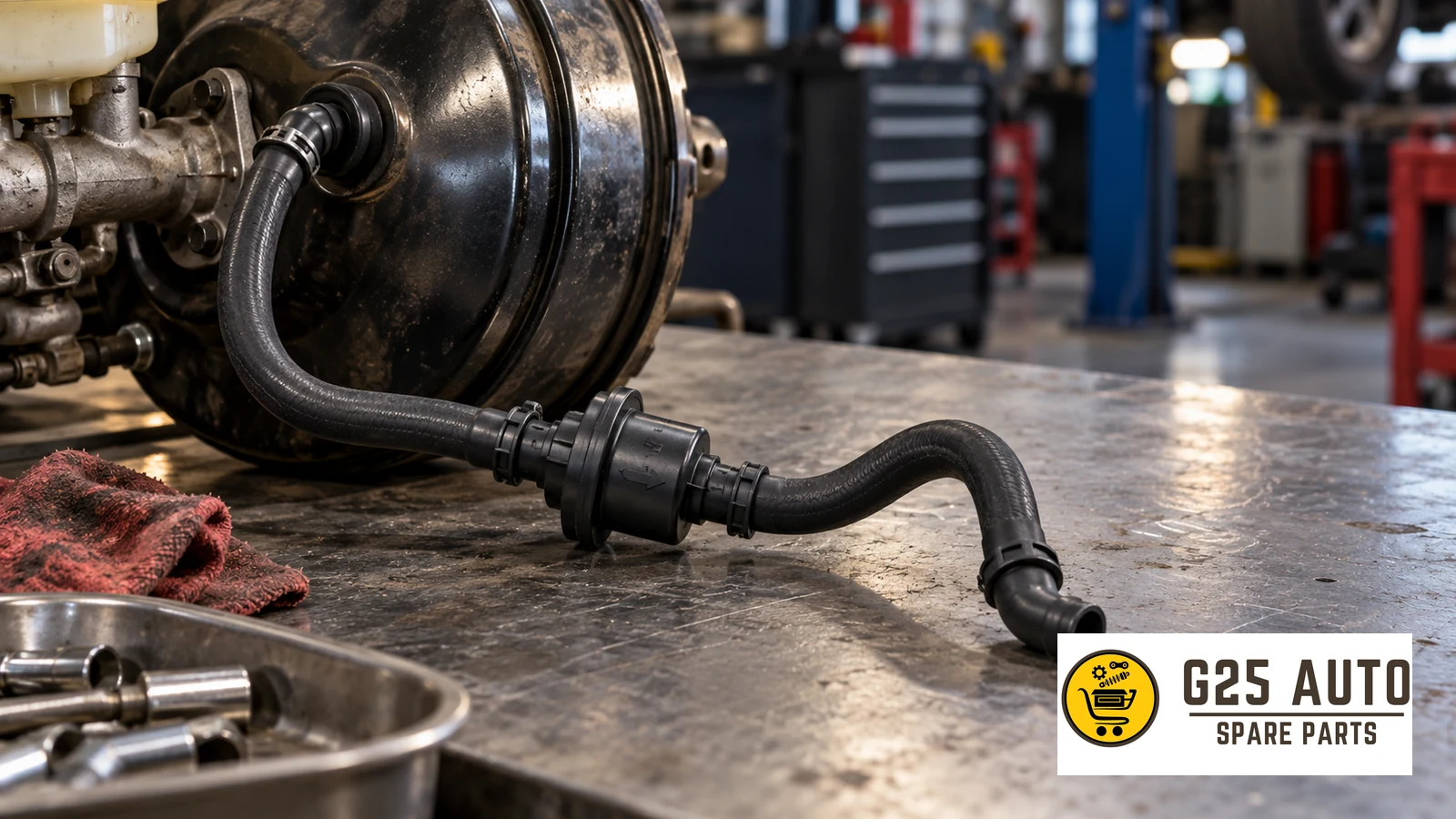
The brake booster vacuum hose and check valve are essential to brake assistance. The hose carries vacuum from the engine’s vacuum source to the booster, while the check valve helps retain it and prevents reverse flow. Faults can cause a hard pedal, increase braking effort and compromise braking performance.
How Does the Brake Booster Vacuum System Work?
The booster reduces the effort needed at the pedal. On systems using intake manifold vacuum, the hose connects the manifold to the booster, allowing vacuum assistance to support braking.
The check valve helps preserve vacuum when the engine stops or the vacuum supply falls. Some assistance may remain, but its duration depends on system condition.
Vacuum Hose and Check Valve Fault Symptoms
Problems with these components may produce the following symptoms:
General Symptoms
- A harder brake pedal than usual
- Greater effort needed for braking
- Whistling from the engine compartment
- No expected pedal movement when the engine starts
- Uneven or reduced idle speed
- Loss of assistance after the engine stops
- Visible cracks or physical hose damage
- Vibration during braking, requiring broader diagnosis
Check Valve Symptoms
Possible signs of a valve fault include:
- An unusually hard first pedal application after engine shutdown
- Persistent air leakage noise around the valve
- No retained booster assistance with the engine off
- Changes in fuel consumption associated with a vacuum leak
How Is the Fault Diagnosed?
Symptoms need systematic checks before a component is condemned:
Diagnostic Checklist
- With the vehicle stationary and engine off, apply the pedal repeatedly to exhaust retained assistance
- Hold pedal pressure and start the engine; assess pedal movement against the service procedure
- Inspect the hose for cracks or holes, keeping clear of moving and hot parts
- Check hose connections and seals
- Test the removed valve for one-way airflow using suitable equipment
- Confirm the permitted flow direction against the vehicle’s service information
- Have a technician assess any idle changes associated with suspected leakage
- Measure vacuum with suitable equipment and compare it with vehicle-specific specifications
Original Equipment and Aftermarket Parts Compared
| Feature | Original Equipment Part | Aftermarket Part |
|---|---|---|
| Compatibility | Confirm the exact vehicle application | Verify the manufacturer’s application data |
| Material quality | Check the applicable specifications | Specifications vary by manufacturer |
| Availability | Confirm with the supplier | Confirm with the supplier |
| Cost | Assess the current quotation | Compare equivalent specifications |
| Warranty | Check the applicable terms | Check the supplier’s terms |
| Range | Vehicle-specific original references | Options from different manufacturers |
Verifying Compatibility Before Selection
Correct application is crucial. Hose diameter, length and connection types can vary between vehicle versions.
Information Needed for Verification
- Original part reference: Cross-check the existing reference against application data
- Vehicle identification number (VIN): Use it to identify the relevant vehicle specification
- Engine code: Different engines within one model may use different systems
- Production date: Components may change during a production year
- Engine capacity and type: Petrol and diesel applications can have different vacuum arrangements
Diesel applications generally use a vacuum pump. Petrol applications may use manifold vacuum or another arrangement. Identify the actual vacuum source before selecting parts.
Installation and Replacement Considerations
Before Installation
- Reconfirm the replacement parts’ application
- Clean hose connection points
- Remove old seals as required by the replacement procedure
- Remove oil and dirt from the installation area
During Installation
- Route the hose without excessive bending or tension
- Install the valve in the specified direction, checking any arrow marking
- Avoid overtightening clamps or crushing the hose
- Check that connections are secure and leak-free
After Installation
- Start the engine and check for unusual noises
- Repeat the specified brake assistance test
- Arrange a controlled braking assessment after stationary checks pass
- Recheck connections after initial use
Vacuum Hose Materials
Different materials are used according to the application:
Rubber (EPDM) Hoses
Rubber hoses offer flexibility and heat resistance. The specific compound must suit the vehicle’s operating conditions.
Silicone Hoses
Silicone offers different temperature and ageing characteristics. Suitability depends on the required hose specification.
Plastic and Rigid Pipe Combinations
Some vehicles combine rigid plastic lines with flexible connections. Replacement may involve the complete assembly, depending on its design.
Check Valve Types and Features
Check valves may use different internal arrangements:
- Spring-loaded ball valves: Use a ball and spring to control flow
- Diaphragm types: Use a flexible membrane to control flow
- Integrated valve systems: Incorporate the valve into a hose assembly, potentially requiring assembly replacement
Maintenance and Prevention
Regular inspection helps identify developing problems:
- Visually inspect hoses during servicing
- Keep the engine compartment clean and prevent oil or chemical contamination
- Make sure hoses cannot become trapped when closing the bonnet
- Check flexibility, particularly in cold weather
- Investigate abnormal pedal behaviour promptly
Sourcing Quality Parts
Brake components require careful selection. For European and Balkan B2B sourcing through G25Auto, compare documented applications and specifications.
Assess the following when selecting a supplier:
- Supplier reliability and references
- Documented part origin and specifications
- Clear returns and warranty terms
- Technical support arrangements
- A process for checking vehicle compatibility
Frequently Asked Questions
How Often Should the Vacuum Hose Be Replaced?
Follow the vehicle’s maintenance guidance. Cracking, hardening, swelling or functional faults require assessment; a universal service life cannot be assumed.
Can a Vehicle Be Driven with a Faulty Check Valve?
Reduced assistance can make braking much harder. A suspected fault requires professional assessment before further use.
Can I Replace the Hose Myself?
The task depends on access and system design. Because it affects braking, installation and subsequent checks require appropriate competence.
Is the System Different on Diesel Vehicles?
Diesel applications generally rely on a vacuum pump. Hose and valve functions are similar, but the vacuum source also needs checking.
How Do Aftermarket Parts Differ?
Materials and dimensions vary between manufacturers. Compare documented specifications and application data rather than assuming equivalent performance.
Why Does Hose Diameter Matter?
An incorrect diameter can restrict flow or prevent sealing at connections. Use the diameter specified for the vehicle.
Conclusion
The vacuum hose and check valve support safe brake assistance. Recognising symptoms early, inspecting regularly and choosing appropriate parts help maintain system performance.
Confirm compatibility using the VIN, engine code and production date. Assess original equipment and aftermarket options against the vehicle’s requirements.
Seek professional help when diagnosis is uncertain. Verify braking after installation under controlled conditions; timely inspection helps address developing faults.