
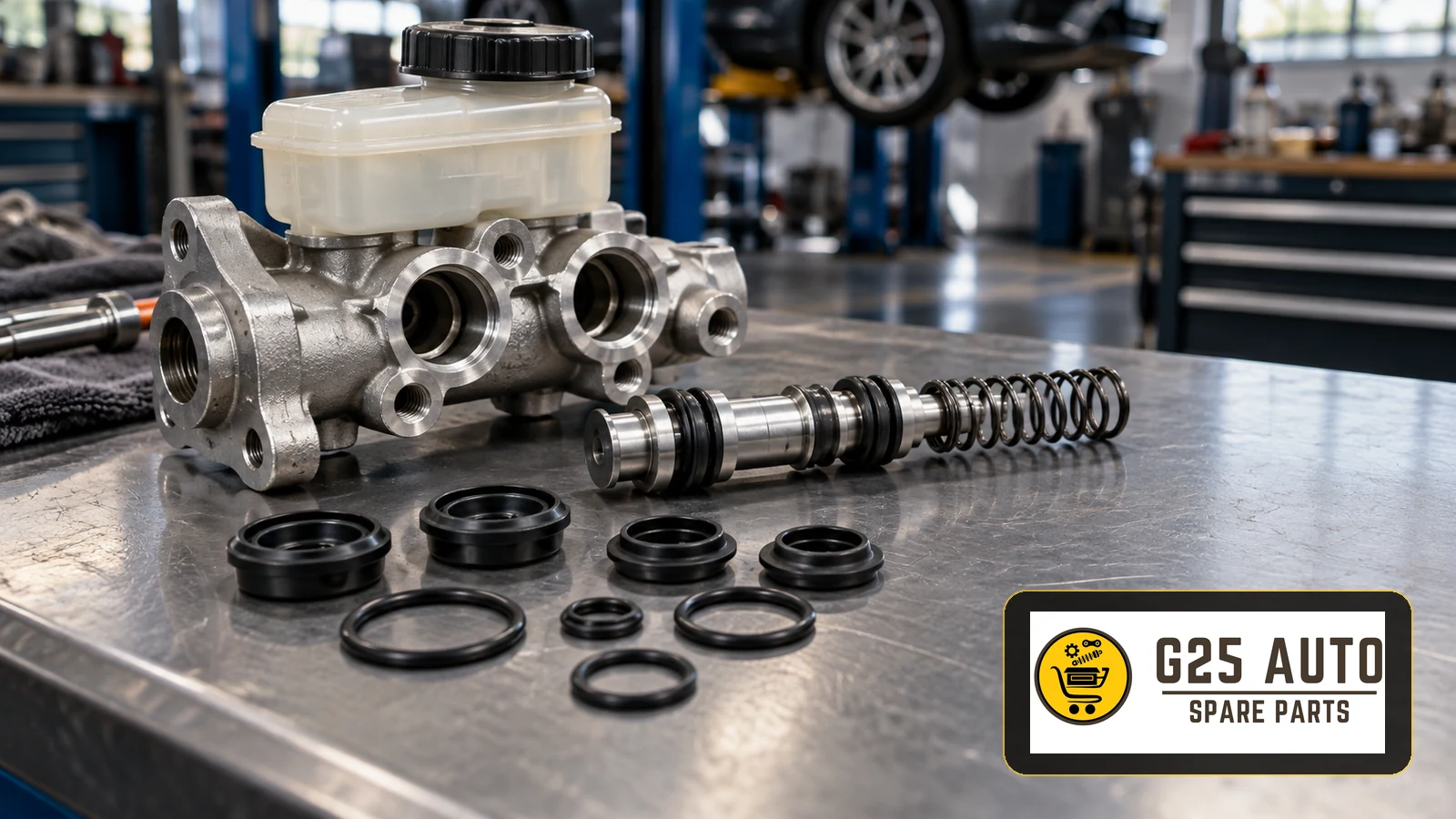
What Are a Brake Master Cylinder and Seal Kit?
The master cylinder is central to hydraulic braking. It converts pedal force into hydraulic pressure for the wheel brakes. Its seal kit provides internal sealing. Seals can wear, harden or crack, allowing fluid leakage or pressure loss.
Correct operation is essential for braking safety. Inspection and timely repair or replacement help address faults before braking deteriorates.
Symptoms of Master Cylinder Faults
Possible symptoms include:
- A soft pedal: Greater travel or less resistance than usual.
- Repeatedly falling fluid level: May indicate leakage requiring investigation.
- Fluid near the pedal: Requires inspection to identify its source.
- Brake warning light: May indicate low fluid or another braking fault.
- Reduced braking performance: Stopping distances may increase.
- Wetness around the cylinder: May indicate an external leak.
- A spongy pedal: Air or another hydraulic fault may be involved.
Arrange professional assessment rather than relying on symptoms alone. If braking is impaired, do not drive; arrange recovery.
How Is the Fault Diagnosed?
A qualified technician must establish the cause. Assessment may include:
Workshop Diagnostic Steps
- Fluid level and condition checks.
- Visual master cylinder inspection.
- Hydraulic pressure testing.
- Vacuum or booster checks where applicable, alongside leakage investigation.
- Inspection of the complete braking system.
- Reading relevant diagnostic fault codes where supported.
- Controlled performance assessment only after safe brake function is established.
Other braking faults can produce similar symptoms, so inspection should extend beyond the master cylinder.
When Should the Seal Kit Be Replaced?
Replacement depends on condition and the manufacturer’s repair instructions:
- Check for seal-related problems during fluid servicing.
- Follow vehicle-specific guidance rather than a universal mileage interval.
- Investigate leakage promptly and repair as appropriate.
- Renew required seals during an approved overhaul.
- Assess seal condition after prolonged vehicle storage.
Choosing Original Equipment or Aftermarket Parts
Both options require checks of suitability, documented specifications and supplier terms.
Comparison Table
| Factor | Original Equipment Part | Aftermarket Part |
|---|---|---|
| Fitment | Confirm the exact application | Verify the listed application and references |
| Quality | Check the specified product | Review manufacturer documentation |
| Cost | Compare the actual quotation | Compare the actual quotation |
| Supply | Confirm availability and lead time | Confirm availability and lead time |
| Warranty | Check applicable terms | Check supplier and manufacturer terms |
| Choice | Vehicle-brand supply channel | Alternative manufacturers may be available |
A Balanced Assessment
An original equipment designation does not remove the need for application checks. Aftermarket status alone does not establish poor quality; assess the particular product.
Use traceable suppliers and documented specifications. Performance and overall value depend on the selected part and installation.
Consider vehicle age, mileage, intended use, budget and applicable warranty conditions when comparing options.
Checklist for Selecting the Right Part
Prepare the following before ordering:
- Vehicle identification details from its documents.
- The vehicle identification number (VIN).
- Engine code.
- Production year and month.
- The existing cylinder’s OEM or part reference.
- Relevant equipment, including ABS or stability control.
- A traceable supplier.
- Confirmation of warranty terms.
- Return and exchange conditions.
- A professional installation plan.
Why Verify the OEM or Part Reference?
Different versions of the same model may use different cylinders.
Reasons for Variation
- Production date: Designs may change during production.
- Engine: Braking specifications may differ.
- Equipment: ABS and stability-control configurations may affect selection.
- Market: Regional specifications may differ.
- Facelift: Updated versions may introduce changes.
A model name alone is insufficient. Cross-check the VIN, engine code, production date and existing reference against application information. These checks support selection without guaranteeing compatibility by themselves.
Master Cylinder Replacement
A qualified technician should follow the vehicle-specific procedure. The general stages are:
- Secure the vehicle and raise it if required.
- Manage fluid in the reservoir as instructed.
- Disconnect relevant electrical connections.
- Disconnect brake pipes.
- Remove the old cylinder.
- Install the replacement.
- Bleed the hydraulic system as specified, maintaining fluid supply.
- Confirm and adjust the final fluid level.
- Check for leaks.
- Complete final checks and controlled testing once safe operation is established.
Correct bleeding is critical: trapped air can seriously reduce braking performance.
Replacing the Seal Kit
Seal replacement may be an alternative where the cylinder is serviceable and an approved repair is possible:
- Dismantle the cylinder as specified.
- Clean internal components appropriately.
- Inspect the cylinder bore for damage.
- Renew the required seals.
- Use specified special tools where needed.
- Bleed the system after reassembly.
New seals cannot remedy a damaged or worn bore. Inspection determines whether overhaul or complete replacement is appropriate.
Brake System Maintenance
Regular maintenance supports reliable operation:
- Replace fluid at the manufacturer’s interval.
- Check fluid level regularly.
- Use the specified fluid type.
- Investigate braking abnormalities promptly.
- Follow storage and recommissioning guidance after prolonged disuse.
- Keep the reservoir cap correctly secured against contamination.
- Monitor pedal operation.
Reliable Parts Supply
For European and Balkan B2B procurement, assess:
- Supplier experience and traceability.
- Relevant product range.
- Documented original equipment and aftermarket options.
- Technical information and support.
- Warranty and return terms.
- Confirmed delivery arrangements.
Frequently Asked Questions
How long does a master cylinder last?
Service life varies with use, maintenance and condition. A general mileage figure cannot predict failure.
Are new seals enough, or is a complete cylinder needed?
Internal inspection and repair guidance determine this. Bore damage may require complete replacement.
Are other parts replaced at the same time?
Fluid is serviced as required. Damaged pipes may need replacement; seal availability depends on the application.
Is an aftermarket master cylinder safe?
Assess the specific product, documented suitability and supplier traceability. Correct selection and professional installation remain essential.
Why is bleeding important?
Air disrupts hydraulic pressure transmission. Bleeding must follow the specified procedure after relevant hydraulic work.
Conclusion
The master cylinder and seals are safety-critical. Early assessment, maintenance and timely repairs support reliable braking.
Prioritise documented quality and application checks using vehicle details and part references. Choose traceable supply and professional installation.
Have braking symptoms assessed by a qualified technician without delay.